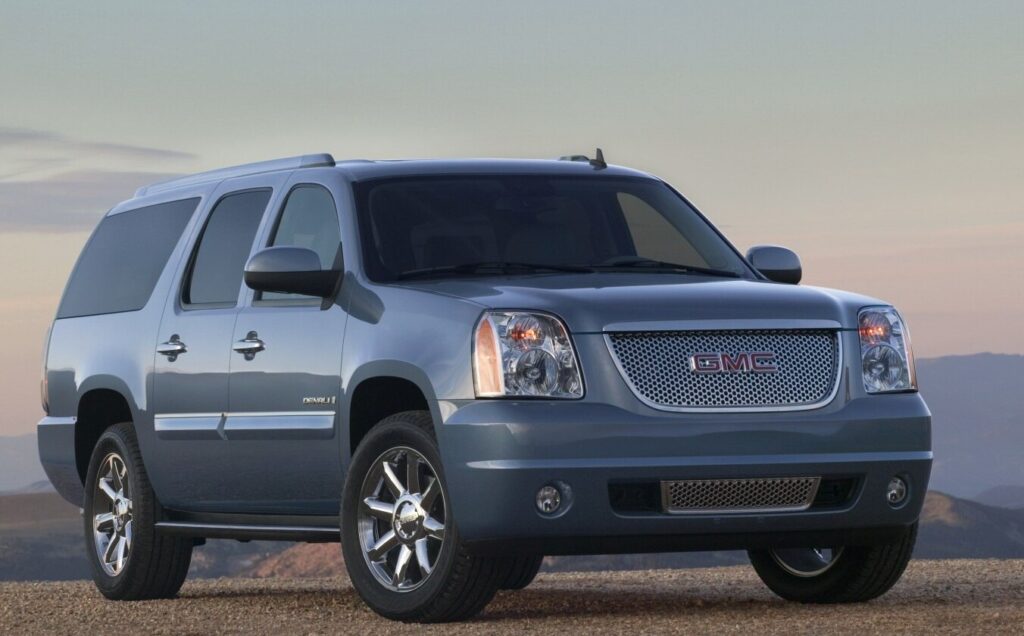
The GMC Yukon XL III, specifically the 2500 series equipped with the 6.0-liter VVT V8 engine and four-wheel drive paired with an automatic transmission, was produced from 2007 to 2009. This variant represented a heavy-duty, full-size SUV offering within the GMT900 platform generation. Positioned as a step up from the standard 1500 series, the 2500 model catered to buyers needing increased towing and payload capacity, making it popular for those with boats, trailers, or demanding work requirements. It shared its platform with the Chevrolet Suburban 2500HD and Cadillac Escalade 2500HD.
Technical Specifications
| Brand | GMC |
| Model | Yukon XL |
| Generation | Yukon XL III (GMT900) |
| Type | 2500 6.0 VVT V8 16V (352 Hp) 4WD Automatic |
| Start of production | 2007 |
| End of production | 2009 |
| Powertrain Architecture | Internal Combustion engine |
| Body type | SUV |
| Seats | 9 |
| Doors | 5 |
| Fuel Type | Petrol (Gasoline) |
| Weight-to-power ratio | 8.3 kg/Hp, 119.8 Hp/tonne |
| Weight-to-torque ratio | 5.7 kg/Nm, 176.3 Nm/tonne |
| Power | 352 Hp @ 5400 rpm |
| Power per litre | 59 Hp/l |
| Torque | 518 Nm @ 4200 rpm, 382.06 lb.-ft. @ 4200 rpm |
| Maximum engine speed | 6000 rpm |
| Engine layout | Front, Longitudinal |
| Engine Model/Code | LY6 |
| Engine displacement | 5967 cm3, 364.13 cu. in. |
| Number of cylinders | 8 |
| Engine configuration | V-engine |
| Cylinder Bore | 101.6 mm, 4 in. |
| Piston Stroke | 92 mm, 3.62 in. |
| Compression ratio | 9.6:1 |
| Number of valves per cylinder | 2 |
| Fuel injection system | Multi-port manifold injection |
| Engine aspiration | Naturally aspirated engine |
| Valvetrain | OHV, VVT |
| Engine oil capacity | 5.7 l, 6.02 US qt | 5.02 UK qt |
| Coolant | 16.9 l, 17.86 US qt | 14.87 UK qt |
| Kerb Weight | 2939 kg, 6479.39 lbs. |
| Max. weight | 3901 kg, 8600.23 lbs. |
| Max load | 962 kg, 2120.85 lbs. |
| Trunk (boot) space – minimum | 1298 l, 45.84 cu. ft. |
| Trunk (boot) space – maximum | 3891 l, 137.41 cu. ft. |
| Fuel tank capacity | 148 l, 39.1 US gal | 32.56 UK gal |
| Permitted trailer load with brakes (12%) | 4218 kg, 9299.1 lbs. |
| Length | 5648 mm, 222.36 in. |
| Width | 2010 mm, 79.13 in. |
| Height | 1962 mm, 77.24 in. |
| Wheelbase | 3302 mm, 130 in. |
| Front track | 1732 mm, 68.19 in. |
| Rear (Back) track | 1702 mm, 67.01 in. |
| Ride height (ground clearance) | 235 mm, 9.25 in. |
| Minimum turning circle (turning diameter) | 13.8 m, 45.28 ft. |
| Approach angle | 16.91° |
| Departure angle | 20.93° |
| Drivetrain Architecture | The Internal combustion engine (ICE) drives permanently the four wheels of the vehicle. |
| Drive wheel | All wheel drive (4×4) |
| Number of gears and type of gearbox | 6 gears, automatic transmission |
| Front suspension | Independent, type McPherson with coil spring and anti-roll bar |
| Rear suspension | Independent multi-link suspension, Leaf spring |
| Front brakes | Disc |
| Rear brakes | Disc |
| Assisting systems | ABS (Anti-lock braking system) |
| Steering type | Steering rack and pinion |
| Power steering | Electric Steering |
| Tires size | 245/75 R16; 265/70 R17 |
| Wheel rims size | 6.5J x 16; 7.5J x 17 |
INTRODUCTION
The 2007-2009 GMC Yukon XL 2500, powered by the 6.0-liter LY6 V8 and equipped with a four-wheel-drive system and automatic transmission, was a significant offering in the full-size SUV segment. Built on the GMT900 platform, it provided a substantial increase in capability over the lighter-duty 1500 series. This model was designed to appeal to buyers who frequently towed heavy loads or required a large interior volume for passengers and cargo. The “XL” designation indicated the extended wheelbase version, offering significantly more cargo space behind the third row of seats compared to the standard Yukon.
Powertrain & Engine Architecture
At the heart of this Yukon XL 2500 variant lies the LY6 6.0-liter V8 engine. This engine is a member of GM’s Vortec family, known for its robust construction and reliable performance. The LY6 features a cast iron block and aluminum cylinder heads, incorporating Variable Valve Timing (VVT) for improved efficiency and low-end torque. Fuel delivery is managed by a multi-port fuel injection system. The engine produces 352 horsepower at 5400 rpm and 382 lb-ft of torque at 4200 rpm. The 4L80-E four-speed automatic transmission was the standard pairing for this engine and drivetrain combination. This transmission is a heavy-duty unit designed to handle the high torque output of the 6.0L V8 and the demands of towing. It features electronic control for smooth shifting and optimized performance.
Driving Characteristics
The Yukon XL 2500 6.0L automatic offered a comfortable, yet capable driving experience. While not designed for sporty handling, the suspension provided a reasonably smooth ride, even when unladen. The 4L80-E transmission, while only a four-speed, was well-matched to the engine’s torque curve, providing adequate acceleration for everyday driving and confident performance when towing. Compared to the 1500 series with smaller engines, the 2500 felt significantly more powerful, especially when loaded or towing. The four-wheel-drive system provided enhanced traction in inclement weather or on slippery surfaces. However, the larger engine and heavier weight resulted in lower fuel economy compared to the 1500 models.
Equipment & Trim Levels
The Yukon XL 2500 typically came standard with features such as air conditioning, power windows and locks, a CD player, and cloth upholstery. Higher trim levels, like the SLT, added features such as leather upholstery, heated seats, a premium sound system, and tri-zone climate control. Optional extras included a navigation system, rear-seat entertainment system, and power-adjustable pedals. The extended length of the XL provided ample space for passengers in all three rows, and with the rear seats folded down, offered a cavernous cargo area.
Chassis & Braking
The GMT900 platform utilized a body-on-frame construction, providing a robust foundation for heavy-duty use. The front suspension featured an independent McPherson strut design with coil springs and an anti-roll bar. The rear suspension employed a multi-link setup with leaf springs, designed to handle heavy loads. Braking duties were handled by disc brakes on all four wheels, assisted by an Anti-lock Braking System (ABS). The 2500 series typically featured heavier-duty components compared to the 1500, including thicker stabilizer bars and upgraded shocks, to improve handling and stability when towing or carrying heavy loads.
Market Reception & Comparison
The Yukon XL 2500 was generally well-received by critics and consumers alike. It was praised for its spacious interior, powerful engine, and impressive towing capacity. Compared to the 1500 series, the 2500 offered a significant increase in capability, but at the expense of fuel economy. Against competitors like the Ford Expedition 250 and Chevrolet Suburban 2500HD, the Yukon XL 2500 held its own, offering a comparable level of performance and features. Some reviewers noted that the four-speed automatic transmission felt dated compared to newer transmissions with more gears, but it proved to be reliable and durable.
Legacy
The LY6 6.0-liter V8 engine has proven to be a remarkably durable and reliable powerplant. The 4L80-E transmission is also known for its robustness. Today, used Yukon XL 2500 models from this era remain relatively common, and well-maintained examples can provide years of reliable service. However, potential buyers should be aware of potential maintenance issues associated with older vehicles, such as worn suspension components and potential oil leaks. The Yukon XL 2500 continues to be a popular choice for those needing a large, capable SUV with significant towing capacity, and its reputation for durability ensures its continued presence on the used car market.