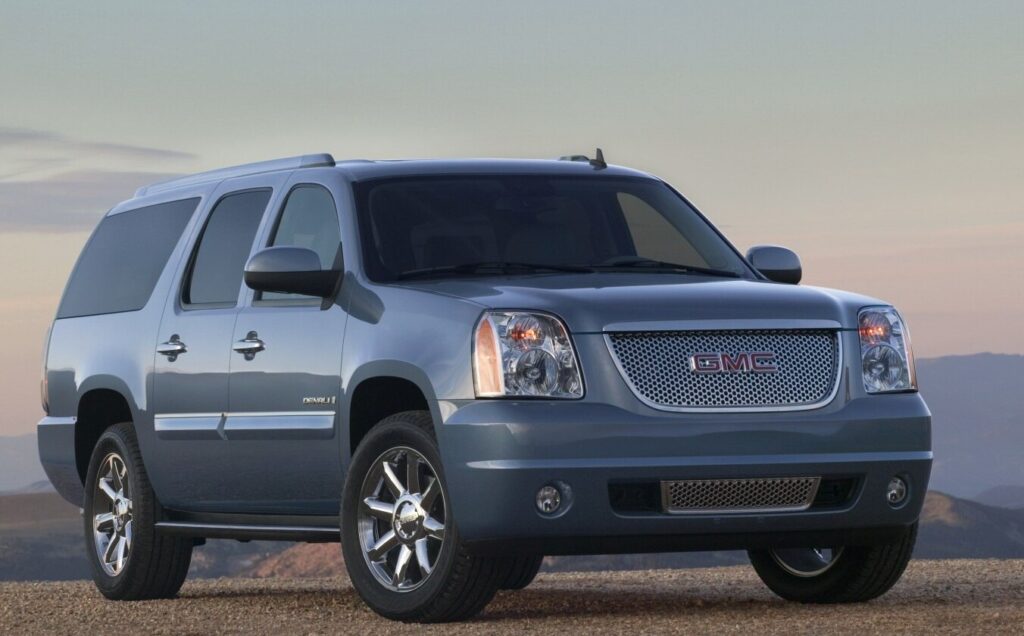
The GMC Yukon XL III, produced between 2007 and 2009, represents the third generation of the full-size Yukon XL SUV. Built on the GMT900 platform, this iteration of the Yukon XL aimed to provide substantial interior space and towing capacity, catering to families and those requiring a versatile vehicle for both daily driving and recreational activities. The 5.3 i V8 16V (310 Hp) 4WD FlexFuel Automatic variant occupied a central position within the Yukon XL lineup, offering a balance between performance, fuel efficiency, and capability. It was positioned above the base model with the smaller 4.8L V8, but below the more powerful 6.2L V8 option.
Technical Specifications
| Brand | GMC |
| Model | Yukon XL |
| Generation | Yukon XL III (GMT900) |
| Type | 5.3 i V8 16V (310 Hp) 4WD FlexFuel Automatic |
| Start of production | 2007 |
| End of production | 2009 |
| Powertrain Architecture | Internal Combustion engine |
| Body type | SUV |
| Seats | 9 |
| Doors | 5 |
| Fuel consumption (economy) – urban | 16.8 l/100 km (14 US mpg, 16.8 UK mpg) |
| Fuel consumption (economy) – urban (Ethanol – E85) | 21.4 l/100 km |
| Fuel consumption (economy) – extra urban | 12.4 l/100 km (19 US mpg, 22.8 UK mpg) |
| Fuel consumption (economy) – extra urban (Ethanol – E85) | 16.8 l/100 km |
| Fuel Type | Petrol / Ethanol – E85 |
| Power | 310 Hp @ 5200 rpm |
| Power per litre | 58.2 Hp/l |
| Torque | 454 Nm @ 4400 rpm (334.85 lb.-ft. @ 4400 rpm) |
| Engine layout | Front, Longitudinal |
| Engine Model/Code | LMG |
| Engine displacement | 5327 cm3 (325.07 cu. in.) |
| Number of cylinders | 8 |
| Engine configuration | V-engine |
| Cylinder Bore | 96 mm (3.78 in.) |
| Piston Stroke | 92 mm (3.62 in.) |
| Compression ratio | 9.9:1 |
| Number of valves per cylinder | 2 |
| Fuel injection system | Multi-port manifold injection |
| Engine aspiration | Naturally aspirated engine |
| Engine oil capacity | 5.7 l (6.02 US qt | 5.02 UK qt) |
| Coolant | 17.3 l (18.28 US qt | 15.22 UK qt) |
| Max. weight | 3357 kg (7400.92 lbs.) |
| Trunk (boot) space – minimum | 1297 l (45.8 cu. ft.) |
| Trunk (boot) space – maximum | 3891 l (137.41 cu. ft.) |
| Fuel tank capacity | 119 l (31.44 US gal | 26.18 UK gal) |
| Permitted trailer load with brakes (12%) | 3175 kg (6999.68 lbs.) |
| Length | 5648 mm (222.36 in.) |
| Width | 2010 mm (79.13 in.) |
| Height | 1962 mm (77.24 in.) |
| Wheelbase | 3302 mm (130 in.) |
| Front track | 1732 mm (68.19 in.) |
| Rear (Back) track | 1702 mm (67.01 in.) |
| Ride height (ground clearance) | 235 mm (9.25 in.) |
| Minimum turning circle (turning diameter) | 13.8 m (45.28 ft.) |
| Approach angle | 16.91° |
| Departure angle | 20.93° |
| Drive wheel | All wheel drive (4×4) |
| Number of gears and type of gearbox | 4 gears, automatic transmission |
| Front suspension | Independent, type McPherson with coil spring and anti-roll bar |
| Rear suspension | Independent multi-link suspension, Coil spring |
| Front brakes | Disc, 330×30 mm |
| Rear brakes | Disc, 345×20 mm |
| Assisting systems | ABS (Anti-lock braking system) |
| Steering type | Steering rack and pinion |
| Power steering | Electric Steering |
| Tires size | 255/70 R17 |
| Wheel rims size | 7.5J x 17 |
Powertrain & Engine Architecture
The heart of this Yukon XL variant is the 5.3-liter (325 cubic inch) LMG V8 engine. This engine is a member of GM’s Vortec family, known for its robust construction and relatively simple design. The LMG features a cast iron block with aluminum cylinder heads, incorporating two valves per cylinder. Fuel delivery is managed by a multi-port fuel injection system, providing precise fuel metering for optimal combustion. The engine’s 9.9:1 compression ratio contributes to its balance of power and efficiency. The 4L80-E four-speed automatic transmission was the standard pairing for the 5.3L engine. This transmission is known for its durability and ability to handle the high torque output of the V8, making it well-suited for towing and hauling. The 4L80-E features electronic control for smoother shifting and improved fuel economy.
Driving Characteristics
The 5.3L V8, producing 310 horsepower and 334 lb-ft of torque, provided adequate power for the substantial weight of the Yukon XL. Acceleration was respectable, though not particularly brisk, with a 0-60 mph time estimated around 8-9 seconds. The four-speed automatic transmission, while reliable, lacked the responsiveness and efficiency of more modern transmissions with additional gears. Gear ratios were optimized for towing and cruising, resulting in a comfortable ride on the highway but potentially feeling somewhat sluggish during quick acceleration maneuvers. Compared to the 6.2L V8 Yukon XL, this variant offered less outright performance, but it provided better fuel economy. Against the 4.8L V8, the 5.3L offered a noticeable power increase, making it a more capable choice for those who frequently towed or carried heavy loads.
Equipment & Trim Levels
The Yukon XL in this configuration typically came standard with features such as air conditioning, power windows and locks, a CD player, and cloth upholstery. Higher trim levels, like the SLT, added features such as leather upholstery, heated seats, a premium sound system, and tri-zone climate control. Optional extras included a navigation system, rear-seat entertainment system, and a sunroof. The interior design was functional and spacious, prioritizing practicality over luxury. The third-row seating was a key selling point, providing seating for up to nine passengers.
Chassis & Braking
The Yukon XL III utilized a body-on-frame construction, providing a robust and durable platform. The front suspension featured an independent McPherson strut design with coil springs and an anti-roll bar, while the rear suspension employed an independent multi-link setup with coil springs. This suspension configuration aimed to balance ride comfort with handling stability. Braking duties were handled by disc brakes on all four wheels, with ABS (Anti-lock Braking System) as standard equipment. The braking system was adequate for the vehicle’s weight, but it lacked the stopping power of more modern braking systems.
Market Reception & Comparison
The 5.3L V8 Yukon XL was generally well-received by critics and consumers alike. It was praised for its spacious interior, comfortable ride, and strong towing capacity. However, some reviewers noted the relatively low fuel economy, especially compared to newer SUVs. Compared to the 4.8L V8, the 5.3L offered a significant performance upgrade without a drastic increase in fuel consumption. The 6.2L V8 provided even more power, but at a higher price point and with lower fuel economy. Reliability was generally good, with the 5.3L V8 proving to be a durable and long-lasting engine.
Legacy
The GMT900 Yukon XL, particularly the 5.3L V8 4WD variant, remains a popular choice in the used car market. The LMG engine is known for its longevity and relatively low maintenance costs. Common issues include oil leaks and occasional sensor failures, but these are generally inexpensive to repair. The 4L80-E transmission is also known for its durability, although regular fluid changes are essential to maintain its performance. Today, these Yukon XLs are often sought after by those needing a large, capable SUV for towing, hauling, or family transportation, offering a blend of space, power, and affordability.