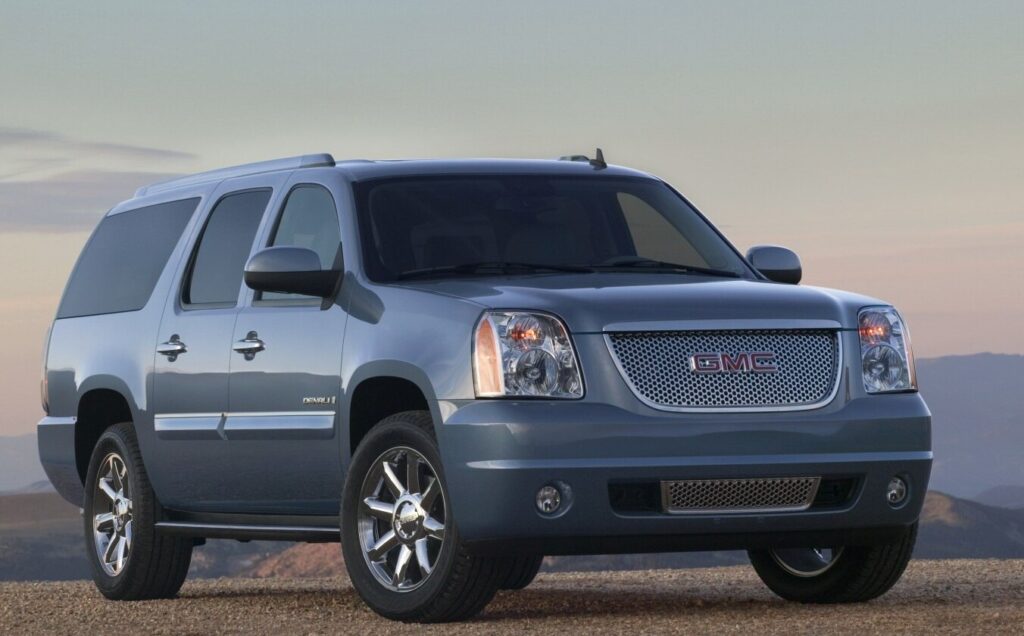
The GMC Yukon XL III, produced between 2007 and 2009, represented the third generation of the extended-length Yukon full-size SUV. Built on the GMT900 platform, it served as GMC’s offering in the highly competitive American full-size SUV segment, directly competing with the Chevrolet Suburban, Ford Expedition EL, and Cadillac Escalade ESV. The Yukon XL prioritized interior space and towing capacity, catering to large families and those requiring substantial cargo volume. This particular variant, equipped with the 6.0-liter VVT V8 engine paired with a six-speed automatic transmission, occupied a mid-to-upper position within the Yukon XL lineup, offering a balance of power, refinement, and capability. It was positioned above the base 5.3L V8 models but below the more luxurious and often better-equipped trims.
Technical Specifications
| Brand | GMC |
| Model | Yukon XL |
| Generation | Yukon XL III (GMT900) |
| Type (Engine) | 6.0 VVT V8 16V (366 Hp) Automatic |
| Start of production | 2007 |
| End of production | 2009 |
| Powertrain Architecture | Internal Combustion engine |
| Body type | SUV |
| Seats | 9 |
| Doors | 5 |
| Fuel consumption (urban) | 19.6 l/100 km (12 US mpg, 14.4 UK mpg, 5.1 km/l) |
| Fuel consumption (extra urban) | 13.8 l/100 km (17 US mpg, 20.5 UK mpg, 7.2 km/l) |
| Fuel Type | Petrol (Gasoline) |
| Power | 366 Hp @ 5500 rpm |
| Power per litre | 61.3 Hp/l |
| Torque | 510 Nm @ 4400 rpm (376.16 lb.-ft. @ 4400 rpm) |
| Maximum engine speed | 6000 rpm |
| Engine layout | Front, Longitudinal |
| Engine Model/Code | L76 |
| Engine displacement | 5967 cm3 (364.13 cu. in.) |
| Number of cylinders | 8 |
| Engine configuration | V-engine |
| Cylinder Bore | 101.6 mm (4 in.) |
| Piston Stroke | 92 mm (3.62 in.) |
| Compression ratio | 9.6:1 |
| Number of valves per cylinder | 2 |
| Fuel injection system | Multi-port manifold injection |
| Engine aspiration | Naturally aspirated engine |
| Valvetrain | OHV, VVT |
| Engine oil capacity | 5.7 l (6.02 US qt, 5.02 UK qt) |
| Coolant | 16.5 l (17.44 US qt, 14.52 UK qt) |
| Max. weight | 3265 kg (7198.09 lbs.) |
| Trunk (boot) space – minimum | 1297 l (45.8 cu. ft.) |
| Trunk (boot) space – maximum | 3891 l (137.41 cu. ft.) |
| Fuel tank capacity | 119 l (31.44 US gal, 26.18 UK gal) |
| Length | 5648 mm (222.36 in.) |
| Width | 2010 mm (79.13 in.) |
| Height | 1950 mm (76.77 in.) |
| Wheelbase | 3302 mm (130 in.) |
| Front track | 1732 mm (68.19 in.) |
| Rear (Back) track | 1702 mm (67.01 in.) |
| Ride height (ground clearance) | 227 mm (8.94 in.) |
| Minimum turning circle (turning diameter) | 13.8 m (45.28 ft.) |
| Approach angle | 17.04° |
| Departure angle | 20.45° |
| Drivetrain Architecture | Rear wheel drive |
| Number of gears and type of gearbox | 6 gears, automatic transmission |
| Front suspension | Independent, type McPherson with coil spring and anti-roll bar |
| Rear suspension | Independent multi-link suspension, Coil spring |
| Front brakes | Disc |
| Rear brakes | Disc |
| Assisting systems | ABS (Anti-lock braking system) |
| Steering type | Steering rack and pinion |
| Power steering | Electric Steering |
| Tires size | 265/70 R17; 265/65 R18 |
| Wheel rims size | 7.5J x 17; 18 |
INTRODUCTION
The 2007-2009 GMC Yukon XL III, powered by the 6.0-liter L76 V8 and a six-speed automatic transmission, was a significant vehicle in GMC’s lineup. It represented a move towards increased refinement and capability in the full-size SUV segment. The GMT900 platform, shared with the Chevrolet Tahoe and Suburban, provided a robust foundation for the Yukon XL, allowing for substantial towing capacity and passenger space. This particular engine and transmission combination was aimed at buyers who needed more power than the standard 5.3L V8 offered, but didn’t necessarily require the luxury appointments of the Denali trim.
Powertrain & Engine Architecture
The heart of this Yukon XL variant is the 6.0-liter L76 V8 engine. This engine is a member of GM’s Vortec family, featuring cast iron block and aluminum cylinder heads. It utilizes a 9.6:1 compression ratio and a multi-port fuel injection system. The key feature of the L76 is its Variable Valve Timing (VVT) technology, which optimizes valve timing based on engine speed and load, improving both fuel efficiency and performance. The overhead valve (OHV) valvetrain, while traditional, proved to be durable and reliable. The engine produces 366 horsepower at 5500 rpm and 510 Nm (376 lb-ft) of torque at 4400 rpm.
Paired with the L76 is a six-speed automatic transmission (likely the 6L80E). This transmission offered smoother shifts and improved fuel economy compared to the older four-speed automatics. The 6L80E features electronically controlled shifting and overdrive, contributing to a more refined driving experience. The transmission was designed to handle the substantial torque output of the 6.0L V8, making it well-suited for towing and hauling.
Driving Characteristics
The 6.0L V8 and six-speed automatic combination in the Yukon XL provided a noticeable improvement in performance over the 5.3L models. Acceleration was brisk, especially considering the vehicle’s size and weight. While not a sports car, the Yukon XL felt confident when merging onto highways or passing other vehicles. The six-speed transmission helped keep the engine in its optimal power band, delivering smooth and responsive acceleration. Compared to a manual transmission equipped Yukon XL (which was rare), the automatic offered greater convenience and ease of use, particularly in city driving. However, a manual transmission would have provided slightly better fuel economy and a more direct connection to the engine.
Equipment & Trim Levels
The Yukon XL with the 6.0L V8 typically came standard with features such as tri-zone automatic climate control, power windows and locks, a CD player with auxiliary input, and cloth upholstery. Higher trim levels offered options like leather seats, a premium Bose sound system, a navigation system, and rear-seat entertainment. The Yukon XL also offered a variety of convenience features, such as power-adjustable pedals, heated seats, and a remote start system. The exterior typically featured chrome accents and alloy wheels.
Chassis & Braking
The Yukon XL III utilized a body-on-frame construction, providing a robust and durable chassis. The front suspension consisted of an independent McPherson strut setup with coil springs and an anti-roll bar. The rear suspension employed an independent multi-link design, also with coil springs. This suspension setup aimed to balance ride comfort with handling stability. Braking duties were handled by disc brakes on all four wheels, with ABS (Anti-lock Braking System) as standard equipment. The braking system was adequate for the vehicle’s weight, but larger brakes were sometimes found on higher trim levels or as part of a towing package.
Market Reception & Comparison
Critics generally praised the Yukon XL for its spacious interior, strong V8 engine, and impressive towing capacity. The 6.0L V8 was considered a good compromise between power and fuel economy, offering more performance than the 5.3L without the higher fuel costs associated with larger engines. However, the Yukon XL’s large size and truck-like handling were sometimes criticized. Compared to the Ford Expedition EL, the Yukon XL was often seen as offering a more refined interior and a more comfortable ride. Fuel economy, however, remained a concern, with the 6.0L V8 averaging around 12-17 mpg in real-world driving.
Legacy
The GMT900 Yukon XL, particularly the 6.0L V8 variant, has proven to be a relatively reliable vehicle. The L76 engine is known for its durability, and the 6L80E transmission has also demonstrated good longevity with proper maintenance. Today, these Yukon XLs can be found on the used car market at relatively affordable prices. They remain popular choices for families and individuals who need a large, capable SUV with ample space and towing capacity. Common maintenance items include oil changes, transmission fluid flushes, and occasional repairs to the suspension components. Overall, the 2007-2009 GMC Yukon XL III 6.0L V8 represents a solid and dependable full-size SUV that continues to provide value to its owners.