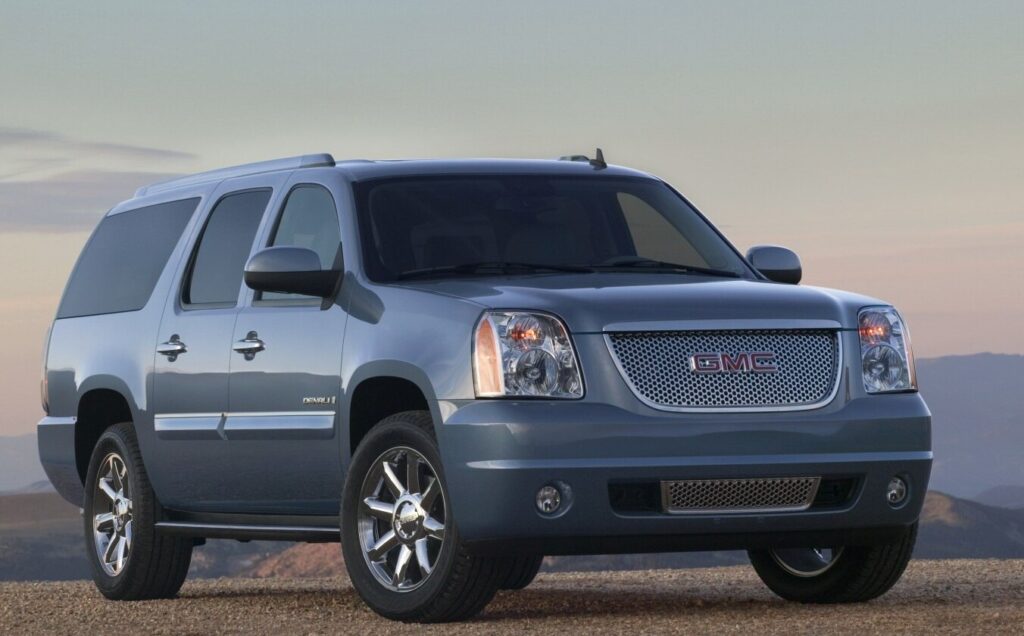
The GMC Yukon XL III Denali 6.2L V8, produced from 2009 to 2013, represents the pinnacle of luxury and capability within the GMT900 generation of the Yukon XL. Positioned as the flagship trim, the Denali offered a significant step up in features and refinement compared to the standard Yukon XL models. This extended-length SUV catered to buyers needing substantial passenger and cargo space, combined with the prestige of the Denali sub-brand. The 6.2-liter V8 engine and six-speed automatic transmission pairing delivered robust performance, making it suitable for towing and hauling, while the FlexFuel capability provided versatility at the pump. It was a key competitor to the Cadillac Escalade EXT, Lincoln Navigator L, and other large, premium SUVs.
Technical Specifications
| Brand | GMC |
| Model | Yukon XL |
| Generation | Yukon XL III (GMT900) |
| Type | Denali 6.2L i V8 16V (403 Hp) FlexFuel Automatic |
| Start of production | 2009 |
| End of production | 2013 |
| Powertrain Architecture | Internal Combustion engine |
| Body type | SUV |
| Seats | 9 |
| Doors | 5 |
| Fuel consumption (urban) | 19 l/100 km (12.4 US mpg) |
| Fuel consumption (extra urban) | 12 l/100 km (19.6 US mpg) |
| Fuel Type | Petrol / Ethanol – E85 |
| Weight-to-power ratio | 6.9 kg/Hp |
| Weight-to-torque ratio | 4.9 kg/Nm |
| Power | 403 Hp @ 5700 rpm |
| Power per litre | 65.4 Hp/l |
| Torque | 565 Nm @ 4300 rpm (416.72 lb.-ft. @ 4300 rpm) |
| Maximum engine speed | 6000 rpm |
| Engine layout | Front, Longitudinal |
| Engine Model/Code | L9H |
| Engine displacement | 6162 cm3 (376.03 cu. in.) |
| Number of cylinders | 8 |
| Engine configuration | V-engine |
| Cylinder Bore | 103.25 mm (4.06 in.) |
| Piston Stroke | 92 mm (3.62 in.) |
| Compression ratio | 10.5:1 |
| Number of valves per cylinder | 2 |
| Fuel injection system | Multi-port manifold injection |
| Engine aspiration | Naturally aspirated engine |
| Valvetrain | OHV, VVT |
| Engine oil capacity | 5.7 l (6.02 US qt | 5.02 UK qt) |
| Kerb Weight | 2789 kg (6148.69 lbs.) |
| Max. weight | 3265 kg (7198.09 lbs.) |
| Max load | 476 kg (1049.4 lbs.) |
| Trunk (boot) space – minimum | 1298 l (45.84 cu. ft.) |
| Trunk (boot) space – maximum | 3891 l (137.41 cu. ft.) |
| Fuel tank capacity | 119 l (31.44 US gal | 26.18 UK gal) |
| Permitted trailer load with brakes (12%) | 3447 kg (7599.33 lbs.) |
| Length | 5648 mm (222.36 in.) |
| Width | 2010 mm (79.13 in.) |
| Height | 1962 mm (77.24 in.) |
| Wheelbase | 3302 mm (130 in.) |
| Front track | 1732 mm (68.19 in.) |
| Rear (Back) track | 1702 mm (67.01 in.) |
| Ride height (ground clearance) | 236 mm (9.29 in.) |
| Minimum turning circle (turning diameter) | 13.1 m (42.98 ft.) |
| Approach angle | 15.9° |
| Departure angle | 21.95° |
| Drivetrain Architecture | The Internal combustion engine (ICE) drives the rear wheels of the vehicle. |
| Drive wheel | All wheel drive (4×4) |
| Number of gears and type of gearbox | 6 gears, automatic transmission |
| Front suspension | Independent, type McPherson with coil spring and anti-roll bar |
| Rear suspension | Coil spring |
| Front brakes | Disc |
| Rear brakes | Disc |
| Assisting systems | ABS (Anti-lock braking system) |
| Steering type | Steering rack and pinion |
| Power steering | Electric Steering |
| Tires size | 265/70 R17 |
| Wheel rims size | 7.5J x 17 |
INTRODUCTION
The GMC Yukon XL III Denali 6.2L, launched in 2009, was a significant update to the GMT900 platform, representing the third generation of the extended-length Yukon. Building upon the foundation of the standard Yukon XL, the Denali trim elevated the SUV with a more luxurious interior, distinctive exterior styling cues, and the potent 6.2-liter V8 engine. This model year marked a shift towards increased refinement and technology for GMC, aiming to compete directly with premium offerings from other manufacturers. The Yukon XL’s extended wheelbase provided ample space for passengers and cargo, making it a popular choice for large families and those requiring substantial towing capacity. Production continued through the 2013 model year before a complete redesign for 2015.
Powertrain & Engine Architecture
At the heart of the Yukon XL Denali was the L9H 6.2-liter V8 engine. This naturally aspirated engine featured a cast iron block and aluminum cylinder heads, incorporating variable valve timing (VVT) for improved efficiency and performance. The engine utilized multi-port fuel injection, delivering fuel directly to the intake ports. The 6.2L engine produced 403 horsepower at 5700 rpm and 417 lb-ft of torque at 4300 rpm. The engine’s FlexFuel capability allowed it to run on gasoline or a blend of up to 85% ethanol (E85). Paired with the L9H was the 6L80 six-speed automatic transmission, known for its smooth shifting and durability. This transmission featured electronically controlled shifting and overdrive, contributing to both performance and fuel economy. The transmission was designed to handle the high torque output of the 6.2L V8, making it well-suited for towing applications.
Driving Characteristics
The 6.2-liter V8 and six-speed automatic combination provided the Yukon XL Denali with strong acceleration and effortless cruising. While not a sports car, the Denali offered ample power for merging onto highways and passing other vehicles. The automatic transmission was tuned for smooth, comfortable shifts, prioritizing refinement over aggressive performance. Compared to the standard 5.3-liter V8 Yukon XL models, the 6.2L Denali delivered a noticeable increase in power and responsiveness. The 6L80 transmission’s gear ratios were optimized for both towing and fuel efficiency, providing a balance between performance and economy. The Yukon XL’s substantial weight (over 6,000 lbs) did limit its agility, but the suspension provided a comfortable ride, even on rough roads.
Equipment & Trim Levels
The Denali trim was distinguished by its unique exterior styling, including a chrome grille, body-colored cladding, and distinctive wheels. Inside, the Denali featured premium leather upholstery, wood trim, and a host of convenience features. Standard equipment included tri-zone automatic climate control, a Bose premium sound system, power-adjustable front seats with memory function, and a rear-seat entertainment system. Optional extras included a navigation system, power-retractable running boards, and a sunroof. The Denali trim was positioned as the top-of-the-line Yukon XL, offering a level of luxury and refinement not found in other models.
Chassis & Braking
The Yukon XL III utilized a body-on-frame construction, providing a robust and durable platform. The front suspension featured an independent McPherson strut design with coil springs and an anti-roll bar, while the rear suspension employed a solid axle with coil springs. The Denali was equipped with four-wheel disc brakes, providing ample stopping power. An anti-lock braking system (ABS) was standard, enhancing safety and control. The Yukon XL’s substantial weight required a robust braking system to ensure confident stopping performance. The Denali trim typically featured heavier-duty suspension components to handle the increased weight and power of the 6.2L V8 engine.
Market Reception & Comparison
The Yukon XL Denali was generally well-received by critics and consumers alike. It was praised for its spacious interior, luxurious features, and powerful engine. However, its fuel economy was a common criticism, as expected for a large SUV with a V8 engine. Compared to the standard Yukon XL models, the Denali offered a significant upgrade in terms of luxury and refinement, but at a higher price point. Against competitors like the Cadillac Escalade EXT and Lincoln Navigator L, the Yukon XL Denali offered a compelling combination of features, performance, and value. The FlexFuel capability was also a unique selling point, appealing to environmentally conscious buyers.
Legacy
The GMT900 Yukon XL Denali 6.2L has proven to be a relatively reliable vehicle, with the 6.2L V8 engine and 6L80 transmission generally holding up well over time. Common maintenance items include oil changes, fluid flushes, and brake service. While some owners have reported issues with the air suspension system (if equipped), the overall reliability of the powertrain has been good. Today, these Yukon XL Denalis can be found on the used car market at reasonable prices, offering a lot of space, luxury, and capability for the money. They remain a popular choice for those needing a large SUV with towing capacity and a comfortable ride.