
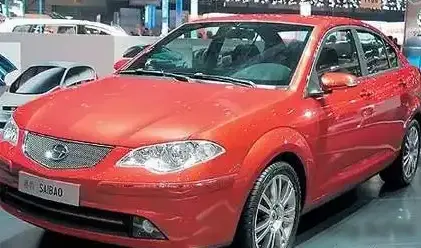
The Hafei Saibao 2.0i, produced between 2005 and 2007, marked a significant milestone for Hafei Motor as they aimed to create a domestically designed and manufactured sedan for the burgeoning Chinese automotive market. Positioned as a mid-range offering within the Saibao lineup, it sought to strike a balance between comfort, interior space, and performance at a competitive price. The Saibao, as a whole, represented Hafei’s ambition to establish a modern and appealing sedan, with the 2.0i variant specifically targeting buyers desiring a more potent engine option than the smaller displacement models available. Built on a dedicated platform, the Saibao 2.0i showcased Hafei’s expanding engineering capabilities during this period of growth.
Technical Specifications
| Brand | Hafei |
| Model | Saibao |
| Generation | Saibao |
| Type (Engine) | 2.0i (126 Hp) |
| Start of production | 2005 |
| End of production | 2007 |
| Powertrain Architecture | Internal Combustion engine |
| Body type | Sedan |
| Seats | 5 |
| Doors | 4 |
| Fuel Type | Petrol (Gasoline) |
| Maximum speed | 180 km/h (111.85 mph) |
| Weight-to-power ratio | 9.4 kg/Hp, 106.8 Hp/tonne |
| Weight-to-torque ratio | 6.7 kg/Nm, 148.3 Nm/tonne |
| Power | 126 Hp @ 5500 rpm |
| Power per litre | 63.1 Hp/l |
| Torque | 175 Nm (129.07 lb.-ft.) |
| Engine layout | Front, Longitudinal |
| Engine Model/Code | Mitsubishi 4G63S4M |
| Engine displacement | 1997 cm3 (121.86 cu. in.) |
| Number of cylinders | 4 |
| Number of valves per cylinder | 4 |
| Engine aspiration | Naturally aspirated engine |
| Kerb Weight | 1180 kg (2601.45 lbs.) |
| Max. weight | 1555 kg (3428.19 lbs.) |
| Max load | 375 kg (826.73 lbs.) |
| Fuel tank capacity | 50 l (13.21 US gal | 11 UK gal) |
| Length | 4434 mm (174.57 in.) |
| Width | 1708 mm (67.24 in.) |
| Height | 1471 mm (57.91 in.) |
| Wheelbase | 2600 mm (102.36 in.) |
| Drivetrain Architecture | The Internal combustion engine (ICE) drives the front wheels of the vehicle. |
| Drive wheel | Front wheel drive |
| Front brakes | Disc |
| Rear brakes | Drum |
| Tires size | 185/65 R14 |
| Wheel rims size | 14 |
Powertrain & Engine Architecture
The Saibao 2.0i’s powertrain revolved around the Mitsubishi-sourced 4G63S4M engine, a 2.0-liter inline-four cylinder unit. This engine, while employing a relatively straightforward design, was well-regarded for its inherent durability and reliability. It featured a single overhead camshaft (SOHC) valvetrain configuration with four valves per cylinder, a common setup for engines of this era. Fuel delivery was managed by a multi-point fuel injection system, providing adequate performance for the target market segment. The engine produced 126 horsepower at 5500 rpm and 175 Nm (129.07 lb.-ft.) of torque – respectable figures for its time and class within the Chinese automotive landscape. The engine was mounted longitudinally in the front of the vehicle, transmitting power to the front wheels. The transmission paired with the 2.0i engine was a four-speed automatic, prioritizing convenience for the driver but resulting in some compromise in responsiveness compared to available manual transmission options.
Driving Characteristics
The driving experience in the Saibao 2.0i was primarily focused on comfort rather than delivering a particularly sporty or engaging performance. The four-speed automatic transmission, while generally smooth in operation, featured relatively wide gear ratios. This meant the engine frequently operated at higher revolutions during acceleration, sometimes feeling strained. A hypothetical manual transmission version would have offered a more direct connection between the engine and the wheels, resulting in noticeably improved responsiveness. The 126 hp engine provided sufficient power for everyday driving scenarios and highway cruising, but it wasn’t designed for rapid acceleration. The front-wheel-drive configuration did contribute to a degree of torque steer under hard acceleration. The suspension system was tuned to prioritize ride comfort, effectively absorbing bumps and road imperfections, but it didn’t offer the firm, controlled handling characteristics favored by driving enthusiasts.
Equipment & Trim Levels
The Saibao 2.0i typically came equipped with a reasonable array of standard features for its price point in the Chinese market. These included power windows, power steering, air conditioning, and a basic audio system. Interior upholstery was generally cloth, although options for upgraded materials were available to buyers seeking a more premium feel. The dashboard layout was functional and straightforward, emphasizing ease of use over elaborate styling. Optional extras could include alloy wheels, a more sophisticated audio system, and a sunroof. The 2.0i trim level generally represented a step up from the base models, offering a more comprehensive feature set and a slightly more refined interior ambiance.
Chassis & Braking
The Saibao 2.0i utilized a conventional front-wheel-drive chassis layout. The front suspension consisted of MacPherson struts, a common and cost-effective design providing a good balance of ride comfort and handling. The rear suspension employed a torsion beam setup, further contributing to ride comfort and simplicity. The braking system featured disc brakes on the front wheels, providing adequate stopping power, and drum brakes on the rear wheels, a cost-saving measure. While sufficient for normal driving conditions, the braking performance wasn’t particularly strong when compared to vehicles equipped with four-wheel disc brakes. The 185/65 R14 tires provided reasonable grip for everyday driving, but they weren’t specifically designed for high-performance applications.
Market Reception & Comparison
The Hafei Saibao 2.0i received a mixed reception from automotive critics in China. It was generally praised for its spacious interior, comfortable ride quality, and competitive pricing. However, it also faced criticism for its somewhat underwhelming performance and the relatively basic quality of its interior materials. When compared to other sedans in its class, such as the Geely CK or the Chery Elara, the Saibao 2.0i offered a similar level of equipment and overall performance. However, the Mitsubishi-sourced engine was often viewed as a positive attribute, offering a degree of reliability and refinement that some of its competitors lacked. Fuel economy was considered average for a 2.0-liter sedan of that era.
Legacy
The Hafei Saibao 2.0i, while not a revolutionary vehicle, played a role in Hafei Motor’s development as a domestic automaker. The Mitsubishi 4G63 engine proved to be a durable and reliable powerplant, and a significant number of Saibao 2.0i vehicles remain in operation today. In the used car market, these vehicles are generally affordable and represent a practical transportation option. However, prospective buyers should be mindful of the vehicle’s age and the potential for maintenance issues associated with older automobiles. The Saibao 2.0i stands as a reminder of a period of rapid growth and innovation within the Chinese automotive industry, showcasing Hafei’s ambition to compete in a rapidly evolving market.
