
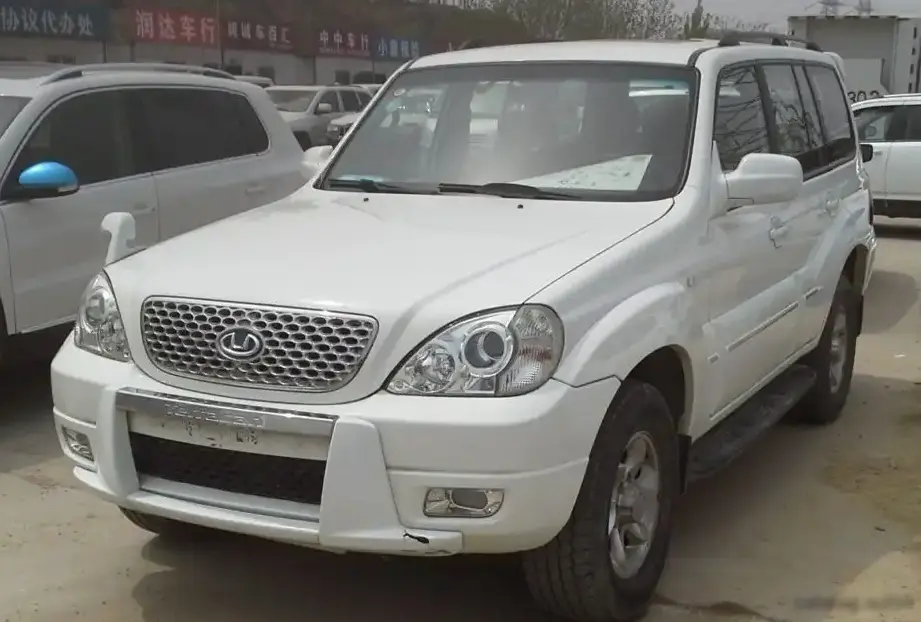
The Hawtai Terracan 2.4, produced between 2014 and 2017, represents a relatively late entry into the mid-size SUV market from the Chinese manufacturer Hawtai. Positioned as a more affordable option within the Terracan lineup, the 2.4-liter variant aimed to provide a practical and accessible vehicle for families and individuals seeking a spacious SUV with reasonable fuel economy. It was primarily sold within the Chinese domestic market, with limited export sales. The Terracan, in general, was Hawtai’s attempt to establish a foothold in the growing SUV segment, leveraging styling cues from established Japanese and Korean models.
Technical Specifications
| Brand | Hawtai |
| Model | Terracan |
| Generation | Terracan |
| Type (Engine) | 2.4 (125 Hp) |
| Start of production | 2014 |
| End of production | 2017 |
| Powertrain Architecture | Internal Combustion engine |
| Body type | Off-road vehicle, SUV |
| Seats | 5 |
| Doors | 5 |
| Fuel Type | Petrol (Gasoline) |
| Emission standard | Euro 4 |
| Weight-to-power ratio | 20 kg/Hp, 49.9 Hp/tonne |
| Weight-to-torque ratio | 12.5 kg/Nm, 79.8 Nm/tonne |
| Power | 125 Hp @ 5250 rpm |
| Torque | 200 Nm @ 2500 rpm (147.51 lb.-ft. @ 2500 rpm) |
| Engine layout | Front, Transverse |
| Engine Model/Code | 4G69 |
| Number of cylinders | 4 |
| Engine configuration | Inline |
| Kerb Weight | 2505 kg (5522.58 lbs) |
| Trunk (boot) space – maximum | 1060 l (37.43 cu. ft) |
| Fuel tank capacity | 75 l (19.81 US gal | 16.5 UK gal) |
| Length | 4710 mm (185.43 in) |
| Width | 1860 mm (73.23 in) |
| Height | 1850 mm (72.83 in) |
| Wheelbase | 2750 mm (108.27 in) |
| Ride height (ground clearance) | 205 mm (8.07 in) |
| Drivetrain Architecture | The Internal combustion engine (ICE) drives the front wheels of the vehicle. |
| Drive wheel | Front wheel drive |
| Number of gears and type of gearbox | 5 gears, manual transmission |
| Front suspension | Coil spring, Independent torsion bar, double wishbone |
| Rear suspension | Independent multi-link suspension |
| Front brakes | Disc |
| Rear brakes | Disc |
| Assisting systems | ABS (Anti-lock braking system) |
| Steering type | Steering rack and pinion |
| Tires size | 255/65 R16 |
Powertrain & Engine Architecture
The Hawtai Terracan 2.4 is powered by the Mitsubishi-sourced 4G69 2.4-liter inline-four cylinder engine. This engine, a common sight in various Mitsubishi and Chinese-market vehicles, is known for its relative simplicity and durability. It utilizes a multi-point fuel injection system and a single overhead camshaft (SOHC) valvetrain. While not a particularly high-performance engine, the 4G69 provides adequate power for everyday driving. The 125 horsepower peak is reached at 5250 rpm, while the 200 Nm (147.51 lb-ft) of torque is available at 2500 rpm. This torque curve prioritizes low-end and mid-range usability, making it suitable for navigating urban environments and moderate inclines. The engine is paired with a 5-speed manual transmission, which was the sole transmission option for this variant. The transmission is a conventional setup, designed for reliability rather than sporty performance.
Driving Characteristics
The Terracan 2.4, with its 125 hp and 5-speed manual transmission, delivers a driving experience focused on practicality and fuel efficiency. Acceleration is modest, and overtaking maneuvers require careful planning. The gear ratios are tuned for economy, meaning the engine needs to be revved to access its full potential. Compared to potential higher-output versions (had Hawtai offered them), the 2.4 feels noticeably less responsive. However, the manual transmission allows for greater driver control and engagement. The front-wheel-drive configuration provides predictable handling, but lacks the all-weather capability of an all-wheel-drive system. The suspension, tuned for comfort, absorbs bumps reasonably well, but body roll is noticeable during cornering.
Equipment & Trim Levels
The Terracan 2.4 typically came with a fairly basic level of equipment, reflecting its position as the entry-level model. Standard features generally included air conditioning, power windows, and a basic audio system. Interior upholstery was typically cloth, and the dashboard featured a functional, if somewhat utilitarian, design. Optional extras, depending on the market and dealer, could include alloy wheels, a more advanced audio system, and rear parking sensors. Safety features were also relatively basic, typically limited to ABS and dual front airbags.
Chassis & Braking
The Terracan 2.4 utilizes a conventional chassis layout with independent suspension at all four wheels. The front suspension employs a coil spring and independent torsion bar with a double wishbone setup, while the rear features an independent multi-link suspension. This configuration aims to provide a balance between ride comfort and handling stability. The braking system consists of disc brakes on all four wheels, providing adequate stopping power for the vehicle’s weight and performance. The inclusion of ABS helps to maintain steering control during emergency braking situations. The steering system is a rack and pinion type, offering reasonable precision and feedback.
Market Reception & Comparison
The Hawtai Terracan 2.4 received mixed reviews in the Chinese market. Critics generally praised its spacious interior and relatively affordable price point, but noted its lack of refinement and modest performance. Compared to competitors like the Geely Emgrand X7 and the Changan CS75, the Terracan 2.4 offered a less polished driving experience and a less feature-rich interior. However, its lower price made it an attractive option for budget-conscious buyers. Fuel economy was considered average for its class, with reported figures around 9-11 liters per 100 kilometers (22-26 mpg).
Legacy
The Hawtai Terracan 2.4, while not a groundbreaking vehicle, served as an important stepping stone for Hawtai in establishing its presence in the Chinese SUV market. The 4G69 engine, known for its reliability, has proven to be relatively durable in long-term use. However, the Terracan’s overall build quality and component durability are generally considered to be below that of established Japanese and Korean competitors. On the used car market, the Terracan 2.4 remains an affordable option, but potential buyers should be aware of potential maintenance issues and the limited availability of spare parts. Its legacy is one of a practical, if unremarkable, SUV that provided a relatively affordable entry point into the growing SUV segment.
