
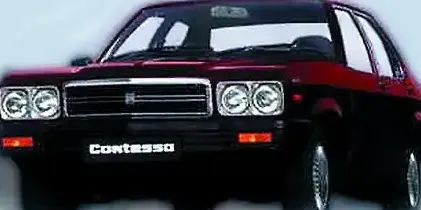
The Hindustan Contessa 1.8 Classic Line, produced between 1984 and 1996, represents a significant chapter in Indian automotive history. This variant, powered by a 1.8-liter inline-four engine producing 75 horsepower, was a mainstay of the Contessa lineup during its production run. The Contessa itself was a unique vehicle, born from a collaboration between Hindustan Motors and Vauxhall, initially based on the Vauxhall Victor. It filled a niche in the Indian market as one of the few domestically produced sedans offering a degree of style and space not readily available at the time. The 1.8 Classic Line occupied the entry-level position within the Contessa range, offering a more affordable option compared to later, more powerful versions.
Technical Specifications
| Brand | Hindustan |
| Model | Contessa |
| Generation | Contessa |
| Type (Engine) | 1.8 Classic Line (75 Hp) |
| Start of production | 1984 |
| End of production | 1996 |
| Powertrain Architecture | Internal Combustion engine |
| Body type | Sedan |
| Seats | 5 |
| Doors | 4 |
| Fuel Type | Petrol (Gasoline) |
| Maximum speed | 135 km/h (83.89 mph) |
| Weight-to-power ratio | 15.2 kg/Hp, 65.9 Hp/tonne |
| Weight-to-torque ratio | 8.8 kg/Nm, 114.2 Nm/tonne |
| Power | 75 Hp @ 5000 rpm |
| Power per litre | 41.3 Hp/l |
| Torque | 130 Nm @ 3000 rpm (95.88 lb.-ft. @ 3000 rpm) |
| Engine layout | Front, Longitudinal |
| Engine displacement | 1817 cm3 (110.88 cu. in.) |
| Number of cylinders | 4 |
| Engine configuration | Inline |
| Cylinder Bore | 84 mm (3.31 in.) |
| Piston Stroke | 82 mm (3.23 in.) |
| Compression ratio | 8.5:1 |
| Number of valves per cylinder | 2 |
| Fuel injection system | Carburettor |
| Engine aspiration | Naturally aspirated engine |
| Valvetrain | OHC |
| Kerb Weight | 1138 kg (2508.86 lbs.) |
| Max. weight | 1588 kg (3500.94 lbs.) |
| Max load | 450 kg (992.08 lbs.) |
| Trunk (boot) space – minimum | 600 l (21.19 cu. ft.) |
| Fuel tank capacity | 65 l (17.17 US gal | 14.3 UK gal) |
| Length | 4591 mm (180.75 in.) |
| Width | 1699 mm (66.89 in.) |
| Height | 1432 mm (56.38 in.) |
| Wheelbase | 2667 mm (105 in.) |
| Front track | 1420 mm (55.91 in.) |
| Rear (Back) track | 1400 mm (55.12 in.) |
| Drivetrain Architecture | The Internal combustion engine (ICE) drives the rear wheels of the vehicle. |
| Drive wheel | Rear wheel drive |
| Number of gears and type of gearbox | 5 gears, manual transmission |
| Front suspension | Coil spring |
| Rear suspension | Coil spring |
| Front brakes | Disc |
| Rear brakes | Drum |
| Assisting systems | ABS (Anti-lock braking system) |
| Steering type | Steering rack and pinion |
| Tires size | 175/80 R13 Q |
| Wheel rims size | 13 |
Powertrain & Engine Architecture
The heart of the Contessa 1.8 Classic Line was the 1817cc inline-four cylinder engine. This engine, derived from the Vauxhall Victor’s powerplant, was adapted for Indian conditions and initially featured a carbureted fuel system. The overhead camshaft (OHC) valvetrain operated two valves per cylinder. While relatively simple by modern standards, the engine proved to be reasonably durable. The 75 horsepower output at 5000 rpm and 130 Nm (95.88 lb.-ft.) of torque at 3000 rpm were considered adequate for the vehicle’s weight, but didn’t provide particularly brisk acceleration. The engine was mounted longitudinally in the front of the vehicle, driving the rear wheels. The five-speed manual transmission was the only gearbox option available for this variant.
Driving Characteristics
The Contessa 1.8 Classic Line offered a driving experience that was typical of rear-wheel-drive sedans of its era. The 75 hp engine provided sufficient power for everyday driving, but overtaking required careful planning. The five-speed gearbox allowed for reasonable control over engine speed, but the gear ratios were spaced to prioritize fuel economy over outright performance. Compared to later Contessa variants equipped with larger engines (like the 2.0-liter Isuzu engine), the 1.8 Classic Line felt noticeably slower. The rear-wheel-drive configuration provided a balanced feel, but the suspension, while adequate, wasn’t particularly sophisticated, resulting in a ride that could be firm on uneven surfaces.
Equipment & Trim Levels
The 1.8 Classic Line represented the base trim level for the Contessa. Standard features typically included basic cloth upholstery, a simple dashboard layout with analog gauges, and manual windows and door locks. Air conditioning was often an optional extra. The interior was functional rather than luxurious, reflecting the car’s positioning as an affordable family sedan. Exterior features were similarly basic, with steel wheels and minimal chrome trim. Optional extras could include a radio, upgraded upholstery, and sometimes, a sunroof.
Chassis & Braking
The Contessa 1.8 Classic Line utilized a body-on-frame construction, a common practice for vehicles of that period. The front suspension consisted of coil springs, while the rear also employed coil springs. The braking system featured disc brakes on the front wheels and drum brakes on the rear. An anti-lock braking system (ABS) was included, a relatively advanced feature for an Indian-made car of the 1980s and 90s. The steering was a rack and pinion system, providing reasonably precise control. Tire size was typically 175/80 R13.
Market Reception & Comparison
The Hindustan Contessa 1.8 Classic Line was generally well-received in the Indian market, particularly for its spacious interior and relatively modern styling compared to other domestically produced cars. Critics noted the engine’s modest power output, but acknowledged its reliability. Compared to the later, more powerful Contessa variants, the 1.8 Classic Line offered a more affordable entry point into Contessa ownership, appealing to budget-conscious buyers. Fuel economy was reasonable for the time, but not exceptional. The car’s rear-wheel-drive layout and relatively simple mechanicals made it relatively easy to maintain.
Legacy
The Hindustan Contessa, and particularly the 1.8 Classic Line, holds a special place in Indian automotive history. It was one of the first domestically produced sedans to offer a degree of style and sophistication. While production ceased in 1996, the Contessa remains a popular classic car among enthusiasts. The 1.8-liter engine, while not particularly powerful, proved to be durable and relatively easy to maintain. Today, well-maintained examples of the Contessa 1.8 Classic Line are sought after by collectors and enthusiasts, representing a nostalgic reminder of a bygone era in Indian motoring. Parts availability can be a challenge, but a dedicated community of owners and mechanics helps to keep these cars on the road.
