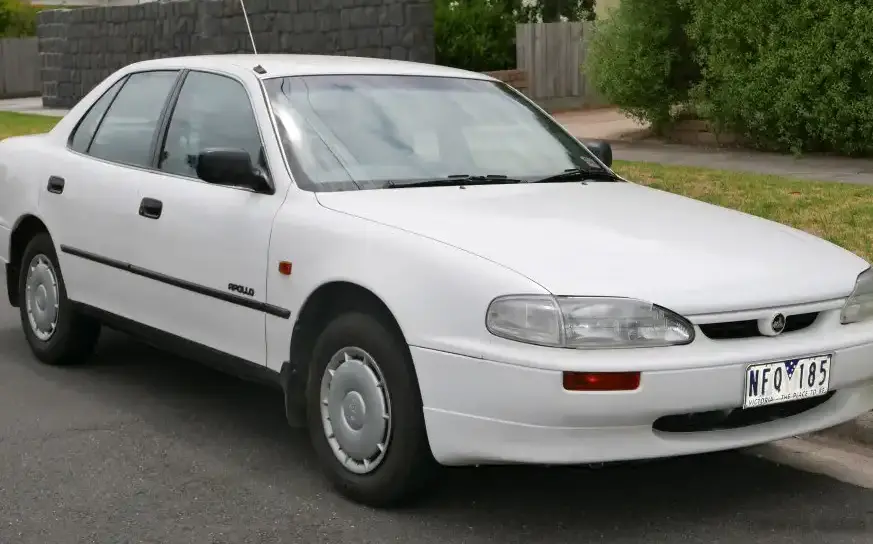
The Holden Apollo 3.0i V6 24V, produced between 1991 and 1996, represented a significant offering in the Australian mid-size car market. Based on the Toyota Camry platform – a result of the General Motors-Toyota joint venture known as United Automotive Group (UAG) – the Apollo aimed to provide a locally-branded alternative with a more powerful engine option than typically found in its direct competitors. This variant, equipped with the 3.0-liter V6 engine and a four-speed automatic transmission, occupied a mid-range position within the Apollo lineup, offering a balance between performance and convenience. It was positioned above the base 2.0-liter four-cylinder models and below any potential future performance-oriented trims.
Technical Specifications
| Brand | Holden |
| Model | Apollo |
| Generation | Apollo |
| Type (Engine) | 3.0 i V6 24V (180 Hp) |
| Start of production | 1991 |
| End of production | 1996 |
| Powertrain Architecture | Internal Combustion engine |
| Body type | Sedan |
| Seats | 5 |
| Doors | 4 |
| Fuel consumption (combined) | 11 l/100 km (21.4 US mpg, 25.7 UK mpg, 9.1 km/l) |
| Fuel Type | Petrol (Gasoline) |
| Acceleration 0 – 100 km/h | 10 sec |
| Acceleration 0 – 62 mph | 10 sec |
| Acceleration 0 – 60 mph | 9.5 sec |
| Maximum speed | 210 km/h (130.49 mph) |
| Weight-to-power ratio | 8.1 kg/Hp, 124.1 Hp/tonne |
| Weight-to-torque ratio | 5.5 kg/Nm, 182.1 Nm/tonne |
| Power | 180 Hp @ 5200 rpm |
| Power per litre | 60.8 Hp/l |
| Torque | 264 Nm @ 4400 rpm (194.72 lb.-ft. @ 4400 rpm) |
| Engine layout | Front, Transverse |
| Engine displacement | 2959 cm3 (180.57 cu. in.) |
| Number of cylinders | 6 |
| Engine configuration | V-engine |
| Cylinder Bore | 87.5 mm (3.44 in.) |
| Piston Stroke | 82 mm (3.23 in.) |
| Compression ratio | 9.6:1 |
| Number of valves per cylinder | 4 |
| Fuel injection system | Multi-port manifold injection |
| Engine aspiration | Naturally aspirated engine |
| Valvetrain | DOHC |
| Kerb Weight | 1450 kg (3196.7 lbs.) |
| Trunk (boot) space – minimum | 517 l (18.26 cu. ft.) |
| Fuel tank capacity | 70 l (18.49 US gal | 15.4 UK gal) |
| Length | 4725 mm (186.02 in.) |
| Width | 1770 mm (69.69 in.) |
| Height | 1400 mm (55.12 in.) |
| Wheelbase | 2620 mm (103.15 in.) |
| Front track | 1550 mm (61.02 in.) |
| Rear (Back) track | 1500 mm (59.06 in.) |
| Drivetrain Architecture | The Internal combustion engine (ICE) drives the front wheels of the vehicle. |
| Drive wheel | Front wheel drive |
| Number of gears and type of gearbox | 4 gears, automatic transmission |
| Front suspension | Spring Strut |
| Rear suspension | Coil spring |
| Front brakes | Ventilated discs |
| Rear brakes | Disc |
| Assisting systems | ABS (Anti-lock braking system) |
| Power steering | Hydraulic Steering |
| Tires size | 205/65 R15 H |
Powertrain & Engine Architecture
The heart of this Apollo variant was the 3.0-liter (2959 cc) 6VE V6 engine. This engine, derived from Toyota’s JZ series, featured a 90-degree V-angle, dual overhead camshafts (DOHC), and four valves per cylinder. The multi-port fuel injection system delivered fuel directly to each intake port, optimizing combustion efficiency. The engine produced 180 horsepower at 5200 rpm and 264 Nm (194.72 lb-ft) of torque at 4400 rpm. The four-speed automatic transmission, while providing convenient operation, was a conventional hydraulic unit, lacking the sophistication of electronically controlled transmissions found in some contemporary vehicles. It was designed to provide smooth, if not particularly sporty, shifts. The transmission’s gear ratios were tuned for comfortable cruising and adequate acceleration, prioritizing fuel economy over outright performance.
Driving Characteristics
The Holden Apollo 3.0i with the automatic transmission offered a comfortable and refined driving experience. Acceleration from a standstill to 60 mph took approximately 9.5 seconds, which was respectable for the early 1990s but noticeably slower than the manual transmission versions of the same engine. The automatic transmission’s shift points were programmed to favor fuel efficiency, resulting in a slightly less responsive feel compared to the manual. However, the V6 engine provided ample torque for everyday driving and overtaking maneuvers. The front-wheel-drive configuration offered predictable handling, although it lacked the dynamic finesse of rear-wheel-drive vehicles. The suspension was tuned for comfort, absorbing bumps and imperfections in the road surface effectively.
Equipment & Trim Levels
The 3.0i V6 automatic trim level typically included features such as power windows, power steering, central locking, and an AM/FM radio cassette player. Air conditioning was often standard, though sometimes offered as an option depending on the specific year and package. Interior upholstery was typically cloth, with a relatively simple dashboard layout. Optional extras included a sunroof, upgraded sound system, and alloy wheels. The interior design prioritized functionality and durability over luxury, reflecting the Apollo’s positioning as a practical and affordable mid-size sedan.
Chassis & Braking
The Apollo utilized a front-wheel-drive chassis with a MacPherson strut front suspension and a coil spring rear suspension. The braking system consisted of ventilated discs on the front wheels and solid discs on the rear. Anti-lock braking system (ABS) was included as standard equipment, enhancing safety by preventing wheel lockup during hard braking. The suspension setup was geared towards providing a comfortable ride, with stabilizer bars helping to reduce body roll during cornering. The tires were typically 205/65 R15, offering a good balance between grip and ride comfort.
Market Reception & Comparison
The Holden Apollo 3.0i V6 automatic was generally well-received by Australian motoring journalists. Critics praised the engine’s smooth power delivery and the car’s comfortable ride. However, the automatic transmission was sometimes criticized for being less engaging than the manual option. Compared to the 2.0-liter four-cylinder Apollo models, the 3.0i offered significantly improved performance, but at a higher price point. Against competitors like the Ford Falcon and Holden Commodore, the Apollo offered a more fuel-efficient and refined driving experience, but lacked the performance and spaciousness of those larger vehicles. Fuel economy averaged around 11 liters per 100 kilometers (21.4 US mpg), which was competitive for its class.
Legacy
The Holden Apollo, while not a long-lived model, played a role in bridging the gap between Australian-made Holdens and the increasing influence of Japanese automotive technology. The 3.0-liter V6 engine proved to be a reliable and durable powerplant, and many examples are still on the road today. The automatic transmission, while not known for its sporty characteristics, generally held up well over time with proper maintenance. In the used car market, the Apollo 3.0i V6 automatic is often sought after by enthusiasts looking for a comfortable, reliable, and relatively affordable classic Australian sedan. Its simplicity and readily available parts contribute to its ongoing appeal.