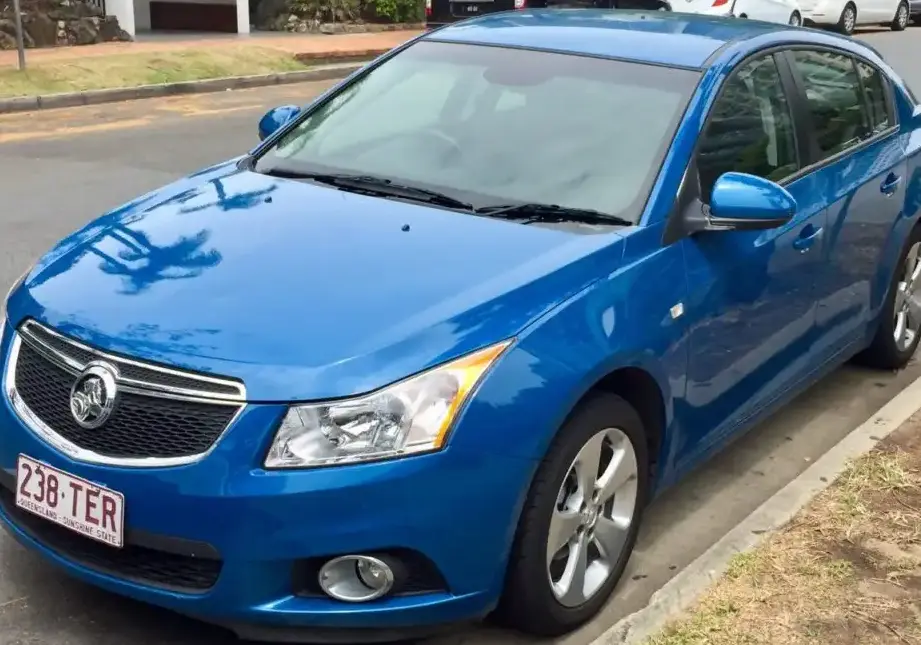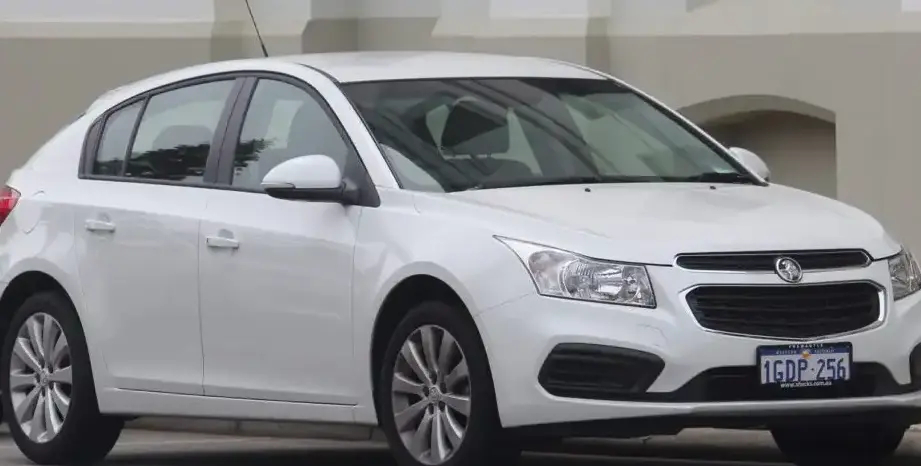
The Holden Cruze Sedan (JH) 1.8 ECOTEC, produced from March 2011 to December 2014, represented a significant entry for Holden into the competitive small-to-midsize sedan segment in Australia and New Zealand. Based on the global Chevrolet Cruze platform (J300), the JH series aimed to offer a modern, fuel-efficient, and well-equipped vehicle to challenge established rivals like the Toyota Corolla and Mazda3. The 1.8-liter ECOTEC variant occupied a crucial position in the lineup, serving as the entry-level engine option, appealing to buyers prioritizing affordability and practicality over outright performance. It was a key model for attracting a broader customer base to the Cruze nameplate.
Technical Specifications
| Brand | Holden |
| Model | Cruze |
| Generation | Cruze Sedan (JH) |
| Type (Engine) | 1.8 ECOTEC (141 Hp) |
| Start of production | March, 2011 |
| End of production | December, 2014 |
| Powertrain Architecture | Internal Combustion engine |
| Body type | Sedan |
| Seats | 5 |
| Doors | 4 |
| Fuel consumption (combined) | 7 l/100 km (33.6 US mpg, 40.4 UK mpg, 14.3 km/l) |
| CO2 emissions | 165 g/km |
| Fuel Type | Petrol (Gasoline) |
| Weight-to-power ratio | 9.9 kg/Hp, 101.5 Hp/tonne |
| Weight-to-torque ratio | 7.9 kg/Nm, 126.7 Nm/tonne |
| Power | 141 Hp @ 6200 rpm |
| Power per litre | 78.5 Hp/l |
| Torque | 176 Nm @ 3800 rpm (129.81 lb.-ft. @ 3800 rpm) |
| Engine layout | Front, Transverse |
| Engine Model/Code | A18XER |
| Engine displacement | 1796 cm3 (109.6 cu. in.) |
| Number of cylinders | 4 |
| Engine configuration | Inline |
| Cylinder Bore | 80.5 mm (3.17 in.) |
| Piston Stroke | 88.2 mm (3.47 in.) |
| Compression ratio | 10.5:1 |
| Number of valves per cylinder | 4 |
| Fuel injection system | Multi-port manifold injection |
| Engine aspiration | Naturally aspirated engine |
| Valvetrain | DOHC, DCVCP |
| Engine oil capacity | 4.5 l (4.76 US qt | 3.96 UK qt) |
| Coolant | 6.5 l (6.87 US qt | 5.72 UK qt) |
| Kerb Weight | 1389 kg (3062.22 lbs.) |
| Max. weight | 1797 kg (3961.71 lbs.) |
| Max load | 408 kg (899.49 lbs.) |
| Trunk (boot) space – minimum | 445 l (15.72 cu. ft.) |
| Trunk (boot) space – maximum | 1245 l (43.97 cu. ft.) |
| Fuel tank capacity | 60 l (15.85 US gal | 13.2 UK gal) |
| Permitted trailer load with brakes (12%) | 1200 kg (2645.55 lbs.) |
| Permitted trailer load without brakes | 695 kg (1532.21 lbs.) |
| Length | 4615 mm (181.69 in.) |
| Width | 1797 mm (70.75 in.) |
| Height | 1477 mm (58.15 in.) |
| Wheelbase | 2685 mm (105.71 in.) |
| Front track | 1539-1545 mm (60.59 – 60.83 in.) |
| Rear (Back) track | 1561-1567 mm (61.46 – 61.69 in.) |
| Minimum turning circle (turning diameter) | 10.9 m (35.76 ft.) |
| Drivetrain Architecture | The Internal combustion engine (ICE) drives the front wheels of the vehicle. |
| Drive wheel | Front wheel drive |
| Number of gears and type of gearbox | 5 gears, manual transmission |
| Front suspension | Independent, type McPherson with coil spring and anti-roll bar |
| Rear suspension | Coil spring, Torsion |
| Front brakes | Ventilated discs, 276 mm |
| Rear brakes | Disc, 268 mm |
| Assisting systems | ABS (Anti-lock braking system) |
| Steering type | Steering rack and pinion |
| Power steering | Hydraulic Steering |
| Tires size | 205/60 R16; 215/50 R17 |
| Wheel rims size | 6.5J x 16; 7J x 17 |
INTRODUCTION
The Holden Cruze JH series, launched in 2011, was a pivotal model for the Australian manufacturer, representing a move towards more globally-aligned vehicles. The 1.8-liter ECOTEC variant was positioned as the entry point to the Cruze range, offering a balance of affordability and acceptable performance for everyday driving. It was aimed at buyers who prioritized fuel economy and value over sporty handling or rapid acceleration. The JH Cruze was a direct replacement for the Holden Astra, and represented a significant investment by Holden in a modern, competitive sedan.
Powertrain & Engine Architecture
The heart of the Cruze 1.8 ECOTEC is the A18XER engine, a 1.8-liter (1796cc) inline-four cylinder gasoline engine. This engine utilizes multi-port fuel injection and a double overhead camshaft (DOHC) valvetrain with variable valve timing (DCVCP – Dual Continuous Variable Cam Phasing) to optimize efficiency and power delivery. The engine produces 141 horsepower at 6200 rpm and 176 Nm (129.81 lb-ft) of torque at 3800 rpm. The engine’s design focused on reducing internal friction and optimizing combustion for improved fuel economy. The 1.8L engine was paired with a five-speed manual transmission as standard, offering a relatively simple and reliable drivetrain. While an automatic transmission was available, it was a traditional four-speed unit, which impacted fuel efficiency and responsiveness compared to more modern automatic gearboxes.
Driving Characteristics
The Cruze 1.8L with the five-speed manual transmission provided adequate performance for daily commuting and general driving. Acceleration was not particularly brisk, but sufficient for merging onto highways and overtaking slower traffic. The engine felt most comfortable in the mid-range, offering reasonable torque for everyday driving situations. The four-speed automatic version, however, noticeably dulled performance. The gear ratios were spaced widely, leading to the engine feeling strained during acceleration and lacking responsiveness. Compared to the higher-output 1.6L turbo or the diesel variants, the 1.8L automatic felt significantly slower and less refined. The suspension tuning prioritized comfort over sporty handling, resulting in a relatively soft ride quality.
Equipment & Trim Levels
The 1.8-liter Cruze typically came equipped with a base level of features, including air conditioning, power windows, a basic audio system with CD player and auxiliary input, and standard safety equipment like ABS brakes and dual front airbags. Higher trim levels, such as the CD and CDX, added features like alloy wheels, cruise control, upgraded audio systems, and additional safety features like side airbags and curtain airbags. Interior upholstery was typically cloth, with a relatively simple dashboard layout. Optional extras included a sunroof, leather upholstery, and a more advanced infotainment system.
Chassis & Braking
The Cruze JH utilized a front-wheel-drive layout with an independent McPherson strut suspension in the front and a torsion beam suspension in the rear. The front brakes were ventilated discs, providing adequate stopping power, while the rear brakes were solid discs. The steering was a hydraulic rack and pinion system, offering reasonable feel and precision. The suspension was tuned for comfort, prioritizing ride quality over sharp handling. Stabilizer bars were fitted to both the front and rear axles to reduce body roll during cornering.
Market Reception & Comparison
The Holden Cruze 1.8L was generally well-received as an affordable and practical sedan. Critics praised its comfortable ride and spacious interior, but noted its lack of outright performance compared to some rivals. Fuel economy was considered competitive for its class. Compared to the 1.6L turbo variant, the 1.8L offered lower running costs but significantly less power and refinement. The diesel variants provided superior fuel economy and torque, but came at a higher purchase price. The 1.8L automatic, in particular, received criticism for its sluggish performance and dated four-speed transmission.
Legacy
The Holden Cruze JH, including the 1.8L ECOTEC variant, enjoyed moderate success in the Australian and New Zealand markets. While it didn’t achieve the sales figures of some of its competitors, it established the Cruze as a viable contender in the small-to-midsize sedan segment. The A18XER engine proved to be relatively reliable, with few major mechanical issues reported. On the used car market today, the 1.8L Cruze represents an affordable and practical option for buyers seeking a reliable and fuel-efficient sedan. However, potential buyers should be aware of the limitations of the four-speed automatic transmission and prioritize well-maintained examples.