
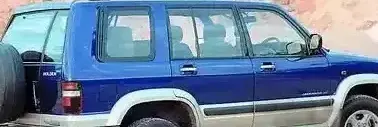
The Holden Jackaroo (UBS) 3.2i V6 24V S, produced between 1998 and 2003, represents a significant iteration of Holden’s popular off-road vehicle. Part of the UBS series, this variant occupied a mid-range position within the Jackaroo lineup, offering a balance between performance, features, and affordability. The UBS series itself was a substantial update to the previous generation, incorporating revised styling, improved safety features, and updated powertrains. The Jackaroo, originally based on the Isuzu Trooper, was a key model for Holden in the Australian and New Zealand markets, catering to buyers seeking a robust and capable four-wheel drive vehicle for both on and off-road adventures.
Technical Specifications
| Brand | Holden |
| Model | Jackaroo |
| Generation | Jackaroo (UBS) |
| Type (Engine) | 3.2i V6 24V S (177 Hp) |
| Start of production | 1998 |
| End of production | 2003 |
| Powertrain Architecture | Internal Combustion engine |
| Body type | Off-road vehicle |
| Seats | 5 |
| Doors | 3 |
| Fuel consumption (combined) | 14.4 l/100 km |
| Fuel consumption (US mpg) | 16.3 US mpg |
| Fuel consumption (UK mpg) | 19.6 UK mpg |
| Fuel consumption (km/l) | 6.9 km/l |
| Fuel Type | Petrol (Gasoline) |
| Acceleration 0 – 100 km/h | 11.5 sec |
| Acceleration 0 – 62 mph | 11.5 sec |
| Acceleration 0 – 60 mph | 10.9 sec |
| Maximum speed | 170 km/h |
| Maximum speed (mph) | 105.63 mph |
| Weight-to-power ratio | 10.1 kg/Hp |
| Hp/tonne | 98.6 Hp/tonne |
| Weight-to-torque ratio | 6.9 kg/Nm |
| Nm/tonne | 144.8 Nm/tonne |
| Power | 177 Hp @ 5200 rpm |
| Power per litre | 55.9 Hp/l |
| Torque | 260 Nm @ 3750 rpm |
| Torque (lb.-ft.) | 191.77 lb.-ft. @ 3750 rpm |
| Engine layout | Front, Longitudinal |
| Engine displacement | 3165 cm3 |
| Engine displacement (cu. in.) | 193.14 cu. in. |
| Number of cylinders | 6 |
| Engine configuration | V-engine |
| Number of valves per cylinder | 4 |
| Fuel injection system | Multi-port manifold injection |
| Engine aspiration | Naturally aspirated engine |
| Valvetrain | OHC |
| Kerb Weight | 1795 kg |
| Kerb Weight (lbs.) | 3957.3 lbs. |
| Trunk (boot) space – minimum | 1339 l |
| Trunk (boot) space – minimum (cu. ft.) | 47.29 cu. ft. |
| Trunk (boot) space – maximum | 1934 l |
| Trunk (boot) space – maximum (cu. ft.) | 68.3 cu. ft. |
| Fuel tank capacity | 85 l |
| Fuel tank capacity (US gal) | 22.45 US gal |
| Fuel tank capacity (UK gal) | 18.7 UK gal |
| Length | 4270 mm |
| Length (in.) | 168.11 in. |
| Width | 1745 mm |
| Width (in.) | 68.7 in. |
| Height | 1835 mm |
| Height (in.) | 72.24 in. |
| Wheelbase | 2330 mm |
| Wheelbase (in.) | 91.73 in. |
| Front track | 1455 mm |
| Front track (in.) | 57.28 in. |
| Rear (Back) track | 1460 mm |
| Rear (Back) track (in.) | 57.48 in. |
| Drive wheel | All wheel drive (4×4) |
| Number of gears | 5 |
| Gearbox type | Manual transmission |
| Front suspension | Coil spring |
| Rear suspension | Coil spring |
| Front brakes | Ventilated discs |
| Rear brakes | Ventilated discs |
| Assisting systems | ABS (Anti-lock braking system) |
| Power steering | Hydraulic Steering |
| Tires size | 245/70 R16 |
Powertrain & Engine Architecture
The heart of the Jackaroo 3.2i V6 S is the 6VE1 3.2-liter V6 engine. This engine, derived from Isuzu’s design, features a 60-degree V-angle and a cast iron block with aluminum cylinder heads. The 24-valve configuration (four valves per cylinder) and multi-point fuel injection contribute to its relatively smooth power delivery. The engine’s 177 horsepower at 5200 rpm and 260 Nm (192 lb-ft) of torque at 3750 rpm provided adequate performance for both on-road driving and moderate off-road conditions. The five-speed manual transmission was the standard offering for this variant, providing drivers with full control over the engine’s power band. The transmission’s gear ratios were tuned for a balance of acceleration and fuel efficiency, though the Jackaroo was never known for exceptional fuel economy.
Driving Characteristics
The 3.2i V6 with the five-speed manual transmission offered a reasonably engaging driving experience. While not a sports car, the engine provided sufficient power for overtaking and maintaining highway speeds. The manual gearbox allowed drivers to exploit the engine’s torque curve, making it easier to navigate challenging terrain. Compared to the later four-speed automatic transmission option, the manual version felt more responsive and offered better control, particularly when off-roading. The Jackaroo’s body-on-frame construction resulted in a noticeable body roll in corners, but the robust suspension system absorbed bumps and irregularities effectively. The 4×4 system, typically selectable between 2H (rear-wheel drive), 4H (high-range four-wheel drive), and 4L (low-range four-wheel drive), provided excellent traction in various conditions.
Equipment & Trim Levels
The ‘S’ designation indicated a mid-range trim level for the Jackaroo. Standard equipment typically included air conditioning, power windows, central locking, and a basic audio system. Interior upholstery was usually a durable cloth material. Optional extras could include alloy wheels, a sunroof, and upgraded audio systems. The dashboard layout was functional and straightforward, prioritizing usability over aesthetics. Safety features, while improving with the UBS series, were still relatively basic by modern standards, typically including ABS brakes and driver/passenger airbags.
Chassis & Braking
The Jackaroo UBS utilized a traditional body-on-frame construction, providing a robust and durable platform for off-road use. The suspension system consisted of coil springs all around, with independent front suspension and a multi-link rear suspension. Ventilated disc brakes were fitted to all four wheels, providing adequate stopping power for the vehicle’s weight. Hydraulic power steering made maneuvering easier, especially at low speeds. The tires, typically 245/70 R16, were chosen for a balance of on-road comfort and off-road grip.
Market Reception & Comparison
The Holden Jackaroo 3.2i V6 S was generally well-received in the Australian and New Zealand markets. Critics praised its robust construction, off-road capability, and relatively affordable price point. However, it was also criticized for its dated interior, relatively poor fuel economy, and somewhat agricultural driving experience. Compared to other trims in the Jackaroo lineup, the 3.2i V6 S offered a good balance between performance and value. The smaller 3.0-liter four-cylinder engine was more fuel-efficient but lacked the power for serious off-roading or towing, while the larger 3.5-liter V6 offered more power but came at a higher price.
Legacy
The Holden Jackaroo UBS, including the 3.2i V6 S variant, has developed a loyal following among enthusiasts. The 6VE1 engine, while not known for being particularly sophisticated, is generally considered reliable if properly maintained. Common issues include oil leaks and occasional sensor failures. Today, well-maintained examples of the Jackaroo are sought after by collectors and off-road enthusiasts. The vehicle’s robust construction and capable four-wheel drive system continue to make it a viable option for those seeking a durable and affordable off-road vehicle. The Jackaroo represents a significant chapter in Holden’s history, embodying the brand’s commitment to building tough and capable vehicles for the Australian and New Zealand markets.
