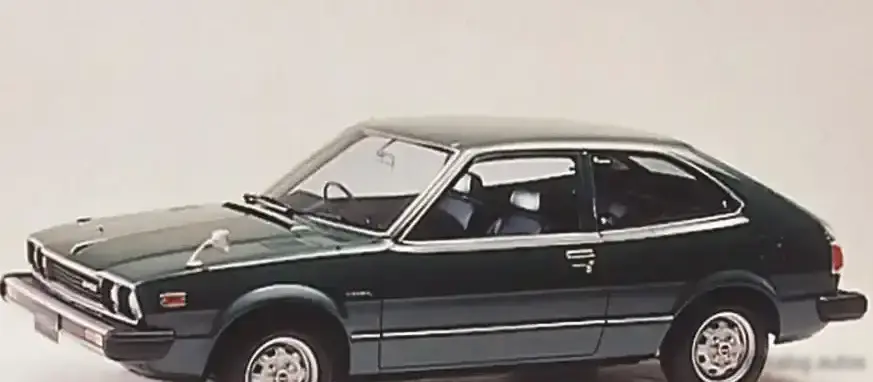
The Honda Accord II Hatchback, specifically the 1.6 EX (AC) variant produced from 1983 to 1985, represents a significant step in Honda’s expansion into the North American market. Falling within the AC/AD facelift of the second-generation Accord, this model offered a practical and fuel-efficient option for buyers seeking a compact car with Honda’s reputation for reliability. The 1.6 EX trim occupied a mid-range position within the Accord II hatchback lineup, offering a balance between affordability and features. It was positioned above the base models and below the more performance-oriented or fully-equipped trims.
Technical Specifications
| Brand | Honda |
| Model | Accord |
| Generation | Accord II Hatchback (AC,AD facelift 1983) |
| Type (Engine) | 1.6 EX (AC) (88 Hp) |
| Start of production | 1983 |
| End of production | 1985 |
| Powertrain Architecture | Internal Combustion Engine |
| Body type | Hatchback |
| Fuel Type | Petrol (Gasoline) |
| Power | 88 Hp |
| Engine Aspiration | Naturally Aspirated |
Powertrain & Engine Architecture
The 1.6 EX (AC) Accord hatchback was powered by Honda’s 1.6-liter, inline-four cylinder engine. This engine, internally designated as the A16A, was a naturally aspirated unit producing 88 horsepower. The A16A featured a single overhead camshaft (SOHC) valvetrain operating four valves per cylinder. Fuel delivery was managed by a carburetor, a common feature for vehicles of this era, though Honda was beginning to experiment with fuel injection in other models. The engine block was constructed from cast iron, while the cylinder head was made of aluminum, contributing to a relatively lightweight design.
The “AC” designation in the model name refers to the automatic transmission. This was a three-speed automatic transmission, designed for smooth and comfortable operation. While not offering the sporty engagement of a manual gearbox, the automatic transmission appealed to a broader range of drivers, particularly in the American market where automatics were highly preferred. The transmission was electronically controlled, a relatively advanced feature for the time, allowing for more precise shift points and improved fuel efficiency compared to earlier automatic designs. The final drive ratio was geared towards fuel economy and everyday drivability rather than outright acceleration.
Driving Characteristics
The 1.6 EX (AC) Accord hatchback provided a comfortable and predictable driving experience. With 88 horsepower and a three-speed automatic transmission, acceleration was adequate for merging onto highways and navigating city streets, but it wasn’t particularly brisk. The automatic transmission, while smooth, did result in some power loss compared to the available five-speed manual transmission. The gear ratios were optimized for fuel efficiency, meaning the engine often operated at lower RPMs during cruising. This contributed to a quiet cabin and reduced fuel consumption.
Handling was generally considered good for a car in its class. The Accord II featured independent front suspension with MacPherson struts and a rear torsion beam suspension. This setup provided a reasonable balance between ride comfort and handling precision. Steering was rack-and-pinion, offering responsive and accurate control. Compared to the manual transmission versions, the automatic felt slightly less engaging, as drivers had less control over gear selection and engine braking.
Equipment & Trim Levels
The 1.6 EX trim level offered a step up in features compared to the base Accord hatchback models. Standard equipment typically included cloth upholstery, a basic AM/FM radio, and a heater/defroster system. The EX trim also included features like a digital clock, upgraded interior trim, and often, a rear window wiper. Optional extras available for the 1.6 EX included air conditioning, a more advanced stereo system, and power windows. The interior design was functional and straightforward, prioritizing practicality and ease of use. The dashboard layout was simple, with clearly labeled controls.
The exterior of the 1.6 EX was generally similar to other Accord hatchback models, but often included features like body-colored bumpers and upgraded wheel covers. The overall aesthetic was conservative and understated, reflecting the Japanese design philosophy of the time.
Chassis & Braking
The Accord II hatchback utilized a unibody construction, providing a good balance of strength and weight. The front suspension featured MacPherson struts, coil springs, and an anti-roll bar. The rear suspension employed a torsion beam setup, which was cost-effective and provided adequate ride comfort.
Braking on the 1.6 EX (AC) consisted of front disc brakes and rear drum brakes. This was a common configuration for cars in this price range during the 1980s. The braking system was hydraulically assisted, providing adequate stopping power for everyday driving. The drum brakes on the rear were less effective at dissipating heat than disc brakes, but they were more affordable and required less maintenance.
Market Reception & Comparison
The Honda Accord II Hatchback, including the 1.6 EX (AC) variant, was well-received by automotive critics and consumers alike. It was praised for its reliability, fuel efficiency, and comfortable ride. The 1.6 EX automatic offered a convenient and practical option for buyers who preferred the ease of an automatic transmission.
Compared to other trims in the Accord II lineup, the 1.6 EX automatic offered a compromise between performance and economy. The more powerful 1.7-liter engine, available in some trims, provided quicker acceleration, but at the expense of fuel efficiency. The manual transmission versions offered a more engaging driving experience, but required more driver involvement. The 1.6 EX automatic was often seen as the sweet spot for buyers who wanted a reliable and comfortable car for everyday use. Compared to competitors like the Toyota Corolla and Nissan Sentra, the Accord II was often considered to be slightly more refined and offered a more spacious interior.
Legacy
The Honda Accord II Hatchback, and particularly the 1.6 EX (AC) variant, has proven to be a remarkably durable and reliable vehicle. Many examples are still on the road today, a testament to Honda’s engineering and build quality. The A16A engine is known for its longevity and relatively simple maintenance requirements.
In the used car market, these Accords are often sought after by enthusiasts and collectors. They represent a piece of automotive history and offer a nostalgic driving experience. While parts availability may be becoming more challenging, many aftermarket suppliers still offer components for these vehicles. The 1.6 EX (AC) Accord hatchback remains a popular choice for those seeking a classic Japanese car that is both reliable and affordable.