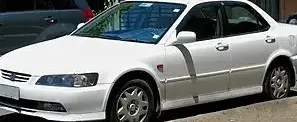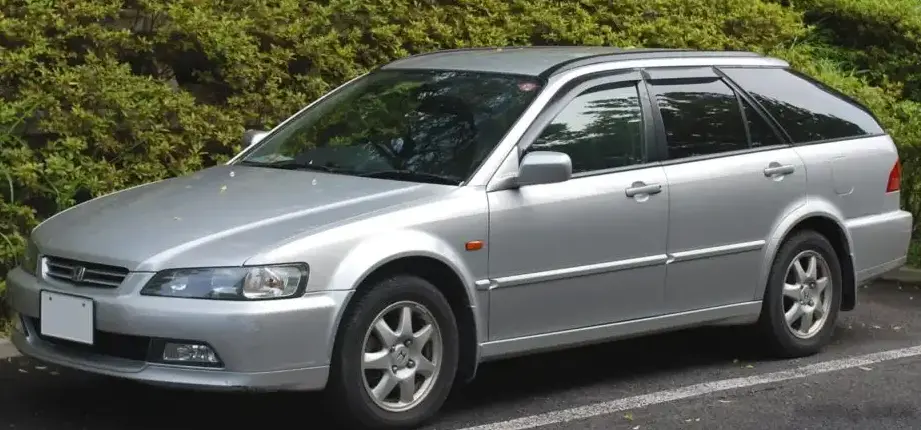
The Honda Accord VI Wagon 2.3 16V, produced between 1998 and 2002, represented a practical and relatively upscale offering in the station wagon segment. Part of the sixth generation of the globally successful Honda Accord, this variant was primarily aimed at the European and Asian markets, where wagons retained significant popularity. In the United States, the wagon body style was not offered during this generation. The 2.3 16V engine coupled with a five-speed automatic transmission positioned this Accord Wagon as a mid-range option, balancing performance with convenience and fuel efficiency. It sat above the base 1.8L models and below the more performance-oriented, though rarely available in wagon form, 2.0L or 2.2L variants.
Technical Specifications
| Brand | Honda |
| Model | Accord |
| Generation | Accord VI Wagon |
| Type (Engine) | 2.3 16V (137 Hp) |
| Start of production | 1998 |
| End of production | 2002 |
| Powertrain Architecture | Internal Combustion engine |
| Body type | Station wagon (estate) |
| Seats | 5 |
| Doors | 5 |
| Fuel Type | Petrol (Gasoline) |
| Power | 137 Hp @ 5400 rpm |
| Power per litre | 60.8 Hp/l |
| Torque | 196 Nm @ 4700 rpm / 144.56 lb.-ft. @ 4700 rpm |
| Engine layout | Front, Transverse |
| Engine Model/Code | F23A5 |
| Engine displacement | 2254 cm3 / 137.55 cu. in. |
| Number of cylinders | 4 |
| Engine configuration | Inline |
| Cylinder Bore | 86 mm / 3.39 in. |
| Piston Stroke | 97 mm / 3.82 in. |
| Compression ratio | 9.8:1 |
| Number of valves per cylinder | 4 |
| Fuel injection system | Multi-port manifold injection |
| Engine aspiration | Naturally aspirated engine |
| Valvetrain | OHC |
| Engine oil capacity | 4.3 l / 4.54 US qt | 3.78 UK qt |
| Coolant | 5.4 l / 5.71 US qt | 4.75 UK qt |
| Fuel tank capacity | 60 l / 15.85 US gal | 13.2 UK gal |
| Length | 4740 mm / 186.61 in. |
| Width | 1730 mm / 68.11 in. |
| Height | 1445 mm / 56.89 in. |
| Wheelbase | 2665 mm / 104.92 in. |
| Front track | 1490 mm / 58.66 in. |
| Rear (Back) track | 1490 mm / 58.66 in. |
| Drivetrain Architecture | The Internal combustion engine (ICE) drives the front wheels of the vehicle. |
| Drive wheel | Front wheel drive |
| Number of gears and type of gearbox | 5 gears, automatic transmission |
| Front suspension | Double wishbone |
| Rear suspension | Several levers and rods |
| Front brakes | Ventilated discs |
| Rear brakes | Disc |
| Assisting systems | ABS (Anti-lock braking system) |
| Steering type | Steering rack and pinion |
| Power steering | Hydraulic Steering |
| Tires size | 205/60 R15 |
| Wheel rims size | 15 |
Powertrain & Engine Architecture
The heart of this Accord Wagon is the F23A5 engine, a 2.3-liter inline-four cylinder powerplant. This engine utilizes a single overhead camshaft (SOHC) valvetrain operating 16 valves (four per cylinder). The F23A5 benefits from Honda’s proven multi-point fuel injection system, ensuring efficient fuel delivery and smooth operation. The engine’s design prioritizes reliability and low-end torque, making it well-suited for everyday driving. The five-speed automatic transmission, a common unit in Honda vehicles of this era, provides smooth shifts and contributes to the car’s ease of use. While not a particularly sporty transmission, it was known for its durability. The transmission’s gear ratios were tuned for fuel economy and comfortable cruising, rather than outright acceleration.
Driving Characteristics
The 137 horsepower and 196 Nm (144.56 lb-ft) of torque delivered by the 2.3L engine and automatic transmission resulted in a comfortable, if not exhilarating, driving experience. Acceleration was adequate for merging onto highways and overtaking slower traffic, but it wasn’t a particularly quick vehicle. Compared to the manual transmission versions of the same engine, the automatic resulted in a noticeable decrease in responsiveness. The automatic’s torque converter slightly muted the engine’s power delivery. However, the automatic transmission made the Accord Wagon significantly easier to drive in congested urban environments. The suspension, tuned for comfort, absorbed bumps and imperfections in the road well, providing a stable and predictable ride.
Equipment & Trim Levels
The 2.3 16V automatic Accord Wagon typically came equipped with a reasonable level of standard features. These included power windows, power door locks, air conditioning, and a basic audio system. Higher trim levels, often denoted by specific badges or option packages, added features such as alloy wheels, a sunroof, upgraded upholstery, and a more sophisticated audio system. Interior upholstery was typically cloth, with leather options available as an upgrade. Dashboard configuration was relatively straightforward, prioritizing functionality and ease of use. Optional extras included a CD changer, cruise control, and upgraded speakers.
Chassis & Braking
The Accord Wagon’s chassis featured a double wishbone suspension setup at the front, providing good handling and ride comfort. The rear suspension utilized a multi-link design, further enhancing ride quality and stability. Braking duties were handled by ventilated discs at the front and solid discs at the rear. Anti-lock braking system (ABS) was standard, enhancing safety by preventing wheel lockup during hard braking. The steering system employed a rack-and-pinion setup with hydraulic power assistance, providing precise and responsive steering feel. The standard tire size was 205/60 R15, mounted on 15-inch steel or alloy wheels.
Market Reception & Comparison
The Honda Accord VI Wagon 2.3 16V was generally well-received by automotive critics. It was praised for its practicality, reliability, and comfortable ride. However, some critics noted that the automatic transmission dulled the engine’s performance compared to the manual versions. Fuel economy was considered respectable for its class, though not class-leading. Compared to other wagons in the European market, such as the Ford Mondeo Estate or the Volkswagen Passat Variant, the Accord Wagon offered a compelling combination of features, reliability, and Honda’s reputation for build quality. The 1.8L models were more affordable but lacked the 2.3L’s power, while the higher-displacement engines were less common and often more expensive.
Legacy
The F23A5 engine, when properly maintained, proved to be a remarkably durable and reliable unit. The automatic transmission, while not known for its sportiness, also demonstrated good longevity. Today, the Honda Accord VI Wagon 2.3 16V is a relatively sought-after used car, particularly in Europe and Asia. Its reputation for reliability and practicality has ensured a steady demand. Finding well-maintained examples can be challenging, as many have accumulated high mileage. However, the Accord Wagon remains a viable option for those seeking a dependable and spacious family vehicle with a touch of Japanese engineering excellence. Parts availability is generally good, further contributing to its appeal in the used car market.