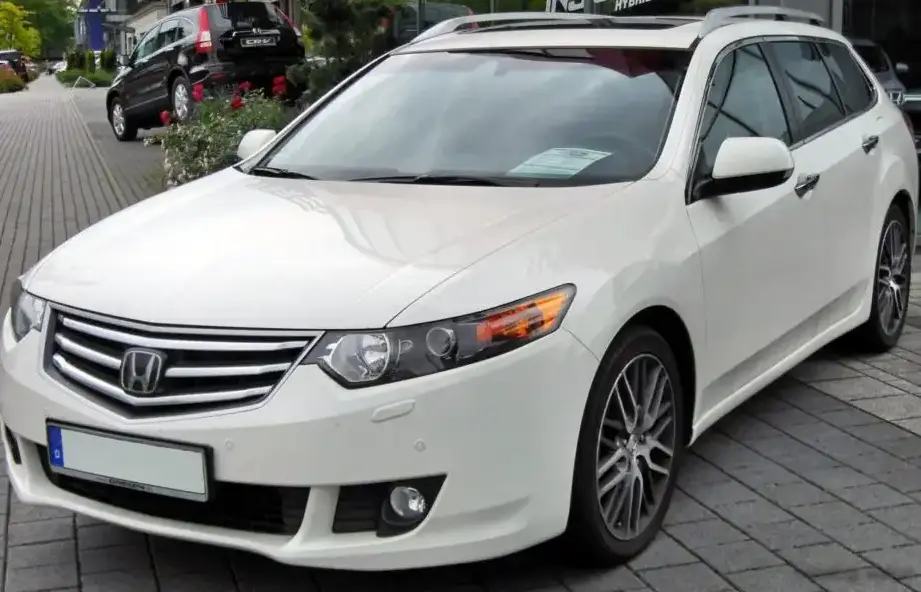
The Honda Accord VIII Wagon, produced between 2008 and 2011, represented Honda’s entry into the European station wagon market with a vehicle designed to blend practicality with the Accord’s established reputation for reliability and refinement. This generation, based on the global Accord platform (internally designated as the CU platform), offered a more spacious and versatile alternative to the sedan body style. The 2.0-liter (156 hp) variant occupied a mid-range position within the wagon lineup, offering a balance between performance and fuel efficiency, appealing to families and drivers prioritizing everyday usability. It was primarily sold in Europe and other international markets, not offered in the North American market.
Technical Specifications
| Brand | Honda |
| Model | Accord |
| Generation | Accord VIII Wagon |
| Type (Engine) | 2.0 (156 Hp) |
| Start of production | 2008 |
| End of production | 2011 |
| Powertrain Architecture | Internal Combustion engine |
| Body type | Station wagon (estate) |
| Seats | 5 |
| Doors | 5 |
| Fuel consumption (urban) | 9.8 l/100 km (24 US mpg) |
| Fuel consumption (extra urban) | 5.9 l/100 km (39.9 US mpg) |
| Fuel consumption (combined) | 7.3 l/100 km (32.2 US mpg) |
| Fuel Type | Petrol (Gasoline) |
| Acceleration 0 – 100 km/h | 9.4 sec |
| Acceleration 0 – 62 mph | 9.4 sec |
| Acceleration 0 – 60 mph | 8.9 sec |
| Maximum speed | 212 km/h (131.73 mph) |
| Emission standard | Euro 5 |
| Weight-to-power ratio | 10.9 kg/Hp |
| Weight-to-torque ratio | 9 kg/Nm |
| Power | 156 Hp @ 6200 rpm |
| Torque | 190 Nm @ 4200 rpm (140.14 lb.-ft. @ 4200 rpm) |
| Engine layout | Front, Transverse |
| Engine Model/Code | R20A3 |
| Engine displacement | 1997 cm3 (121.86 cu. in.) |
| Number of cylinders | 4 |
| Engine configuration | Inline |
| Cylinder Bore | 81 mm (3.19 in.) |
| Piston Stroke | 96.9 mm (3.81 in.) |
| Compression ratio | 10.5:1 |
| Number of valves per cylinder | 4 |
| Fuel injection system | Multi-port manifold injection |
| Engine aspiration | Naturally aspirated engine |
| Valvetrain | DOHC |
| Engine oil capacity | 3.7 l (3.91 US qt | 3.26 UK qt) |
| Coolant capacity | 5.4 l (5.71 US qt | 4.75 UK qt) |
| Kerb Weight | 1702 kg (3752.27 lbs.) |
| Max. weight | 2100 kg (4629.71 lbs.) |
| Max load | 398 kg (877.44 lbs.) |
| Trunk (boot) space – minimum | 395 l (13.95 cu. ft.) |
| Trunk (boot) space – maximum | 1252 l (44.21 cu. ft.) |
| Fuel tank capacity | 65 l (17.17 US gal | 14.3 UK gal) |
| Length | 4750 mm (187.01 in.) |
| Width | 1840 mm (72.44 in.) |
| Height | 1470 mm (57.87 in.) |
| Wheelbase | 2750 mm (108.27 in.) |
| Front track | 1595 mm (62.8 in.) |
| Rear (Back) track | 1600 mm (62.99 in.) |
| Minimum turning circle | 11.8 m (38.71 ft.) |
| Drivetrain Architecture | Front wheel drive |
| Number of gears | 6 gears, manual transmission |
| Front suspension | Double wishbone |
| Rear suspension | Wishbone |
| Front brakes | Ventilated discs |
| Rear brakes | Disc |
| Assisting systems | ABS (Anti-lock braking system) |
| Steering type | Steering rack and pinion |
| Tires size | 215/60 R16 |
| Wheel rims size | 6.5J x 16 |
INTRODUCTION
The Honda Accord VIII Wagon 2.0 (156 Hp) was a key variant within the eighth-generation Accord wagon range, launched in 2008 and continuing through 2011. Designed primarily for the European market, it offered a practical and refined alternative to traditional saloons. The wagon body style significantly increased cargo capacity, making it a popular choice for families and those requiring versatile load-lugging capabilities. This 2.0-liter engine, paired with a six-speed manual transmission, represented a middle-ground offering, positioned between the more economical lower-powered engines and the higher-performance 2.4-liter variants.
Powertrain & Engine Architecture
The heart of the Accord VIII Wagon 2.0 is the R20A3 engine, a 1997cc inline-four cylinder petrol engine. This engine utilizes a naturally aspirated setup with multi-point fuel injection and a double overhead camshaft (DOHC) valvetrain. The R20A3 is known for its relatively smooth operation and decent fuel economy. The engine’s 156 horsepower peak is achieved at 6200 rpm, while its 190 Nm (140 lb-ft) of torque is delivered at 4200 rpm. The six-speed manual transmission was the standard offering for this variant, providing precise gear changes and contributing to a more engaging driving experience. The transmission’s gear ratios were tuned to balance acceleration with fuel efficiency, offering a comfortable cruising speed on motorways while still providing sufficient power for overtaking maneuvers.
Driving Characteristics
The 2.0-liter Accord Wagon offered a balanced driving experience. While not overtly sporty, it provided adequate performance for everyday driving situations. Acceleration from 0-60 mph took approximately 8.9 seconds, and the top speed was around 131.73 mph. The manual transmission allowed for greater driver control, and the engine’s torque curve provided reasonable responsiveness. Compared to the higher-output 2.4-liter engine, the 2.0-liter felt less strained during acceleration, but lacked the same level of outright performance. The suspension, tuned for comfort, absorbed bumps and imperfections in the road well, providing a smooth ride. The steering was precise and well-weighted, offering good feedback to the driver.
Equipment & Trim Levels
The Accord VIII Wagon 2.0 typically came equipped with a respectable level of standard features. These included air conditioning, power windows, central locking, an audio system with CD player, and alloy wheels. Higher trim levels, such as the ‘ES’ or ‘EX’ variants, added features like climate control, a sunroof, leather upholstery, and upgraded audio systems. Safety features were also comprehensive, including ABS brakes, airbags, and stability control. Optional extras included satellite navigation, parking sensors, and a premium sound system.
Chassis & Braking
The Accord VIII Wagon featured a front-wheel-drive layout with a double wishbone front suspension and a wishbone rear suspension. This suspension setup provided a good balance between ride comfort and handling. The braking system consisted of ventilated discs at the front and solid discs at the rear, providing adequate stopping power. ABS (Anti-lock Braking System) was standard, enhancing safety during emergency braking situations. The chassis was designed to provide a stable and predictable driving experience, with minimal body roll during cornering.
Market Reception & Comparison
The Honda Accord VIII Wagon 2.0 was generally well-received by automotive critics. It was praised for its spacious interior, comfortable ride, and reliable engine. However, some critics noted that the 2.0-liter engine could feel underpowered when fully loaded or when tackling steep hills. Compared to the 2.4-liter variant, the 2.0-liter offered better fuel economy but less performance. The 2.0-liter also provided a more affordable entry point into the Accord Wagon range, making it an attractive option for budget-conscious buyers. Fuel economy figures averaged around 32.2 US mpg combined, making it a relatively efficient option for a wagon of its size.
Legacy
The Honda Accord VIII Wagon 2.0 has proven to be a reliable and durable vehicle. The R20A3 engine is known for its longevity, and with regular maintenance, it can provide many years of trouble-free service. In the used car market, these wagons are still sought after for their practicality, reliability, and comfortable ride. While not as common as the sedan version, the wagon offers a unique blend of space and refinement that appeals to a specific segment of buyers. The 2.0-liter engine, while not the most powerful option, provides a good balance between performance and fuel economy, making it a sensible choice for everyday driving.