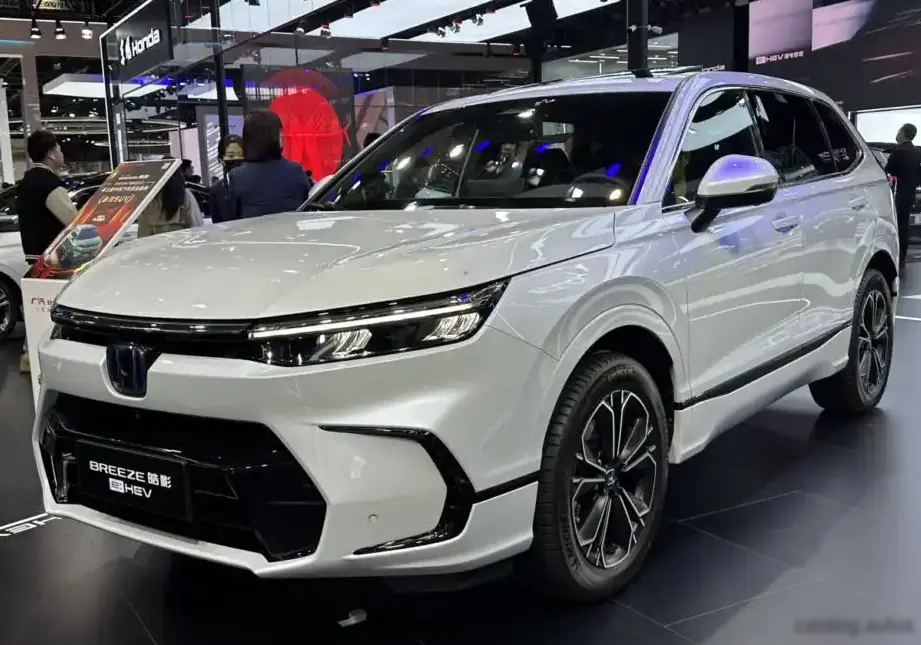
The Honda Breeze I 240 Turbo, produced from October 2019 to 2023, represents Honda’s entry into the compact SUV market with a focus on fuel efficiency and modern technology. Positioned as a mid-range offering within the Breeze lineup, it aimed to bridge the gap between affordability and features, appealing to families and individuals seeking a practical and stylish vehicle. The Breeze I is built on Honda’s compact platform, sharing components with other Honda models globally. This variant, specifically equipped with the 1.5-liter turbocharged engine and a Continuously Variable Transmission (CVT), was a key driver of sales for the model in several markets.
Technical Specifications
| Brand | Honda |
| Model | Breeze |
| Generation | Breeze I |
| Type (Engine) | 240 Turbo (193 Hp) CVT |
| Start of production | October, 2019 |
| End of production | 2023 |
| Powertrain Architecture | Internal Combustion engine |
| Body type | SUV |
| Seats | 5 |
| Doors | 5 |
| Fuel consumption (combined) | 6.4-6.7 l/100 km (36.8 – 35.1 US mpg, 44.1 – 42.2 UK mpg, 15.6 – 14.9 km/l) |
| Fuel Type | Petrol (Gasoline) |
| Acceleration 0 – 100 km/h | 9.3 sec |
| Acceleration 0 – 62 mph | 9.3 sec |
| Acceleration 0 – 60 mph | 8.8 sec |
| Emission standard | China VI |
| Weight-to-power ratio | 8 kg/Hp, 124.7 Hp/tonne |
| Weight-to-torque ratio | 6.4 kg/Nm, 157 Nm/tonne |
| Power | 193 Hp @ 5600 rpm |
| Power per litre | 128.8 Hp/l |
| Torque | 243 Nm @ 2000-5000 rpm (179.23 lb.-ft. @ 2000-5000 rpm) |
| Engine layout | Front, Transverse |
| Engine Model/Code | L15B7 |
| Engine displacement | 1498 cm3 (91.41 cu. in.) |
| Number of cylinders | 4 |
| Engine configuration | Inline |
| Compression ratio | 10.3:1 |
| Number of valves per cylinder | 4 |
| Fuel injection system | Direct injection |
| Engine aspiration | Turbocharger, Intercooler |
| Valvetrain | VTEC |
| Engine oil capacity | 3.5 l (3.7 US qt | 3.08 UK qt) |
| Coolant capacity | 6.2 l (6.55 US qt | 5.46 UK qt) |
| Kerb Weight | 1548-1580 kg (3412.76 – 3483.3 lbs.) |
| Fuel tank capacity | 53 l (14 US gal | 11.66 UK gal) |
| Length | 4634 mm (182.44 in.) |
| Width | 1855 mm (73.03 in.) |
| Height | 1679 mm (66.1 in.) |
| Wheelbase | 2661 mm (104.76 in.) |
| Minimum turning circle | 11 m (36.09 ft.) |
| Drivetrain Architecture | Front wheel drive |
| Number of gears and type of gearbox | automatic transmission CVT |
| Front suspension | Independent, type McPherson with coil spring and anti-roll bar |
| Rear suspension | Independent multi-link spring suspension with stabilizer |
| Front brakes | Ventilated discs |
| Rear brakes | Disc |
| Tires size | 235/65 R17 |
| Wheel rims size | 7.5J x 17 |
Powertrain & Engine Architecture
The heart of the Breeze I 240 Turbo is the L15B7 1.5-liter inline-four cylinder engine. This engine utilizes direct injection and is coupled with a single scroll turbocharger and intercooler to deliver a balance of power and efficiency. Honda’s Variable Timing and Lift Electronic Control (VTEC) system is employed to optimize valve timing for improved performance across the rev range. The engine produces 193 horsepower at 5600 rpm and 243 Nm (179.23 lb-ft) of torque between 2000 and 5000 rpm. This engine is known for its responsiveness and relatively smooth power delivery. The engine is transversely mounted, driving the front wheels. The Continuously Variable Transmission (CVT) was chosen for its fuel efficiency and smooth acceleration. While CVTs sometimes receive criticism for their driving feel, Honda’s implementation aimed to minimize the “rubber band” effect often associated with this type of transmission.
Driving Characteristics
The 1.8L/CVT combination in the Breeze I delivers adequate performance for everyday driving. Acceleration from 0-60 mph takes approximately 8.8 seconds, and 0-100 km/h in 9.3 seconds. The CVT is programmed to simulate gear changes, providing a more familiar driving experience. However, compared to models equipped with a manual transmission or the higher-output engine options, this variant feels less sporty. The CVT prioritizes fuel economy, and while it offers smooth acceleration, it doesn’t provide the same level of engagement as a traditional automatic or manual gearbox. The power delivery is linear, with the turbocharger providing a noticeable boost in the mid-range. The suspension is tuned for comfort, providing a relatively smooth ride over most road surfaces.
Equipment & Trim Levels
The Breeze I 240 Turbo typically came standard with features such as automatic climate control, a touchscreen infotainment system with Apple CarPlay and Android Auto compatibility, and a suite of safety features including ABS, stability control, and multiple airbags. Higher trim levels offered upgrades like leather upholstery, a sunroof, and advanced driver-assistance systems such as adaptive cruise control and lane departure warning. Interior upholstery was typically cloth on the base trims, with leather options available on higher-spec models. The dashboard layout was modern and functional, with a focus on ease of use.
Chassis & Braking
The Breeze I utilizes an independent McPherson strut suspension in the front and an independent multi-link suspension in the rear. This setup provides a good balance of ride comfort and handling. The front brakes are ventilated discs, while the rear brakes are solid discs. The steering is electric power-assisted, providing light and precise steering feel. The vehicle’s weight, ranging from 1548 to 1580 kg, is relatively moderate for its class, contributing to its manageable handling characteristics.
Market Reception & Comparison
The Honda Breeze I 240 Turbo was generally well-received by critics, who praised its fuel efficiency, comfortable ride, and spacious interior. However, some reviewers noted that the CVT could feel sluggish at times, and the overall driving experience wasn’t as engaging as some of its competitors. Compared to other trims in the Breeze lineup, the 240 Turbo offered a good balance of performance and economy. The base engine models were more affordable but lacked the power of the turbo variant, while the higher-output engine options came at a premium price. Fuel economy figures of 6.4-6.7 l/100 km were competitive within the compact SUV segment.
Legacy
The Honda Breeze I 240 Turbo, with its L15B7 engine and CVT, has proven to be a relatively reliable powertrain. While CVTs have historically been a concern for some buyers, Honda’s implementation has demonstrated reasonable durability. In the used car market, these models are often sought after for their fuel efficiency and practicality. Regular maintenance, including timely oil changes and CVT fluid replacements, is crucial for ensuring long-term reliability. The Breeze I 240 Turbo represents a significant step forward for Honda in the compact SUV segment, offering a compelling combination of features, performance, and efficiency.