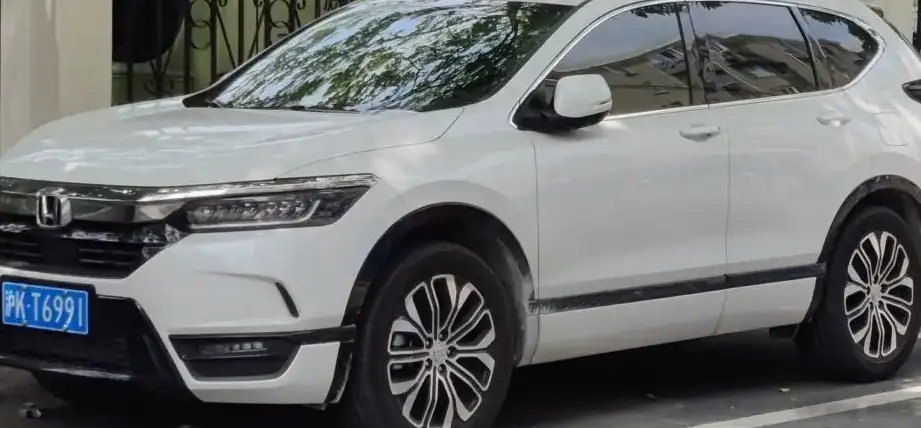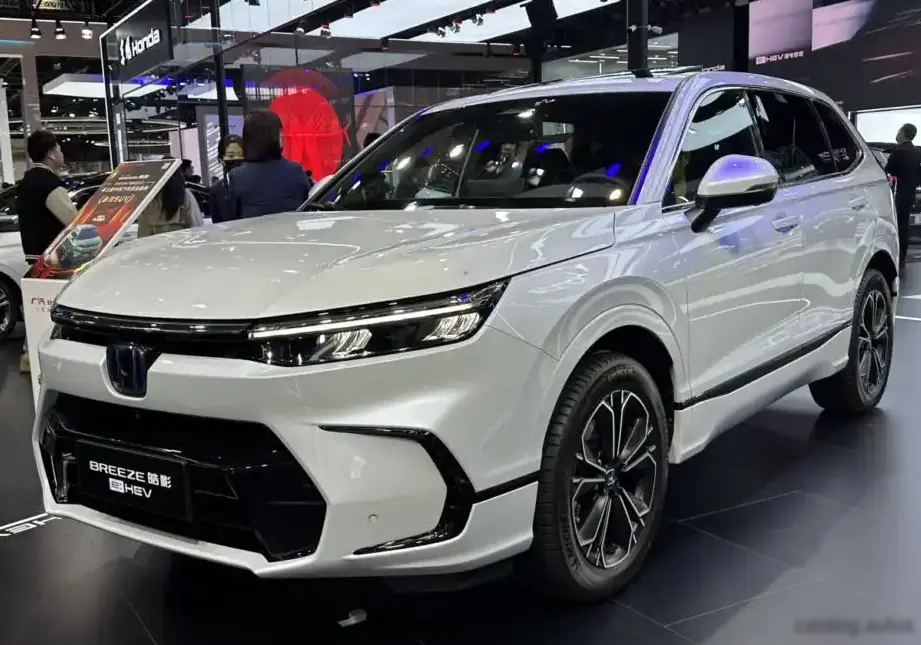
The Honda Breeze II 2.0L e:HEV AWD E-CVT, launched in 2023, represents Honda’s entry into the increasingly competitive compact SUV segment, specifically tailored for the Chinese market. This variant combines a 2.0-liter inline-four gasoline engine with Honda’s e:HEV (electric Hybrid Vehicle) full hybrid system and an electronically controlled continuously variable transmission (E-CVT), coupled with all-wheel drive. Positioned as a mid-range offering within the Breeze II lineup, it aims to balance fuel efficiency, performance, and all-weather capability for family buyers. The Breeze II is built on Honda’s compact SUV platform, sharing architecture with other Honda models globally.
Technical Specifications
| Brand | Honda |
| Model | Breeze |
| Generation | Breeze II |
| Type (Engine) | 2.0L (184 Hp) e:HEV AWD E-CVT |
| Start of production | 2023 |
| Powertrain Architecture | FHEV (Full Hybrid Electric Vehicle) |
| Body type | SUV |
| Seats | 5 |
| Doors | 5 |
| Fuel consumption (combined) | 6.14 l/100 km (38.3 US mpg, 46 UK mpg, 16.3 km/l) |
| Fuel Type | Petrol (Gasoline) |
| Maximum speed | 177 km/h (109.98 mph) |
| Emission standard | China VI |
| Weight-to-power ratio | 11.9 kg/Hp, 83.8 Hp/tonne |
| Weight-to-torque ratio | 9.8 kg/Nm, 102.3 Nm/tonne |
| Battery technology | Lithium-ion (Li-Ion) |
| Battery location | Below the floor, under the rear seats |
| Electric motor power | 184 Hp |
| Electric motor Torque | 335 Nm (247.08 lb.-ft.) |
| Electric motor location | Front, Transverse |
| Electric motor type | Synchronous |
| Engine Power | 150 Hp @ 6100 rpm |
| Engine Torque | 183 Nm @ 4500 rpm (134.97 lb.-ft. @ 4500 rpm) |
| Engine layout | Front, Transverse |
| Engine Model/Code | LFB21 |
| Engine displacement | 1993 cm3 (121.62 cu. in.) |
| Number of cylinders | 4 |
| Engine configuration | Inline |
| Compression ratio | 13.9:1 |
| Number of valves per cylinder | 4 |
| Fuel injection system | Direct injection |
| Engine aspiration | Naturally aspirated engine |
| Valvetrain | DOHC, i-VTEC |
| Engine oil capacity | 4 l (4.23 US qt | 3.52 UK qt) |
| Coolant capacity | 5.7 l (6.02 US qt | 5.02 UK qt) |
| Kerb Weight | 1789 kg (3944.07 lbs.) |
| Max. weight | 2350 kg (5180.86 lbs.) |
| Max load | 561 kg (1236.79 lbs.) |
| Fuel tank capacity | 53 l (14 US gal | 11.66 UK gal) |
| Length | 4716 mm (185.67 in.) |
| Width | 1866 mm (73.46 in.) |
| Height | 1691 mm (66.57 in.) |
| Wheelbase | 2701 mm (106.34 in.) |
| Front track | 1601 mm (63.03 in.) |
| Rear track | 1617 mm (63.66 in.) |
| Front brakes | Ventilated discs |
| Rear brakes | Disc |
| Drive wheel | All wheel drive (4×4) |
| Number of gears | automatic transmission E-CVT |
Powertrain & Engine Architecture
The heart of the Breeze II 2.0L e:HEV is the LFB21 2.0-liter inline-four cylinder engine. This engine utilizes direct fuel injection and Honda’s intelligent Variable Valve Timing and Lift Electronic Control (i-VTEC) system to optimize combustion efficiency and power delivery. The engine produces 150 horsepower at 6100 rpm and 183 Nm (134.97 lb-ft) of torque at 4500 rpm. However, the total system output, combining the engine and electric motor, reaches 184 horsepower. The e:HEV system operates in three primary modes: EV Drive (electric only), Hybrid Drive (engine charges battery and assists motor), and Engine Drive (engine directly powers the wheels). The transition between these modes is managed automatically by the system. The E-CVT, unlike traditional CVTs, doesn’t rely on a belt but uses a planetary gearset to provide a seamless and continuously variable gear ratio. This contributes to smooth acceleration and optimized fuel efficiency.
Driving Characteristics
The 2.0L e:HEV AWD E-CVT offers a comfortable and refined driving experience. The E-CVT provides smooth, linear acceleration, although it lacks the immediate responsiveness of a traditional automatic transmission or a dual-clutch gearbox. The all-wheel-drive system enhances traction, particularly in inclement weather conditions. While not a performance-oriented vehicle, the combined 184 hp provides adequate power for everyday driving and highway merging. The hybrid system prioritizes fuel efficiency, and the vehicle frequently operates in EV mode at lower speeds, resulting in quiet and emissions-free driving. Compared to a potential turbocharged variant, this setup emphasizes smoothness and efficiency over outright power.
Equipment & Trim Levels
The Breeze II 2.0L e:HEV AWD E-CVT typically comes well-equipped, reflecting its mid-range positioning. Standard features generally include automatic climate control, a touchscreen infotainment system with smartphone integration (Apple CarPlay and Android Auto), a rearview camera, and a suite of advanced driver-assistance systems (ADAS) such as adaptive cruise control, lane keeping assist, and automatic emergency braking. Interior upholstery is typically cloth or a combination of cloth and leatherette. Optional extras may include a panoramic sunroof, heated and ventilated front seats, a premium sound system, and upgraded interior trim materials.
Chassis & Braking
The Breeze II utilizes an independent McPherson strut suspension in the front and an independent multi-link suspension in the rear, providing a comfortable ride and stable handling. The suspension is tuned for comfort rather than sporty handling. Braking duties are handled by ventilated discs at the front and solid discs at the rear. Anti-lock braking system (ABS) is standard, along with electronic brake-force distribution (EBD) and brake assist. The electric power steering provides light and precise steering feel.
Market Reception & Comparison
The Honda Breeze II 2.0L e:HEV AWD E-CVT has been well-received in the Chinese market, where fuel efficiency and hybrid technology are highly valued. Critics have praised its comfortable ride, spacious interior, and comprehensive suite of safety features. Compared to other trims in the Breeze II lineup, the 2.0L e:HEV offers a compelling balance of performance and fuel economy. While the base models with smaller engines are more affordable, they lack the power and refinement of the hybrid variant. Higher-trim levels with more luxurious features come at a premium price. Competitors in the Chinese market include the Toyota RAV4 Hybrid, Nissan X-Trail e-POWER, and various domestic Chinese SUVs.
Legacy
As a relatively new model, the long-term reliability of the Breeze II 2.0L e:HEV AWD E-CVT is still being established. However, Honda has a strong reputation for building reliable vehicles, and the e:HEV system has proven to be durable in other Honda models. The combination of a naturally aspirated engine and an E-CVT is generally considered to be less complex and potentially more reliable than some other powertrain configurations. In the used car market, this variant is expected to hold its value well due to its fuel efficiency, all-wheel-drive capability, and Honda’s brand reputation. The Breeze II represents Honda’s commitment to electrification and its adaptation to the evolving demands of the Chinese automotive market.