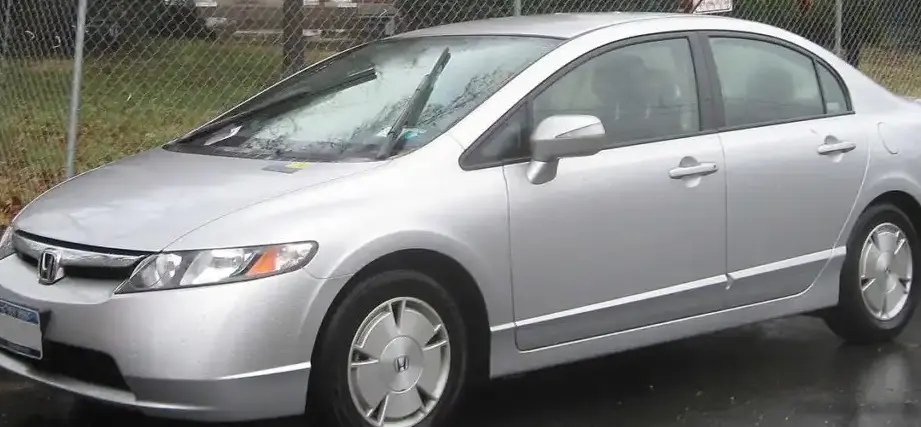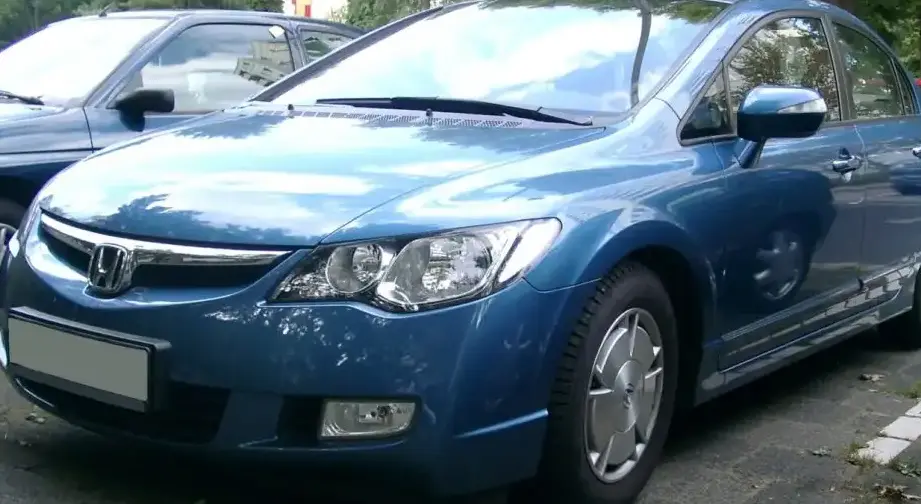
The Honda Civic VIII Sedan 2.0 i-VTEC (155 Hp) represents a significant iteration in Honda’s long-running Civic lineage. Produced from 2006 to 2011, this variant occupied a mid-to-upper position within the eighth-generation Civic (2005-2011) sedan lineup, offering a balance of performance and fuel efficiency. It was primarily marketed towards buyers seeking a sporty yet practical compact sedan, particularly in North America and Europe, where the Civic enjoyed considerable popularity. This model was built on the Honda Civic platform (often referred to as the 8th generation), sharing its core structure with other Civic variants of the same period.
Technical Specifications
| Brand | Honda |
| Model | Civic |
| Generation | Civic VIII Sedan |
| Type (Engine) | 2.0 i-VTEC (155 Hp) |
| Start of production | 2006 |
| End of production | 2011 |
| Powertrain Architecture | Internal Combustion engine |
| Body type | Sedan |
| Seats | 5 |
| Doors | 4 |
| Fuel consumption (combined) | 7.9 l/100 km (29.8 US mpg, 35.8 UK mpg, 12.7 km/l) |
| Fuel Type | Petrol (Gasoline) |
| Emission standard | Euro 4 |
| Weight-to-power ratio | 8.3 kg/Hp, 120.2 Hp/tonne |
| Weight-to-torque ratio | 6.9 kg/Nm, 145.7 Nm/tonne |
| Power | 155 Hp @ 6200 rpm |
| Power per litre | 77.6 Hp/l |
| Torque | 188 Nm @ 4200 rpm (138.66 lb.-ft. @ 4200 rpm) |
| Engine layout | Front, Transverse |
| Engine Model/Code | K20Z2 |
| Engine displacement | 1998 cm3 (121.93 cu. in.) |
| Number of cylinders | 4 |
| Engine configuration | Inline |
| Cylinder Bore | 86 mm (3.39 in.) |
| Piston Stroke | 86 mm (3.39 in.) |
| Number of valves per cylinder | 4 |
| Fuel injection system | Multi-port manifold injection |
| Engine aspiration | Naturally aspirated engine |
| Valvetrain | DOHC, i-VTEC |
| Engine oil capacity | 4.2 l (4.44 US qt | 3.7 UK qt) |
| Coolant | 6.5 l (6.87 US qt | 5.72 UK qt) |
| Kerb Weight | 1290 kg (2843.96 lbs.) |
| Trunk (boot) space – minimum | 376 l (13.28 cu. ft.) |
| Trunk (boot) space – maximum | 485 l (17.13 cu. ft.) |
| Length | 4550 mm (179.13 in.) |
| Width | 1750 mm (68.9 in.) |
| Height | 1435 mm (56.5 in.) |
| Wheelbase | 2700 mm (106.3 in.) |
| Drag coefficient (Cd) | 0.31 |
| Minimum turning circle | 10.8 m (35.43 ft.) |
| Drivetrain Architecture | Front wheel drive |
| Number of gears and type of gearbox | 5 gears, manual transmission |
| Front suspension | Independent, type McPherson with coil spring and anti-roll bar |
| Rear suspension | Double wishbone, Transverse stabilizer, Coil spring |
| Front brakes | Ventilated discs, 282 mm |
| Rear brakes | Disc, 260 mm |
| Assisting systems | ABS (Anti-lock braking system) |
| Steering type | Steering rack and pinion |
| Power steering | Electric Steering |
| Tires size | 205/55 R16 |
| Wheel rims size | 6.5J x 16 |
Powertrain & Engine Architecture
The heart of the Civic 2.0 i-VTEC is the K20Z2 engine, a 1.998-liter (2.0L) inline-four cylinder powerplant. This engine is a naturally aspirated design, meaning it doesn’t utilize forced induction like a turbocharger or supercharger. It features Honda’s innovative i-VTEC (Variable Valve Timing and Lift Electronic Control) system, which optimizes valve timing and lift based on engine speed and load. This technology allows for both high-end power and improved fuel efficiency. The K20Z2 employs multi-point fuel injection, delivering fuel directly into the intake ports. The engine’s robust construction and relatively simple design contribute to its reputation for reliability. The 5-speed manual transmission paired with this engine provides a direct and engaging driving experience.
Driving Characteristics
The 155 hp and 188 Nm (138.66 lb-ft) of torque delivered by the K20Z2 engine, combined with the 5-speed manual transmission, resulted in a responsive and enjoyable driving experience. While not a performance-focused variant like the Civic Si, the 2.0 i-VTEC offered ample power for everyday driving and confident highway merging. The gear ratios were well-matched to the engine’s powerband, providing good acceleration in most situations. Compared to lower-powered Civic trims (like the 1.8L models), the 2.0 i-VTEC felt noticeably more energetic. However, it lacked the sharper handling and higher revving nature of the Civic Si. The manual transmission allowed for greater driver control, while the relatively lightweight chassis contributed to nimble handling.
Equipment & Trim Levels
The 2.0 i-VTEC trim typically included standard features such as air conditioning, power windows and locks, a basic audio system (often with CD player and MP3 compatibility), and standard safety equipment like ABS brakes and front airbags. Higher trim levels within the 2.0 i-VTEC range could add features like alloy wheels, a sunroof, upgraded audio systems, and cruise control. Interior upholstery was generally cloth, with options for upgraded materials on higher trims. The dashboard layout was functional and straightforward, prioritizing ease of use.
Chassis & Braking
The Civic VIII Sedan utilized a McPherson strut front suspension and a double wishbone rear suspension, providing a comfortable ride and predictable handling. The front suspension incorporated a stabilizer bar to reduce body roll during cornering. Braking duties were handled by ventilated discs at the front and solid discs at the rear. The ABS (Anti-lock Braking System) was standard, enhancing braking performance and stability, especially in adverse conditions. The steering system was a rack-and-pinion setup with electric power steering, offering a balance of feel and ease of use.
Market Reception & Comparison
The Civic 2.0 i-VTEC was generally well-received by automotive critics. It was praised for its responsive engine, comfortable ride, and overall practicality. Fuel economy was considered good for its class, averaging around 29.8 US mpg in combined driving. Compared to the base 1.8L Civic, the 2.0 i-VTEC offered a significant performance upgrade, making it a more appealing option for drivers who prioritized driving enjoyment. However, it was more expensive than the base model. The Civic Si, with its higher-output engine and sport-tuned suspension, offered a more engaging driving experience but came at a higher price point.
Legacy
The K20Z2 engine, found in the Civic 2.0 i-VTEC, has earned a reputation for long-term reliability and durability. With proper maintenance, these engines can easily exceed 200,000 miles. In the used car market, the Civic 2.0 i-VTEC remains a popular choice due to its affordability, fuel efficiency, and Honda’s reputation for reliability. While not as sought-after as the Civic Si, it offers a compelling blend of practicality and performance, making it a solid choice for buyers seeking a dependable and enjoyable compact sedan.