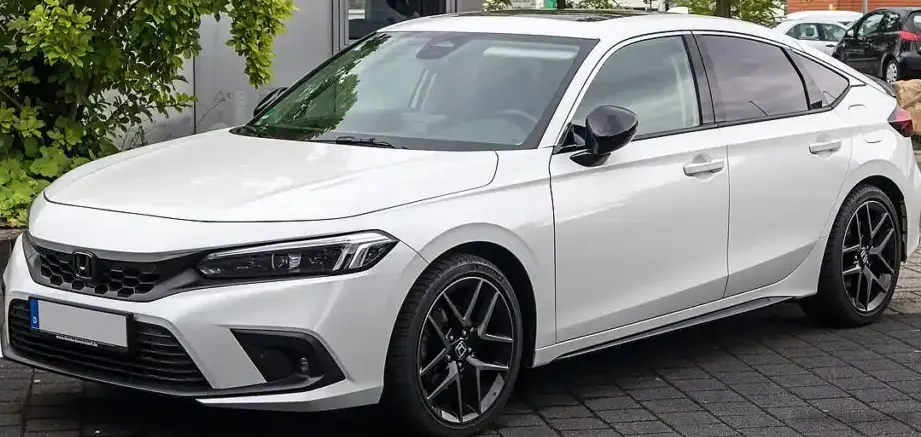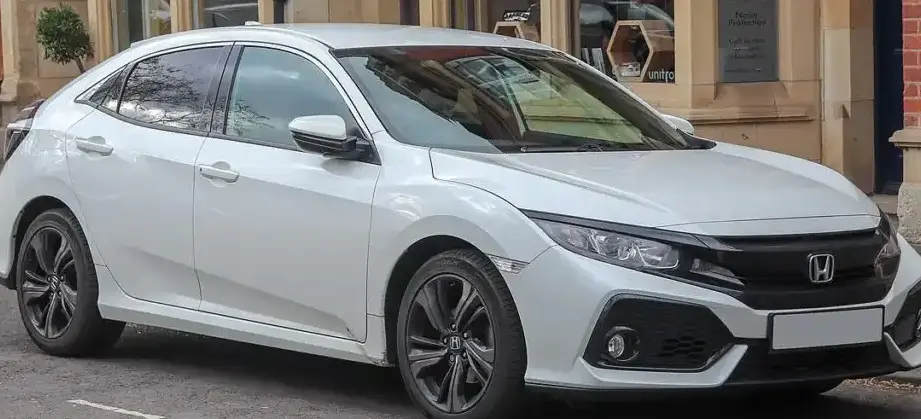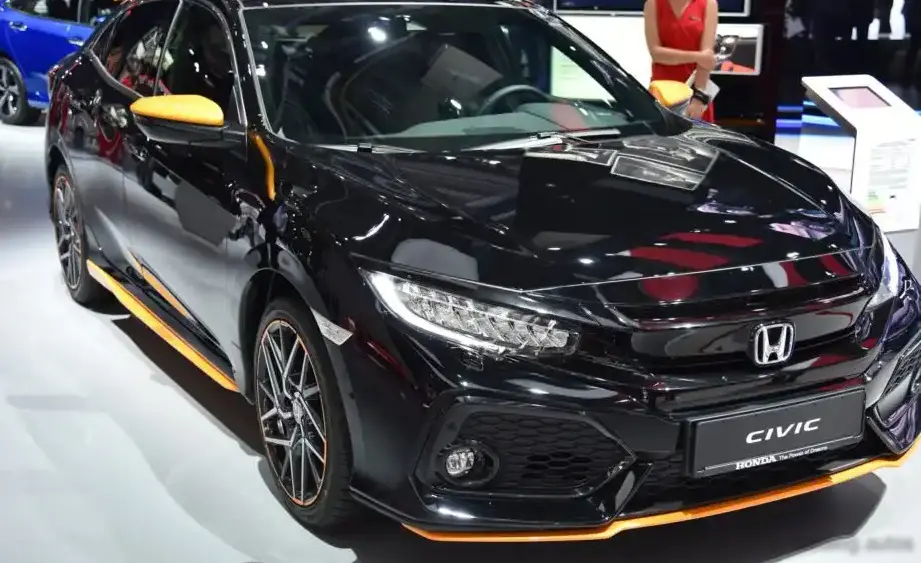
The Honda Civic X Hatchback 1.0 VTEC (129 Hp) CVT Turbo, produced from 2017 to 2019, represented an entry point into the tenth-generation Civic Hatchback lineup. Positioned as a fuel-efficient and accessible option, it catered to buyers prioritizing economy and practicality within the broader Civic range, which also included more powerful 1.5L Turbo and performance-oriented Si models. This variant was primarily marketed in Europe and other global markets where smaller displacement engines were favored, offering a balance between performance and fuel efficiency. It utilized Honda’s Earth Dreams technology to maximize efficiency and minimize emissions.
Technical Specifications
| Brand | Honda |
| Model | Civic |
| Generation | Civic X Hatchback |
| Type (Engine) | 1.0 VTEC (129 Hp) CVT Turbo |
| Start of production | 2017 |
| End of production | 2019 |
| Powertrain Architecture | Internal Combustion engine |
| Body type | Hatchback |
| Seats | 5 |
| Doors | 5 |
| Fuel consumption at Low speed (WLTP) | 7.6-7.8 l/100 km (30.9 – 30.2 US mpg) |
| Fuel consumption at Medium speed (WLTP) | 6.1-6.3 l/100 km (38.6 – 37.3 US mpg) |
| Fuel consumption at high speed (WLTP) | 5.3-5.8 l/100 km (44.4 – 40.6 US mpg) |
| Fuel consumption at very high speed (WLTP) | 6.2-7.1 l/100 km (37.9 – 33.1 US mpg) |
| Combined fuel consumption (WLTP) | 6.1-6.6 l/100 km (38.6 – 35.6 US mpg) |
| CO2 emissions (WLTP) | 107-110 g/km |
| Fuel consumption (economy) – urban | 5.7 l/100 km (41.3 US mpg) |
| Fuel consumption (economy) – extra urban | 4.6 l/100 km (51.1 US mpg) |
| Fuel consumption (economy) – combined | 5 l/100 km (47 US mpg) |
| CO2 emissions | 114 g/km |
| Fuel Type | Petrol (Gasoline) |
| Acceleration 0 – 100 km/h | 10.8 sec |
| Acceleration 0 – 62 mph | 10.8 sec |
| Acceleration 0 – 60 mph | 10.3 sec |
| Maximum speed | 200 km/h (124.27 mph) |
| Emission standard | Euro 6 |
| Weight-to-power ratio | 9.4 kg/Hp |
| Weight-to-torque ratio | 6.7 kg/Nm |
| Power | 129 Hp @ 5500 rpm |
| Torque | 180 Nm @ 1700-4500 rpm (132.76 lb.-ft. @ 1700-4500 rpm) |
| Engine layout | Front, Transverse |
| Engine Model/Code | P10A2 |
| Engine displacement | 988 cm3 (60.29 cu. in.) |
| Number of cylinders | 3 |
| Engine configuration | Inline |
| Cylinder Bore | 73 mm (2.87 in.) |
| Piston Stroke | 78.7 mm (3.1 in.) |
| Compression ratio | 10:1 |
| Number of valves per cylinder | 4 |
| Fuel injection system | Direct injection |
| Engine aspiration | Turbocharger, Intercooler |
| Valvetrain | DOHC |
| Engine oil capacity | 3.8 l (4.02 US qt | 3.34 UK qt) |
| Coolant | 5.9 l (6.23 US qt | 5.19 UK qt) |
| Kerb Weight | 1209 kg (2665.39 lbs.) |
| Max. weight | 1775 kg (3913.21 lbs.) |
| Max load | 566 kg (1247.82 lbs.) |
| Trunk (boot) space – minimum | 478 l (16.88 cu. ft.) |
| Trunk (boot) space – maximum | 1267 l (44.74 cu. ft.) |
| Fuel tank capacity | 46 l (12.15 US gal | 10.12 UK gal) |
| Max. roof load | 45 kg (99.21 lbs.) |
| Permitted trailer load with brakes (12%) | 800 kg (1763.7 lbs.) |
| Permitted trailer load without brakes | 500 kg (1102.31 lbs.) |
| Permitted towbar download | 75 kg (165.35 lbs.) |
| Length | 4518 mm (177.87 in.) |
| Width | 1799 mm (70.83 in.) |
| Width including mirrors | 2076 mm (81.73 in.) |
| Height | 1434 mm (56.46 in.) |
| Wheelbase | 2697 mm (106.18 in.) |
| Front track | 1547 mm (60.91 in.) |
| Rear (Back) track | 1565 mm (61.61 in.) |
| Ride height (ground clearance) | 129 mm (5.08 in.) |
| Minimum turning circle (turning diameter) | 11.8 m (38.71 ft.) |
| Drivetrain Architecture | The Internal combustion engine (ICE) drives the front wheels of the vehicle. |
| Drive wheel | Front wheel drive |
| Number of gears and type of gearbox | automatic transmission CVT |
| Front suspension | Independent type McPherson |
| Rear suspension | Independent multi-link suspension |
| Front brakes | Ventilated discs |
| Rear brakes | Disc |
| Assisting systems | ABS (Anti-lock braking system) |
| Steering type | Steering rack and pinion |
| Power steering | Electric Steering |
| Tires size | 235/45 R17 |
| Wheel rims size | 7J x 17 |
Powertrain & Engine Architecture
The heart of this Civic Hatchback variant is the P10A2 1.0-liter turbocharged inline-three cylinder engine. This engine is part of Honda’s Earth Dreams series, designed for high thermal efficiency and reduced friction. It features direct injection, a single-scroll turbocharger, and a variable valve timing and lift electronic control (VTEC) system. The VTEC system optimizes valve timing for both low-end torque and high-end power. The engine produces 129 horsepower at 5,500 rpm and 180 Nm (132.76 lb.-ft.) of torque between 1,700 and 4,500 rpm. This power is delivered to the front wheels through a continuously variable transmission (CVT). The CVT is programmed for smooth acceleration and fuel efficiency, prioritizing comfort over sporty responsiveness.
Driving Characteristics
The 1.0L Turbo CVT combination delivers adequate performance for everyday driving. Acceleration from 0-60 mph takes approximately 10.3 seconds, and the top speed is 124.27 mph. While not particularly quick, the engine provides sufficient power for merging onto highways and navigating city streets. The CVT, while smooth, can sometimes feel disconnected from the engine, resulting in a slight delay in response. Compared to the 1.5L Turbo models, the 1.0L feels noticeably less powerful, especially during overtaking maneuvers. However, the 1.0L offers a more relaxed driving experience, prioritizing fuel economy and refinement over outright performance. The CVT’s gear ratios are optimized for efficiency, keeping the engine in its optimal power band during cruising.
Equipment & Trim Levels
The 1.0 VTEC CVT Turbo typically came with a reasonable level of standard equipment. This included features like air conditioning, a touchscreen infotainment system with Apple CarPlay and Android Auto compatibility, Honda Sensing safety suite (including collision mitigation braking system, lane departure warning, and adaptive cruise control), and alloy wheels. Higher trim levels offered additional features such as a sunroof, heated front seats, and upgraded audio systems. Interior upholstery was typically cloth, with a functional and modern dashboard layout. Optional extras included navigation systems and premium paint colors.
Chassis & Braking
The Civic X Hatchback utilizes a MacPherson strut front suspension and a multi-link rear suspension, providing a comfortable and controlled ride. The suspension is tuned for everyday driving, offering a good balance between ride quality and handling. The front brakes are ventilated discs, while the rear brakes are solid discs. Anti-lock Braking System (ABS) is standard. The chassis is relatively lightweight, contributing to the car’s fuel efficiency and agility. Stabilizer bars are fitted to both the front and rear axles to reduce body roll during cornering.
Market Reception & Comparison
The 1.0 VTEC CVT Turbo Civic Hatchback was generally well-received by critics for its fuel efficiency and comfortable ride. However, some reviewers noted the engine’s lack of outright power and the CVT’s sometimes-sluggish response. Compared to the 1.5L Turbo models, the 1.0L offered a lower price point and better fuel economy, making it an attractive option for budget-conscious buyers. The 1.5L Turbo provided significantly more performance but came at a higher cost. In terms of reliability, the 1.0L engine has proven to be generally reliable, with few reported issues.
Legacy
The Honda Civic X Hatchback 1.0 VTEC CVT Turbo remains a popular choice in the used car market, particularly for those seeking a fuel-efficient and reliable hatchback. The engine’s relatively simple design and Honda’s reputation for build quality contribute to its long-term durability. While not a performance standout, it offers a practical and economical transportation solution. The combination of a small displacement engine and a CVT transmission has proven to be a reliable and efficient powertrain, making it a sensible choice for daily commuting and long-distance driving.