Technical Specifications
| Brand | Honda |
| Model | HR-V |
| Generation | HR-V II |
| Type (Engine) | 1.8 i-VTEC (141 Hp) CVT |
| Start of production | 2016 |
| End of production | 2018 |
| Powertrain Architecture | Internal Combustion engine |
| Body type | SUV, Crossover |
| Seats | 5 |
| Doors | 5 |
| Fuel consumption (urban) | 8.4 l/100 km (28 US mpg) |
| Fuel consumption (extra urban) | 6.9 l/100 km (34.1 US mpg) |
| Fuel consumption (combined) | 7.5 l/100 km (31.4 US mpg) |
| Fuel Type | Petrol (Gasoline) |
| Weight-to-power ratio | 9.3 kg/Hp |
| Weight-to-torque ratio | 7.7 kg/Nm |
| Power | 141 Hp @ 6500 rpm |
| Power per litre | 78.4 Hp/l |
| Torque | 172 Nm @ 4300 rpm (126.86 lb.-ft. @ 4300 rpm) |
| Maximum engine speed | 6700 rpm |
| Engine layout | Front, Transverse |
| Engine Model/Code | R18Z9 |
| Engine displacement | 1799 cm3 (109.78 cu. in.) |
| Number of cylinders | 4 |
| Engine configuration | Inline |
| Cylinder Bore | 81 mm (3.19 in.) |
| Piston Stroke | 87.3 mm (3.44 in.) |
| Compression ratio | 10.6:1 |
| Number of valves per cylinder | 4 |
| Fuel injection system | Multi-port manifold injection |
| Engine aspiration | Naturally aspirated engine |
| Valvetrain | SOHC i-VTEC |
| Engine oil capacity | 3.7 l (3.91 US qt | 3.26 UK qt) |
| Coolant capacity | 5.25 l (5.55 US qt | 4.62 UK qt) |
| Kerb Weight | 1316 kg (2901.28 lbs.) |
| Trunk (boot) space – minimum | 431 l (15.22 cu. ft.) |
| Trunk (boot) space – maximum | 1456 l (51.42 cu. ft.) |
| Fuel tank capacity | 50 l (13.21 US gal | 11 UK gal) |
| Length | 4294 mm (169.06 in.) |
| Width | 1772 mm (69.76 in.) |
| Width including mirrors | 2019 mm (79.49 in.) |
| Height | 1605 mm (63.19 in.) |
| Wheelbase | 2610 mm (102.76 in.) |
| Front track | 1535 mm (60.43 in.) |
| Rear track | 1540 mm (60.63 in.) |
| Ride height (ground clearance) | 170 mm (6.69 in.) |
| Minimum turning circle | 11.4 m (37.4 ft.) |
| Drivetrain Architecture | Front wheel drive |
| Number of gears and type of gearbox | automatic transmission CVT |
| Front suspension | Independent type McPherson |
| Rear suspension | Semi-independent, coil spring |
| Front brakes | Ventilated discs |
| Rear brakes | Disc |
| Tires size | 215/55 R17 94V |
| Wheel rims size | 17 |
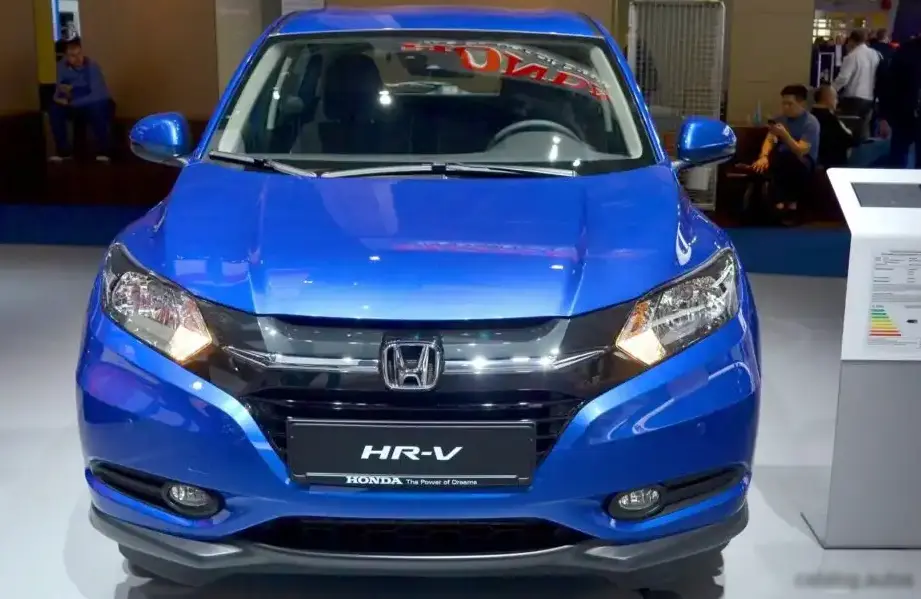
The Honda HR-V II 1.8 i-VTEC CVT, launched in 2016, was a significant model for Honda, particularly in markets outside of North America where the HR-V was offered as a more affordable and compact alternative to the CR-V. It represented the second generation of the HR-V nameplate, following a hiatus of nearly two decades since the original model was discontinued. This iteration was built on Honda’s Global Small Platform, a modular architecture designed to maximize interior space and efficiency. The 1.8L i-VTEC CVT variant served as a core trim level, offering a balance of practicality, fuel economy, and affordability, making it a popular choice for urban commuters and small families.
Powertrain & Engine Architecture
At the heart of the HR-V II 1.8 i-VTEC CVT lies Honda’s R18Z9 engine, a 1.8-liter inline-four cylinder gasoline engine. This engine utilizes Honda’s Intelligent Variable Valve Timing and Lift Electronic Control (i-VTEC) system, which optimizes valve timing and lift based on engine speed and load, improving both fuel efficiency and performance. The R18Z9 employs multi-point fuel injection and a naturally aspirated design, delivering 141 horsepower at 6500 rpm and 172 Nm (126.86 lb-ft) of torque at 4300 rpm. The engine is transversely mounted in the front of the vehicle. Paired with the engine is a Continuously Variable Transmission (CVT), designed to provide smooth, stepless gear changes and maximize fuel economy. Unlike traditional automatic transmissions with fixed gear ratios, the CVT utilizes a belt and pulley system to offer an infinite number of gear ratios within its operating range. This CVT was tuned for efficiency and comfort rather than outright performance.
Driving Characteristics
The 1.8L i-VTEC CVT powertrain delivers adequate performance for everyday driving scenarios. Acceleration is not particularly brisk, with a 0-60 mph time estimated around 9-10 seconds. The CVT contributes to a smooth and linear power delivery, but can sometimes feel less responsive than a traditional automatic or manual transmission, particularly during quick acceleration maneuvers. The CVT’s programming prioritizes fuel efficiency, which can result in the engine holding higher RPMs during acceleration to maintain optimal power output. Compared to potential higher-output engine options (not widely available in all markets), the 1.8L CVT version offers a more relaxed and fuel-conscious driving experience. The gear ratios are optimized for cruising and city driving, making it well-suited for urban environments.
Equipment & Trim Levels
The HR-V II 1.8 i-VTEC CVT typically came standard with a respectable array of features. Base models generally included air conditioning, power windows and locks, a basic audio system with Bluetooth connectivity, and a rearview camera. Higher trim levels, often denoted by designations like “EX” or “LX”, added features such as alloy wheels, a more advanced touchscreen infotainment system with Apple CarPlay and Android Auto compatibility, automatic climate control, and Honda’s LaneWatch blind spot display. Interior upholstery was typically cloth, with optional leather upgrades available on higher trims. Optional extras included a sunroof, navigation system, and premium audio systems.
Chassis & Braking
The HR-V II utilizes a front-wheel-drive configuration. The front suspension consists of independent MacPherson struts, while the rear suspension employs a semi-independent torsion beam setup. This suspension configuration provides a comfortable ride quality, although it’s not particularly sporty. Braking duties are handled by ventilated discs at the front and solid discs at the rear. Anti-lock Braking System (ABS) is standard, enhancing safety and control during emergency braking situations. The HR-V’s chassis was designed to prioritize space efficiency and practicality, resulting in a relatively compact footprint.
Market Reception & Comparison
The Honda HR-V II 1.8 i-VTEC CVT received generally positive reviews from automotive critics. It was praised for its spacious interior, versatile cargo area, and fuel efficiency. However, some critics noted the engine’s lack of outright power and the CVT’s sometimes uninspiring driving experience. Compared to other trims in the HR-V lineup, the 1.8L CVT version represented the most accessible entry point, offering a good balance of features and affordability. It was often compared to competitors such as the Mazda CX-3, Nissan Juke, and Kia Soul, all of which offered similar levels of practicality and fuel economy. The HR-V generally held an advantage in terms of interior space and Honda’s reputation for reliability.
Legacy
The Honda HR-V II 1.8 i-VTEC CVT has proven to be a reliable and durable powertrain. The R18Z9 engine is known for its longevity and relatively low maintenance costs. The CVT, while sometimes criticized for its driving characteristics, has also demonstrated good reliability when properly maintained. In the used car market, these HR-Vs are generally well-regarded for their practicality, fuel efficiency, and Honda’s reputation for build quality. They remain a popular choice for buyers seeking an affordable and reliable subcompact crossover SUV. Regular maintenance, including CVT fluid changes, is crucial to ensure the long-term health of the powertrain.