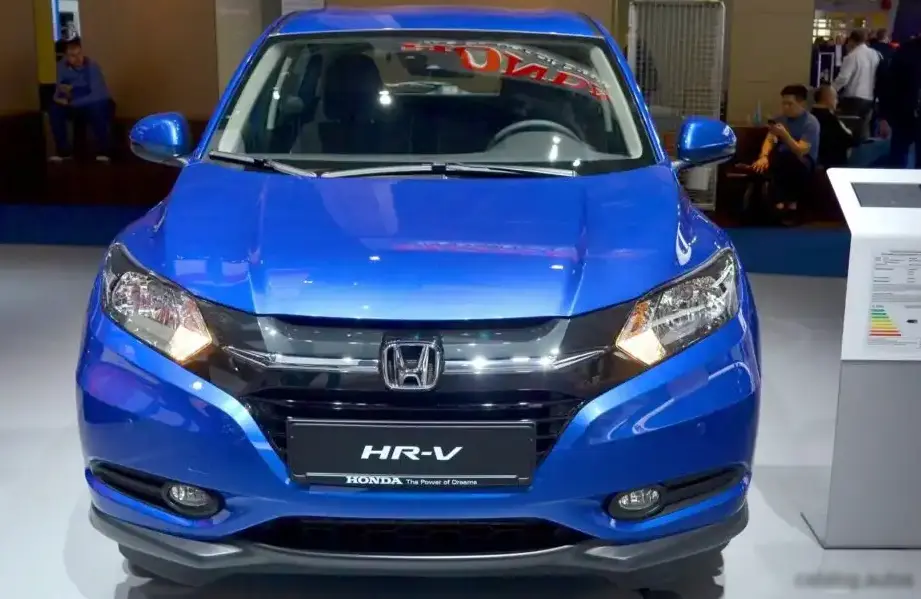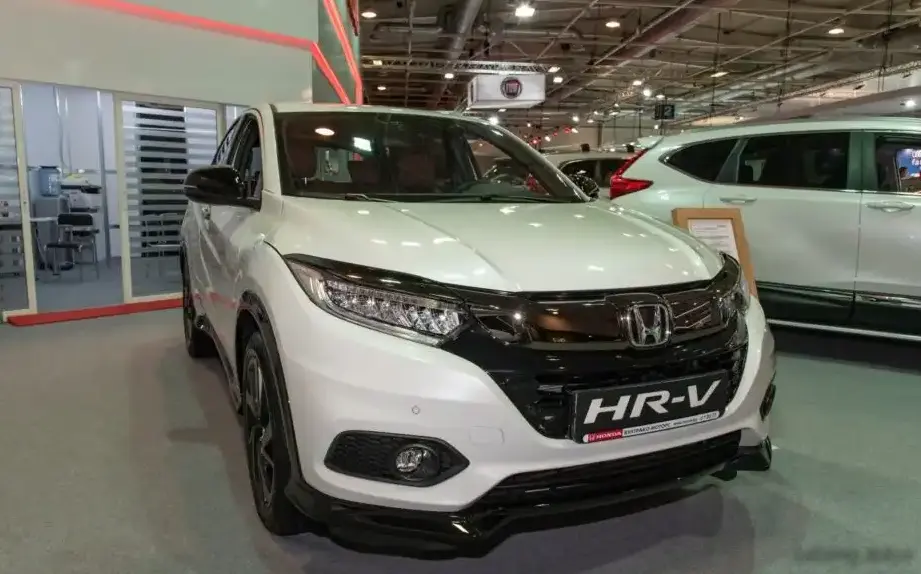
The Honda HR-V II Sport 1.5 VTEC TURBO, produced from 2019 to 2020, represents a performance-oriented variant within the second generation of Honda’s popular subcompact crossover SUV. Positioned as a step up from the base models, the Sport trim aimed to attract buyers seeking a more engaging driving experience without sacrificing the HR-V’s practicality and fuel efficiency. This facelifted version, introduced in 2018, brought styling updates and, crucially, the more powerful 1.5-liter turbocharged engine to the HR-V lineup. It primarily targeted the European and Asian markets, where smaller, fuel-efficient SUVs are highly sought after, though limited numbers were available in North America.
Technical Specifications
| Brand | Honda |
| Model | HR-V |
| Generation | HR-V II (facelift 2018) |
| Type (Engine) | Sport 1.5 VTEC TURBO (182 Hp) |
| Start of production | 2019 |
| End of production | 2020 |
| Powertrain Architecture | Internal Combustion engine |
| Body type | SUV, Crossover |
| Seats | 5 |
| Doors | 5 |
| Fuel consumption at Low speed (WLTP) | 8.2-8.4 l/100 km (28.7 – 28 US mpg, 34.4 – 33.6 UK mpg, 12.2 – 11.9 km/l) |
| Fuel consumption at Medium speed (WLTP) | 6.2-6.4 l/100 km (37.9 – 36.8 US mpg, 45.6 – 44.1 UK mpg, 16.1 – 15.6 km/l) |
| Fuel consumption at high speed (WLTP) | 5.7-5.9 l/100 km (41.3 – 39.9 US mpg, 49.6 – 47.9 UK mpg, 17.5 – 16.9 km/l) |
| Fuel consumption at very high speed (WLTP) | 7.0-7.2 l/100 km (33.6 – 32.7 US mpg, 40.4 – 39.2 UK mpg, 14.3 – 13.9 km/l) |
| Combined fuel consumption (WLTP) | 6.6-6.8 l/100 km (35.6 – 34.6 US mpg, 42.8 – 41.5 UK mpg, 15.2 – 14.7 km/l) |
| CO2 emissions (WLTP) | 130-132 g/km |
| CO2 emissions | 135 g/km |
| Fuel Type | Petrol (Gasoline) |
| Acceleration 0 – 100 km/h | 7.8 sec |
| Acceleration 0 – 62 mph | 7.8 sec |
| Acceleration 0 – 60 mph | 7.4 sec |
| Maximum speed | 215 km/h (133.59 mph) |
| Emission standard | Euro 6d-TEMP |
| Weight-to-power ratio | 7.4 kg/Hp, 135.7 Hp/tonne |
| Weight-to-torque ratio | 5.6 kg/Nm, 179 Nm/tonne |
| Power | 182 Hp @ 5500 rpm |
| Power per litre | 121.5 Hp/l |
| Torque | 240 Nm @ 1900 rpm (177.01 lb.-ft. @ 1900 rpm) |
| Engine layout | Front, Transverse |
| Engine Model/Code | L15BY |
| Engine displacement | 1498 cm3 (91.41 cu. in.) |
| Number of cylinders | 4 |
| Engine configuration | Inline |
| Cylinder Bore | 73 mm (2.87 in.) |
| Piston Stroke | 89.5 mm (3.52 in.) |
| Compression ratio | 10.6:1 |
| Number of valves per cylinder | 4 |
| Fuel injection system | Direct injection |
| Engine aspiration | Turbocharger, Intercooler |
| Engine oil capacity | 3.5 l (3.7 US qt | 3.08 UK qt) |
| Coolant | 5.75 l (6.08 US qt | 5.06 UK qt) |
| Kerb Weight | 1341-1349 kg (2956.4 – 2974.04 lbs.) |
| Trunk (boot) space – minimum | 448 l (15.82 cu. ft.) |
| Trunk (boot) space – maximum | 1043 l (36.83 cu. ft.) |
| Fuel tank capacity | 50 l (13.21 US gal | 11 UK gal) |
| Length | 4346 mm (171.1 in.) |
| Width including mirrors | 2019 mm (79.49 in.) |
| Height | 1605 mm (63.19 in.) |
| Wheelbase | 2610 mm (102.76 in.) |
| Minimum turning circle | 11.8 m (38.71 ft.) |
| Drivetrain Architecture | The Internal combustion engine (ICE) drives the front wheels of the vehicle. |
| Drive wheel | Front wheel drive |
| Number of gears and type of gearbox | 6 gears, manual transmission |
| Front suspension | Independent type McPherson |
| Rear suspension | Torsion |
| Front brakes | Ventilated discs, 293 mm |
| Rear brakes | Disc, 282 mm |
| Assisting systems | ABS (Anti-lock braking system) |
| Steering type | Steering rack and pinion |
| Power steering | Electric Steering |
| Tires size | 215/60 R16; 215/55 R17 |
| Wheel rims size | 16; 17 |
INTRODUCTION
The HR-V II Sport 1.5 VTEC TURBO, launched in 2019 following the 2018 facelift, built upon the success of the second-generation HR-V (RU series). The RU platform, also underpinning the Honda Civic, provided a solid foundation for a compact crossover. The “Sport” designation signified a focus on enhanced performance compared to the standard HR-V models, primarily through the adoption of the 1.5-liter turbocharged engine. This engine, part of Honda’s Earth Dreams Technology series, offered a significant power increase over the naturally aspirated engines available in other HR-V trims. The Sport trim was positioned as a mid-range offering, bridging the gap between the entry-level Comfort/S trims and potentially more luxurious (market dependent) versions.
Powertrain & Engine Architecture
The heart of the HR-V Sport is the L15BY 1.5-liter inline-four cylinder engine. This engine utilizes direct injection and a single-scroll turbocharger with an intercooler to deliver 182 horsepower at 5500 rpm and 240 Nm (177 lb-ft) of torque from as low as 1900 rpm. The engine features Honda’s VTEC (Variable Valve Timing and Lift Electronic Control) technology, optimizing valve timing for both low-end torque and high-end power. The engine’s architecture is relatively compact, contributing to the HR-V’s efficient packaging. The 6-speed manual transmission was standard, providing drivers with a more connected driving experience. The fuel injection system is a multi-point direct injection system, ensuring precise fuel delivery and efficient combustion.
Driving Characteristics
The 1.5-liter turbo engine significantly altered the driving experience compared to the naturally aspirated HR-V models. The readily available torque at low engine speeds made everyday driving and overtaking maneuvers much easier. While not a sports car, the Sport trim offered a noticeable improvement in acceleration, achieving a 0-60 mph time of around 7.4 seconds. The 6-speed manual transmission allowed for precise gear selection and enhanced driver control. Compared to the CVT-equipped versions, the manual offered a more engaging and responsive feel. The gear ratios were tuned to balance acceleration and fuel efficiency, with a relatively tall sixth gear for highway cruising. The suspension, while generally comfortable, was slightly firmer in the Sport trim to provide better body control during cornering.
Equipment & Trim Levels
The HR-V Sport typically included a range of standard features designed to enhance both comfort and convenience. These often included alloy wheels (typically 17-inch), a leather-wrapped steering wheel, sport seats with unique upholstery, and a touchscreen infotainment system with smartphone integration (Apple CarPlay and Android Auto). Additional features could include automatic climate control, a rearview camera, and Honda’s suite of safety technologies, such as collision mitigation braking system and lane departure warning. Optional extras often included a sunroof, upgraded audio system, and navigation system.
Chassis & Braking
The HR-V Sport utilized a front-wheel-drive configuration with an independent McPherson strut suspension in the front and a torsion beam suspension in the rear. The front brakes were ventilated discs measuring 293mm, while the rear brakes were solid discs measuring 282mm. The braking system was equipped with ABS (Anti-lock Braking System) and EBD (Electronic Brakeforce Distribution) for enhanced safety. The chassis was designed to provide a balance between ride comfort and handling agility. The Sport trim often featured slightly stiffer suspension components compared to the base models, improving body control and reducing body roll during cornering.
Market Reception & Comparison
The HR-V Sport was generally well-received by automotive critics, who praised its improved performance and engaging driving dynamics. The turbocharged engine was a significant upgrade over the naturally aspirated options, providing a more enjoyable driving experience. Fuel economy remained competitive, making it an attractive option for buyers seeking both performance and efficiency. Compared to the standard HR-V models, the Sport trim offered a more premium feel and a sportier driving experience. However, some critics noted that the interior materials were still somewhat basic, and the rear suspension could feel a bit harsh on rough roads. Compared to rivals like the Mazda CX-3 or Nissan Juke, the HR-V Sport offered a more spacious interior and a more practical cargo area.
Legacy
The L15BY engine, found in the HR-V Sport, has proven to be a relatively reliable powertrain. With proper maintenance, these engines can provide years of trouble-free service. Common issues, when they arise, often relate to the turbocharger or the direct injection system, but these are not widespread. On the used car market, the HR-V Sport commands a slightly higher price than the base models, reflecting its enhanced performance and features. Its combination of practicality, fuel efficiency, and engaging driving dynamics continues to make it a popular choice among buyers looking for a compact crossover SUV.