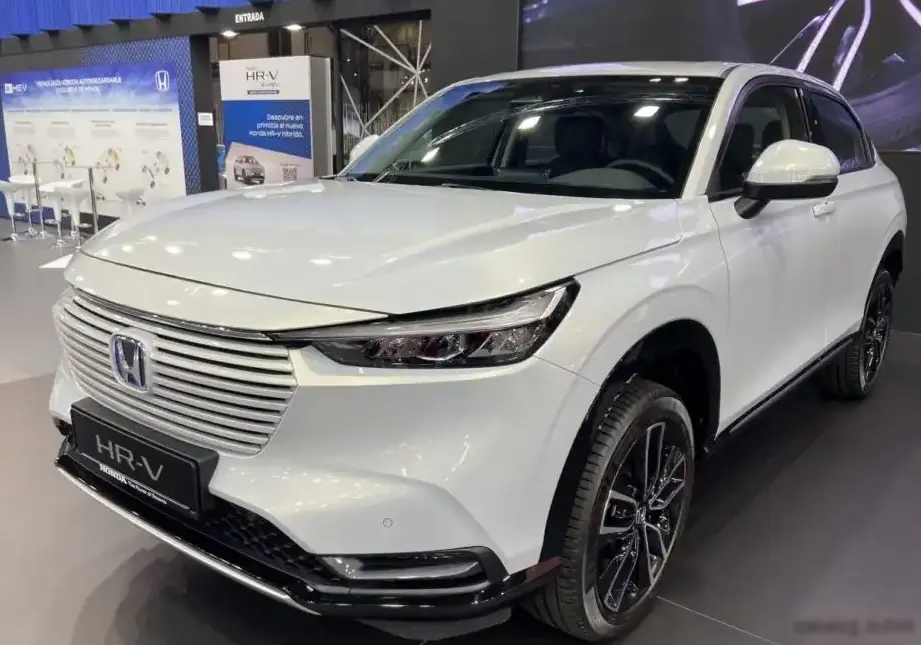
The Honda HR-V III 1.5 i-MMD (131 Hp) e:HEV e-CVT, produced from September 2021 to 2024, represents a significant evolution in Honda’s compact crossover offerings. This variant is part of the third generation HR-V (RU series), positioned as a key model within Honda’s European and Asian lineups, though increasingly available in North America. It distinguishes itself through its sophisticated hybrid powertrain, aiming to deliver a balance of fuel efficiency and everyday usability. The HR-V III moved away from the earlier, more utilitarian approach of previous generations, adopting a sleeker, more modern design and a more refined driving experience. This specific 1.5L hybrid configuration served as a core trim level, bridging the gap between more basic petrol-only models (where available) and potentially higher-spec, fully-equipped versions.
Technical Specifications
| Brand | Honda |
| Model | HR-V |
| Generation | HR-V III |
| Type (Engine) | 1.5 i-MMD (131 Hp) e:HEV e-CVT |
| Start of production | September, 2021 |
| End of production | 2024 |
| Powertrain Architecture | FHEV (Full Hybrid Electric Vehicle) |
| Body type | SUV, Crossover |
| Seats | 5 |
| Doors | 5 |
| Fuel consumption at Low speed (WLTP) | 4.6 l/100 km (51.1 US mpg, 61.4 UK mpg, 21.7 km/l) |
| Fuel consumption at Medium speed (WLTP) | 4.1 l/100 km (57.4 US mpg, 68.9 UK mpg, 24.4 km/l) |
| Fuel consumption at high speed (WLTP) | 4.6 l/100 km (51.1 US mpg, 61.4 UK mpg, 21.7 km/l) |
| Fuel consumption at very high speed (WLTP) | 7.1 l/100 km (33.1 US mpg, 39.8 UK mpg, 14.1 km/l) |
| Combined fuel consumption (WLTP) | 5.4 l/100 km (43.6 US mpg, 52.3 UK mpg, 18.5 km/l) |
| CO2 emissions (WLTP) | 122 g/km |
| Fuel consumption (economy) – urban (NEDC, WLTP equivalent) | 3.1 l/100 km (75.9 US mpg, 91.1 UK mpg, 32.3 km/l) |
| Fuel consumption (economy) – extra urban (NEDC, WLTP equivalent) | 4.8 l/100 km (49 US mpg, 58.9 UK mpg, 20.8 km/l) |
| Fuel consumption (economy) – combined (NEDC, WLTP equivalent) | 4.2 l/100 km (56 US mpg, 67.3 UK mpg, 23.8 km/l) |
| CO2 emissions (NEDC, WLTP equivalent) | 96 g/km |
| Fuel Type | Petrol (Gasoline) |
| Acceleration 0 – 100 km/h | 10.6 sec |
| Acceleration 0 – 62 mph | 10.6 sec |
| Acceleration 0 – 60 mph | 10.1 sec |
| Maximum speed | 170 km/h (105.63 mph) |
| Emission standard | Euro 6d |
| Weight-to-power ratio | 10.5 kg/Hp, 94.9 Hp/tonne |
| Weight-to-torque ratio | 10.5 kg/Nm, 94.9 Nm/tonne |
| Battery voltage | 216 V |
| Battery technology | Lithium-ion (Li-Ion) |
| Battery location | Under the trunk |
| Electric motor power | 131 Hp |
| Electric motor Torque | 253 Nm (186.6 lb.-ft.) |
| Electric motor location | Integrated into the transmission |
| System power | 131 Hp |
| Power | 107 Hp @ 6000-6400 rpm |
| Power per litre | 71.4 Hp/l |
| Torque | 131 Nm @ 4500-5000 rpm (96.62 lb.-ft. @ 4500-5000 rpm) |
| Engine layout | Front, Transverse |
| Engine Model/Code | LEC3 |
| Engine displacement | 1498 cm3 (91.41 cu. in.) |
| Number of cylinders | 4 |
| Engine configuration | Inline |
| Cylinder Bore | 73 mm (2.87 in.) |
| Piston Stroke | 89.5 mm (3.52 in.) |
| Compression ratio | 13.5:1 |
| Number of valves per cylinder | 4 |
| Fuel injection system | Multi-port manifold injection |
| Engine aspiration | Naturally aspirated engine |
| Valvetrain | DOHC, i-VTEC |
| Engine oil capacity | 3.6 l (3.8 US qt | 3.17 UK qt) |
| Coolant | 4.22 l (4.46 US qt | 3.71 UK qt) |
| Kerb Weight | 1380-1401 kg (3042.38 – 3088.68 lbs.) |
| Max. weight | 1870 kg (4122.64 lbs.) |
| Max load | 469-490 kg (1033.97 – 1080.27 lbs.) |
| Trunk (boot) space – minimum | 319 l (11.27 cu. ft.) |
| Trunk (boot) space – maximum | 1305 l (46.09 cu. ft.) |
| Fuel tank capacity | 40 l (10.57 US gal | 8.8 UK gal) |
| Max. roof load | 50 kg (110.23 lbs.) |
| Length | 4340 mm (170.87 in.) |
| Width | 1790 mm (70.47 in.) |
| Width with mirrors folded | 1866 mm (73.46 in.) |
| Width including mirrors | 2028 mm (79.84 in.) |
| Height | 1582 mm (62.28 in.) |
| Wheelbase | 2610 mm (102.76 in.) |
| Front track | 1535 mm (60.43 in.) |
| Rear (Back) track | 1540 mm (60.63 in.) |
| Ride height (ground clearance) | 188 mm (7.4 in.) |
| Minimum turning circle (turning diameter) | 11.3 m (37.07 ft.) |
| Drivetrain Architecture | The Internal combustion engine (ICE) and electric motor drive the front wheels of the car with the ability to work in full electric or mixed mode. |
| Drive wheel | Front wheel drive |
| Number of gears and type of gearbox | automatic transmission e-CVT |
| Front suspension | Independent, type McPherson with coil spring and anti-roll bar |
| Rear suspension | Semi-independent, coil spring |
| Front brakes | Ventilated discs, 293 mm |
| Rear brakes | Disc, 282 mm |
| Assisting systems | ABS (Anti-lock braking system) |
| Steering type | Steering rack and pinion |
| Power steering | Electric Steering |
| Tires size | 225/50 R18 |
| Wheel rims size | 7.5J x 18 |
INTRODUCTION
The Honda HR-V III 1.5 i-MMD e:HEV e-CVT, launched in September 2021, represents Honda’s commitment to hybrid technology within the popular compact SUV segment. Built on the global Honda Small Car platform, it shares its underpinnings with other Honda models like the Civic. This iteration of the HR-V aimed to appeal to a broader audience with its more sophisticated styling and improved interior space. The ‘i-MMD’ designation stands for Intelligent Multi-Mode Drive, referring to Honda’s two-motor hybrid system. This powertrain prioritizes fuel efficiency and a smooth driving experience, making it a popular choice in markets where fuel costs are high and emissions regulations are stringent. The e-CVT (electronic Continuously Variable Transmission) further enhances this smoothness, offering seamless acceleration without traditional gear changes.
Powertrain & Engine Architecture
At the heart of the HR-V III 1.5 i-MMD is Honda’s LEC3 1.5-liter naturally aspirated inline-four cylinder engine. This engine, producing 107 horsepower at 6000-6400 rpm and 131 Nm (96.62 lb-ft) of torque at 4500-5000 rpm, is not directly connected to the wheels. Instead, it functions primarily as a generator, powering the electric motor. The engine utilizes multi-point fuel injection and Honda’s i-VTEC variable valve timing system for optimized efficiency and performance. The electric motor, delivering 131 horsepower and 253 Nm (186.6 lb-ft) of torque, is the primary driver of the vehicle. The e-CVT, a single-speed transmission, seamlessly blends power from the engine and motor, providing a continuously variable gear ratio. The system intelligently switches between EV mode (electric only), Hybrid Drive mode (engine generates electricity, motor drives the wheels), and Engine Drive mode (engine directly drives the wheels at higher speeds) depending on driving conditions and battery charge. The 216V lithium-ion battery is located under the trunk floor.
Driving Characteristics
The 1.5L i-MMD e:HEV e-CVT HR-V offers a distinctly different driving experience compared to versions equipped with traditional automatic transmissions or, where available, manual gearboxes. Acceleration from 0-60 mph takes approximately 10.1 seconds, and 0-100 km/h in 10.6 seconds, which is adequate for everyday driving but not particularly sporty. The e-CVT provides smooth, linear acceleration, lacking the stepped gear changes of a conventional automatic. The electric motor provides instant torque, making city driving effortless. During highway cruising, the engine often operates as a generator, maintaining battery charge and assisting the electric motor. While the engine can sometimes be heard during hard acceleration, the overall experience is quiet and refined. The focus is clearly on efficiency and comfort rather than outright performance. Compared to higher-output engine options (if offered in certain markets), this variant prioritizes fuel economy over spirited driving.
Equipment & Trim Levels
The 1.5 i-MMD e:HEV e-CVT trim typically represents a mid-range offering within the HR-V III lineup. Standard features generally include automatic climate control, a touchscreen infotainment system with Apple CarPlay and Android Auto compatibility, Honda Sensing suite of safety features (including adaptive cruise control, lane keeping assist, and collision mitigation braking system), and alloy wheels. Interior upholstery is typically cloth, with options for leather upgrades on higher trims. Optional extras often include a sunroof, upgraded audio system, and parking sensors. The dashboard layout is modern and minimalist, with a focus on ease of use. The HR-V III prioritizes interior space, offering ample headroom and legroom for passengers.
Chassis & Braking
The HR-V III utilizes a McPherson strut front suspension and a semi-independent coil spring rear suspension. This setup provides a comfortable ride quality, absorbing bumps and imperfections in the road effectively. The front brakes are ventilated discs measuring 293mm, while the rear brakes are solid discs measuring 282mm. ABS (Anti-lock Braking System) is standard, along with electronic brake-force distribution and brake assist. The steering is electric power-assisted, providing light and precise control. The vehicle’s weight, ranging from 1380-1401 kg (3042.38 – 3088.68 lbs.), is relatively moderate for its class, contributing to its manageable handling characteristics.
Market Reception & Comparison
The Honda HR-V III 1.5 i-MMD e:HEV e-CVT has been generally well-received by automotive critics, praised for its fuel efficiency, comfortable ride, and refined hybrid powertrain. Its combined fuel consumption of 5.4 l/100 km (43.6 US mpg) is competitive within the hybrid SUV segment. Compared to petrol-only versions of the HR-V, the hybrid offers significantly improved fuel economy, albeit at a slightly higher purchase price. Reliability is expected to be strong, consistent with Honda’s reputation for building durable vehicles. Some critics have noted the lack of a dedicated ‘sport’ mode and the somewhat uninspiring acceleration, but these are generally considered minor drawbacks given the vehicle’s primary focus on efficiency and practicality.
Legacy
The Honda HR-V III 1.5 i-MMD e:HEV e-CVT powertrain is expected to prove reliable in the long term, benefiting from Honda’s extensive experience with hybrid technology. The i-MMD system, while complex, has demonstrated durability in other Honda models. On the used car market, these HR-Vs are likely to hold their value well, particularly as demand for fuel-efficient vehicles continues to grow. The hybrid system’s components, including the battery, are covered by Honda’s warranty, providing peace of mind for potential buyers. This variant represents a key step in Honda’s electrification strategy, paving the way for future hybrid and electric models.