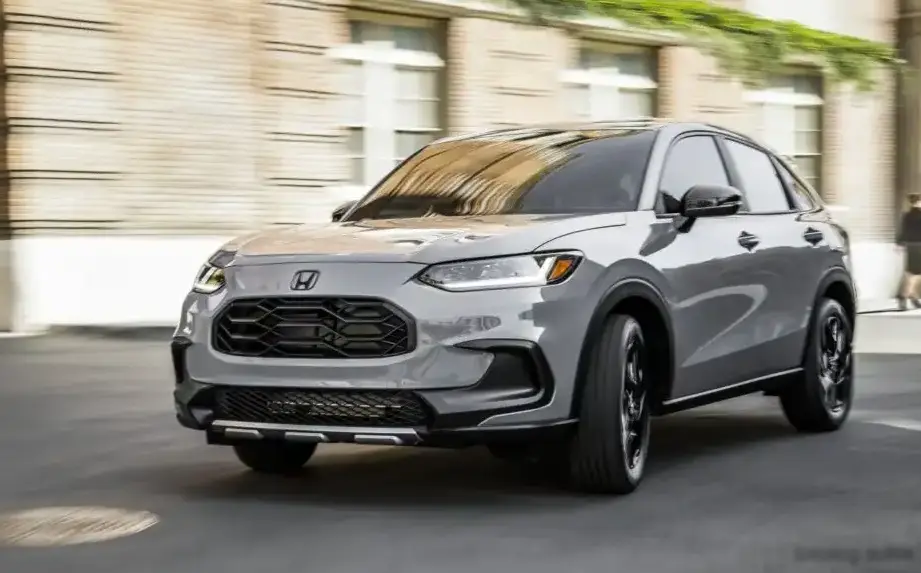
The Honda HR-V III 2.0 AWD CVT (USA) represents Honda’s entry into the compact crossover SUV market for the American consumer, launched in June 2022 and continuing through May 2025. This variant, positioned as a mid-range offering within the HR-V III lineup, aimed to balance fuel efficiency, practicality, and available technology. It builds upon the global HR-V platform (internally designated as the PG8) but with specific tuning and features tailored for the North American market. This generation marked a significant departure from its predecessor, adopting a more conventional SUV silhouette and focusing on a more refined driving experience.
Technical Specifications
| Brand | Honda |
| Model | HR-V |
| Generation | HR-V III |
| Type (Engine) | 2.0 (158 Hp) AWD CVT (USA) |
| Start of production | June, 2022 |
| End of production | May, 2025 |
| Powertrain Architecture | Internal Combustion engine |
| Body type | SUV, Crossover |
| Seats | 5 |
| Doors | 5 |
| Fuel consumption (economy) – urban | 9.4 l/100 km (25 US mpg) |
| Fuel consumption (economy) – extra urban | 7.8 l/100 km (30.2 US mpg) |
| Fuel consumption (economy) – combined | 8.7 l/100 km (27 US mpg) |
| Fuel Type | Petrol (Gasoline) |
| Emission standard | LEV3-SULEV30 |
| Weight-to-power ratio | 9.4 kg/Hp |
| Weight-to-torque ratio | 7.9 kg/Nm |
| Power | 158 Hp @ 6500 rpm |
| Power per litre | 79.2 Hp/l |
| Torque | 187 Nm @ 4200 rpm (137.92 lb.-ft. @ 4200 rpm) |
| Maximum engine speed | 6800 rpm |
| Engine layout | Front, Transverse |
| Engine Model/Code | K20Z5 |
| Engine displacement | 1996 cm3 (121.8 cu. in.) |
| Number of cylinders | 4 |
| Engine configuration | Inline |
| Cylinder Bore | 86 mm (3.39 in.) |
| Piston Stroke | 85.9 mm (3.38 in.) |
| Compression ratio | 10.8:1 |
| Number of valves per cylinder | 4 |
| Fuel injection system | Multi-port manifold injection |
| Engine aspiration | Naturally aspirated engine |
| Valvetrain | DOHC, VTEC, Dual VTC |
| Engine oil capacity | 4.2 l (4.44 US qt | 3.7 UK qt) |
| Coolant | 5.93 l (6.27 US qt | 5.22 UK qt) |
| Kerb Weight | 1486-1512 kg (3276.07 – 3333.39 lbs.) |
| Trunk (boot) space – minimum | 691 l (24.4 cu. ft.) |
| Trunk (boot) space – maximum | 1560 l (55.09 cu. ft.) |
| Fuel tank capacity | 53 l (14 US gal | 11.66 UK gal) |
| Length | 4567 mm (179.8 in.) |
| Width | 1839 mm (72.4 in.) |
| Height | 1610-1621 mm (63.39 – 63.82 in.) |
| Wheelbase | 2654 mm (104.49 in.) |
| Front track | 1590 mm (62.6 in.) |
| Rear (Back) track | 1605 mm (63.19 in.) |
| Ride height (ground clearance) | 178-185 mm (7.01 – 7.28 in.) |
| Minimum turning circle (turning diameter) | 10.7-11.3 m (35.1 – 37.07 ft.) |
| Front brakes | Ventilated discs, 312.42 mm |
| Rear brakes | Disc, 309.88 mm |
| Drive wheel | All wheel drive (4×4) |
| Number of gears and type of gearbox | automatic transmission CVT |
| Tires size | 215/60 R17 96H; 225/55 R18 98H |
| Wheel rims size | 17; 18 |
INTRODUCTION
The 2022-2025 Honda HR-V III 2.0 AWD CVT (USA) represents a significant redesign for Honda’s popular subcompact crossover. Replacing the previous generation’s somewhat quirky design and limited rear passenger space, the HR-V III adopted a more mature and conventional aesthetic. The 2.0-liter engine paired with a continuously variable transmission (CVT) and all-wheel drive was a key configuration, offering a balance of performance and efficiency for a broad range of buyers. This model aimed to compete directly with vehicles like the Mazda CX-5, Toyota Corolla Cross, and Hyundai Kona.
Powertrain & Engine Architecture
At the heart of the HR-V 2.0 AWD CVT lies the K20Z5 engine, a 1.996-liter (121.8 cubic inch) inline-four cylinder naturally aspirated gasoline engine. This engine utilizes Honda’s i-VTEC (Variable Valve Timing and Lift Electronic Control) system, along with Dual VTC (Variable Timing Control) on both intake and exhaust camshafts, to optimize performance and fuel efficiency across the rev range. Fuel delivery is managed by a multi-point fuel injection system. The engine produces 158 horsepower at 6,500 rpm and 138 lb-ft of torque at 4,200 rpm. The engine is transversely mounted in the front of the vehicle.
The powertrain is completed by a CVT (Continuously Variable Transmission). Unlike traditional automatic transmissions with fixed gear ratios, a CVT uses a belt and pulley system to provide a virtually infinite number of gear ratios, optimizing engine speed for efficiency or power. The all-wheel-drive system is a reactive system, primarily driving the front wheels but engaging the rear wheels when front wheel slip is detected. This system utilizes an electronically controlled clutch to distribute torque between the front and rear axles.
Driving Characteristics
The 2.0-liter engine and CVT combination delivers adequate, though not exhilarating, performance. Acceleration is linear and predictable, suitable for everyday commuting and highway merging. The CVT minimizes harsh shifts, providing a smooth driving experience. However, it can sometimes exhibit “rubber band” feel, where engine RPMs rise quickly under acceleration without a corresponding increase in speed. Compared to the available manual transmission on some HR-V trims, the CVT prioritizes fuel economy over sporty driving dynamics. The AWD system provides enhanced traction in inclement weather conditions, but doesn’t transform the HR-V into an off-road vehicle.
Equipment & Trim Levels
The 2.0 AWD CVT trim typically included standard features such as a 7-inch touchscreen infotainment system with Apple CarPlay and Android Auto compatibility, LED headlights, a rearview camera, and Honda Sensing suite of safety features (including adaptive cruise control, lane keeping assist, and automatic emergency braking). Higher trim levels added features like a larger touchscreen, upgraded audio system, heated front seats, and a sunroof. Interior upholstery was typically cloth, with available upgrades to leather in higher trims. The dashboard layout was clean and modern, prioritizing ease of use.
Chassis & Braking
The HR-V III utilizes an independent McPherson strut front suspension and an independent multi-link rear suspension. This setup provides a comfortable ride quality, absorbing bumps and irregularities in the road surface effectively. Stabilizer bars are included on both axles to reduce body roll during cornering. Braking duties are handled by ventilated discs at the front and solid discs at the rear. The HR-V is equipped with ABS (Anti-lock Braking System), electronic brake-force distribution, and brake assist. The electric power steering provides light and precise steering feel.
Market Reception & Comparison
The HR-V III 2.0 AWD CVT was generally well-received by automotive critics. Praise was given for its improved interior space, comfortable ride, and standard safety features. However, some reviewers noted the engine’s lack of outright power and the CVT’s sometimes uninspiring driving experience. Fuel economy was considered competitive within its class, averaging around 27 mpg combined. Compared to the 1.5-liter turbocharged engine offered in some international markets, the 2.0-liter engine prioritized reliability and lower maintenance costs over peak performance. The AWD system was a significant selling point for buyers in regions with harsh winters.
Legacy
The Honda HR-V III 2.0 AWD CVT has established itself as a reliable and practical choice in the used car market. The K20Z5 engine is known for its durability and relatively low maintenance requirements. While the CVT requires regular fluid changes, it has proven to be a generally dependable unit. As of 2024, these models represent a good value proposition for buyers seeking a fuel-efficient, well-equipped, and all-weather capable compact crossover SUV. Its continued presence in the used car market demonstrates its enduring appeal and Honda’s reputation for building long-lasting vehicles.