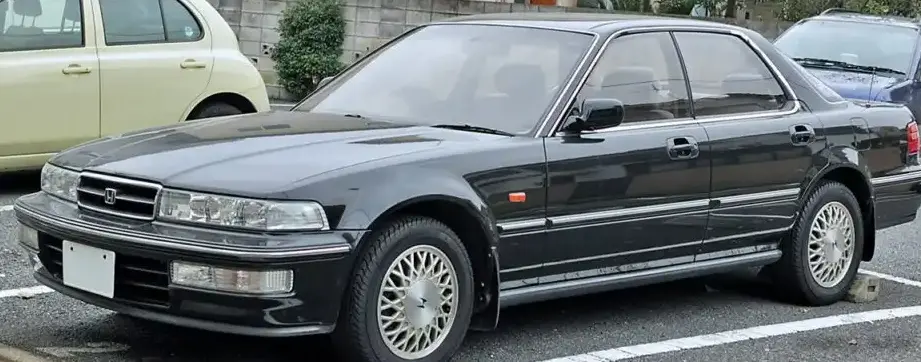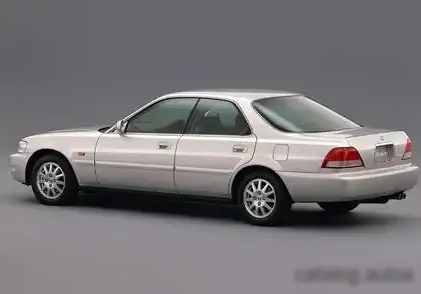
The Honda Inspire II, specifically the 2.0 i 20V G variant with an automatic transmission, was produced between February 1995 and September 1998. This model, designated chassis codes UA1, UA2, and UA3, represented Honda’s offering in the Japanese mid-size sedan segment, positioned as a more upscale and comfortable alternative to the Accord. The Inspire II aimed to provide a refined driving experience with a focus on interior space and features, catering to a market that valued practicality and a degree of luxury. This 2.0L automatic configuration occupied a middle ground within the Inspire II lineup, offering a balance between performance and fuel efficiency compared to the base models and the potentially available V6 options.
Technical Specifications
| Brand | Honda |
| Model | Inspire |
| Generation | Inspire II (UA1/UA2/UA3) |
| Type (Engine) | 2.0 i 20V G (160 Hp) Automatic |
| Start of production | February, 1995 |
| End of production | September, 1998 |
| Powertrain Architecture | Internal Combustion engine |
| Body type | Sedan |
| Seats | 5 |
| Doors | 4 |
| Fuel consumption (combined) | 9.3 l/100 km (25.3 US mpg, 30.4 UK mpg, 10.8 km/l) |
| Fuel Type | Petrol (Gasoline) |
| Weight-to-power ratio | 8.6 kg/Hp, 116.8 Hp/tonne |
| Weight-to-torque ratio | 7.4 kg/Nm, 135.8 Nm/tonne |
| Power | 160 Hp @ 6700 rpm |
| Power per litre | 80.2 Hp/l |
| Torque | 186 Nm @ 4000 rpm (137.19 lb.-ft. @ 4000 rpm) |
| Engine layout | Front, Longitudinal |
| Engine Model/Code | G20A |
| Engine displacement | 1996 cm3 (121.8 cu. in.) |
| Number of cylinders | 5 |
| Engine configuration | Inline |
| Cylinder Bore | 82 mm (3.23 in.) |
| Piston Stroke | 75.6 mm (2.98 in.) |
| Compression ratio | 9.3:1 |
| Number of valves per cylinder | 4 |
| Fuel injection system | Multi-port manifold injection |
| Engine aspiration | Naturally aspirated engine |
| Valvetrain | SOHC |
| Engine oil capacity | 5.2 l (5.49 US qt | 4.58 UK qt) |
| Kerb Weight | 1370 kg (3020.33 lbs.) |
| Fuel tank capacity | 65 l (17.17 US gal | 14.3 UK gal) |
| Length | 4840 mm (190.55 in.) |
| Width | 1785 mm (70.28 in.) |
| Height | 1405 mm (55.31 in.) |
| Wheelbase | 2840 mm (111.81 in.) |
| Front track | 1520 mm (59.84 in.) |
| Rear (Back) track | 1510 mm (59.45 in.) |
| Ride height (ground clearance) | 160 mm (6.3 in.) |
| Minimum turning circle (turning diameter) | 11 m (36.09 ft.) |
| Drivetrain Architecture | The Internal combustion engine (ICE) drives the front wheels of the vehicle. |
| Drive wheel | Front wheel drive |
| Number of gears and type of gearbox | 4 gears, automatic transmission |
| Front suspension | Double wishbone |
| Rear suspension | Double wishbone |
| Front brakes | Ventilated discs |
| Rear brakes | Disc |
| Assisting systems | ABS (Anti-lock braking system) |
| Steering type | Steering rack and pinion |
| Power steering | Hydraulic Steering |
| Tires size | 195/65 R15 |
| Wheel rims size | 6J x 15 |
Powertrain & Engine Architecture
The heart of the Inspire II 2.0 i was the G20A engine, a 1.996-liter inline-five cylinder gasoline engine. This engine utilized a single overhead camshaft (SOHC) valvetrain, operating 20 valves in total. The G20A featured multi-port fuel injection, delivering fuel directly to each cylinder for optimized combustion. The engine’s longitudinal mounting allowed for a front-wheel-drive configuration, a common layout for Japanese sedans of this era. The automatic transmission was a conventional four-speed unit, designed for smooth and comfortable shifts. While not a particularly advanced transmission by modern standards, it was well-suited to the engine’s power characteristics and the car’s intended purpose.
Driving Characteristics
The 160 horsepower and 186 Nm (137 lb-ft) of torque produced by the G20A engine, when paired with the four-speed automatic, resulted in a driving experience focused on refinement rather than outright performance. Acceleration was adequate for everyday driving, but noticeably slower than the manual transmission versions or potential V6 equipped models. The automatic transmission’s gear ratios were tuned for fuel efficiency and smooth cruising, meaning quick downshifts for overtaking required a deliberate push of the throttle. The Inspire II 2.0L automatic prioritized comfort and ease of use, making it a suitable choice for drivers who valued a relaxed driving experience over sporty handling.
Equipment & Trim Levels
The 2.0 i 20V G trim level typically included features such as power windows, power locks, air conditioning, and a basic audio system. Interior upholstery was generally cloth, with options for upgraded materials available. Depending on the specific package, features like alloy wheels, a sunroof, and upgraded audio systems could be added. The Inspire II aimed to offer a comfortable and well-equipped interior, with a focus on spaciousness for both front and rear passengers. The dashboard layout was functional and straightforward, prioritizing ease of use.
Chassis & Braking
The Inspire II utilized a double wishbone suspension system at both the front and rear, providing a comfortable ride quality. The front brakes were ventilated discs, offering good stopping power, while the rear brakes were solid discs. Anti-lock Braking System (ABS) was standard, enhancing safety by preventing wheel lockup during hard braking. The steering was rack and pinion with hydraulic power assistance, providing a light and responsive feel. The 195/65 R15 tires offered a good balance between ride comfort and handling.
Market Reception & Comparison
The Honda Inspire II 2.0 i Automatic was generally well-received in the Japanese market as a comfortable and reliable mid-size sedan. Critics praised its spacious interior, smooth ride, and fuel efficiency. However, some noted that the automatic transmission could feel somewhat sluggish compared to the manual options. Compared to the Accord, the Inspire II offered a more luxurious and refined experience, but at a slightly higher price point. Against competitors like the Toyota Camry and Nissan Cefiro, the Inspire II held its own with its comfortable ride and well-equipped interior.
Legacy
The Honda Inspire II, and specifically the 2.0 i 20V G automatic variant, has proven to be a relatively reliable vehicle over the long term. The G20A engine is known for its durability, and the four-speed automatic transmission, while not particularly sophisticated, is generally robust. In the used car market, these models are often sought after by enthusiasts who appreciate their comfortable ride, spacious interior, and classic Japanese styling. While parts availability may be becoming more challenging as the car ages, the Inspire II remains a viable option for those seeking a well-built and reliable mid-size sedan from the 1990s.