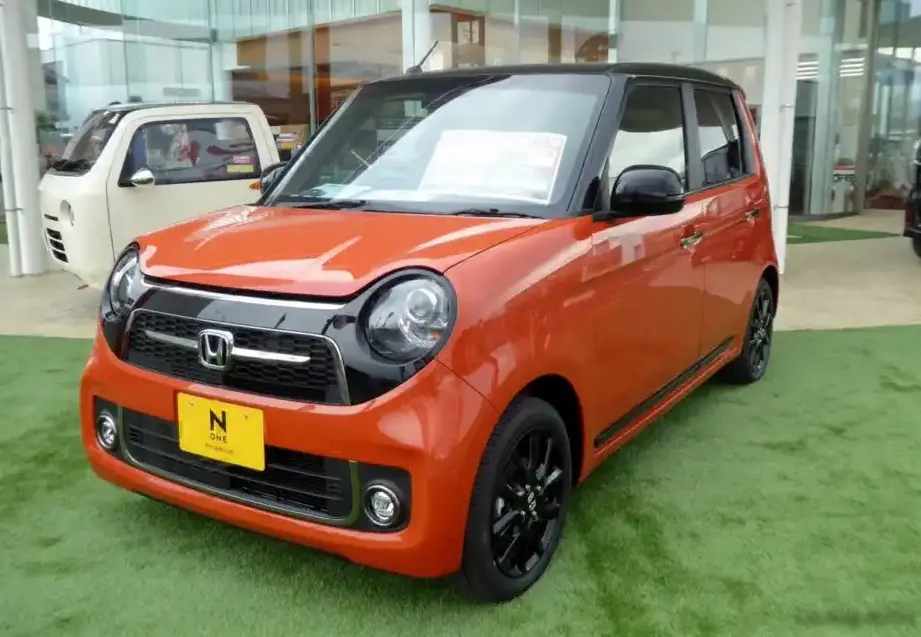
The Honda N-One II 0.7 T (64 hp) CVT is a kei car produced by Honda, representing the second generation of the N-One model. Introduced in 2020, this variant occupies the entry-level position within the N-One II lineup, offering a fuel-efficient and compact city car solution primarily targeted at the Japanese domestic market. The N-One series, known for its retro-inspired styling reminiscent of the original Honda N360, aims to provide practical transportation with a unique aesthetic appeal. This specific 0.7 T CVT model balances affordability with modern features, making it a popular choice for urban commuters.
Technical Specifications
| Brand | Honda |
| Model | N-One |
| Generation | N-One II |
| Type (Engine) | 0.7 T (64 Hp) CVT |
| Start of production | 2020 |
| Powertrain Architecture | Internal Combustion engine |
| Body type | Hatchback |
| Seats | 4 |
| Doors | 5 |
| Fuel consumption (urban) | 5.7 l/100 km (41.3 US mpg, 49.6 UK mpg, 17.5 km/l) |
| Fuel consumption (extra urban) | 4.3 l/100 km (54.7 US mpg, 65.7 UK mpg, 23.3 km/l) |
| Fuel Type | Petrol (Gasoline) |
| Weight-to-power ratio | 13.4 kg/Hp, 74.4 Hp/tonne |
| Weight-to-torque ratio | 8.3 kg/Nm, 120.9 Nm/tonne |
| Power | 64 Hp @ 6000 rpm |
| Power per litre | 97.3 Hp/l |
| Torque | 104 Nm @ 2600 rpm (76.71 lb.-ft. @ 2600 rpm) |
| Engine layout | Front, Transverse |
| Engine Model/Code | S07B |
| Engine displacement | 658 cm3 (40.15 cu. in.) |
| Number of cylinders | 3 |
| Engine configuration | Inline |
| Cylinder Bore | 60 mm (2.36 in.) |
| Piston Stroke | 77.6 mm (3.06 in.) |
| Compression ratio | 9.8:1 |
| Number of valves per cylinder | 4 |
| Fuel injection system | Multi-port manifold injection |
| Engine aspiration | Turbocharger, Intercooler |
| Valvetrain | DOHC |
| Kerb Weight | 860 kg (1895.98 lbs.) |
| Fuel tank capacity | 27 l (7.13 US gal | 5.94 UK gal) |
| Length | 3395 mm (133.66 in.) |
| Width | 1475 mm (58.07 in.) |
| Height | 1545 mm (60.83 in.) |
| Wheelbase | 2520 mm (99.21 in.) |
| Front track | 1295 mm (50.98 in.) |
| Rear track | 1295 mm (50.98 in.) |
| Ride height (ground clearance) | 135 mm (5.31 in.) |
| Minimum turning circle | 9.6 m (31.5 ft.) |
| Drivetrain Architecture | Front wheel drive |
| Drive wheel | Front wheel drive |
| Number of gears and type of gearbox | automatic transmission CVT |
| Front suspension | Independent type McPherson |
| Rear suspension | Torsion |
| Front brakes | Disc |
| Rear brakes | Drum |
| Assisting systems | ABS (Anti-lock braking system) |
| Steering type | Steering rack and pinion |
| Power steering | Electric Steering |
| Tires size | 165/55 R15 |
Powertrain & Engine Architecture
The N-One II 0.7 T utilizes Honda’s S07B engine, a 658cc inline-three cylinder petrol engine. This engine is turbocharged and intercooled, allowing it to produce a respectable 64 horsepower at 6000 rpm and 104 Nm (76.71 lb-ft) of torque at 2600 rpm for its displacement. The engine employs multi-point fuel injection and a double overhead camshaft (DOHC) valvetrain. The turbocharger is a key component, providing a boost in power and improving responsiveness, particularly at lower engine speeds. The engine is paired with a Continuously Variable Transmission (CVT), which prioritizes fuel efficiency and smooth acceleration over traditional stepped gear changes. This CVT is tuned for urban driving conditions, offering a seamless driving experience.
Driving Characteristics
The 0.7 T CVT variant of the N-One II delivers a comfortable and efficient driving experience, well-suited for city commuting. Acceleration is adequate for navigating urban traffic, but it’s not designed for rapid acceleration or highway cruising. The CVT contributes to a smooth, linear power delivery, although it can sometimes feel less engaging than a traditional automatic or manual transmission. The relatively low weight of the vehicle (860 kg) helps to offset the modest power output, providing acceptable performance in everyday driving situations. Compared to higher-spec N-One models with more powerful engines, this variant prioritizes fuel economy and ease of use over outright performance.
Equipment & Trim Levels
The base 0.7 T trim of the N-One II typically includes standard features such as air conditioning, power windows, power steering, and an audio system with USB connectivity. Safety features include ABS (Anti-lock Braking System) and airbags. Higher trim levels offer additional features like alloy wheels, a touchscreen infotainment system, and advanced safety technologies like Honda Sensing, a suite of driver-assistance systems. Interior upholstery is typically cloth, with a functional and durable design. Optional extras could include different exterior color options and upgraded audio systems.
Chassis & Braking
The N-One II features a front-engine, front-wheel-drive layout. The front suspension utilizes an independent McPherson strut setup, providing a comfortable ride and decent handling. The rear suspension employs a torsion beam, which is a cost-effective and space-saving solution. The braking system consists of disc brakes on the front wheels and drum brakes on the rear wheels. This configuration is typical for kei cars in this weight class. The steering is rack and pinion with electric power assistance, offering light and precise steering feel.
Market Reception & Comparison
The Honda N-One II 0.7 T CVT was generally well-received in the Japanese market as an affordable and practical city car. Critics praised its fuel efficiency, compact size, and retro-inspired styling. However, some reviewers noted that the engine could feel underpowered, especially when carrying passengers or cargo. Compared to other kei car options, such as the Suzuki Alto or Daihatsu Mira, the N-One II offered a more distinctive design and a slightly more refined driving experience. Its fuel economy figures of 5.7 l/100km urban and 4.3 l/100km extra-urban were competitive within the kei car segment.
Legacy
The Honda N-One II 0.7 T CVT, while not a performance-oriented vehicle, represents a significant offering in the kei car segment. Its reliable S07B engine and CVT transmission have proven to be durable and relatively maintenance-free. In the used car market, these models are sought after for their fuel efficiency, practicality, and unique styling. The N-One series as a whole has helped to revitalize the kei car market in Japan, appealing to a wider range of customers with its blend of retro charm and modern technology. The 0.7 T CVT variant remains a popular choice for those seeking an economical and easy-to-drive city car.