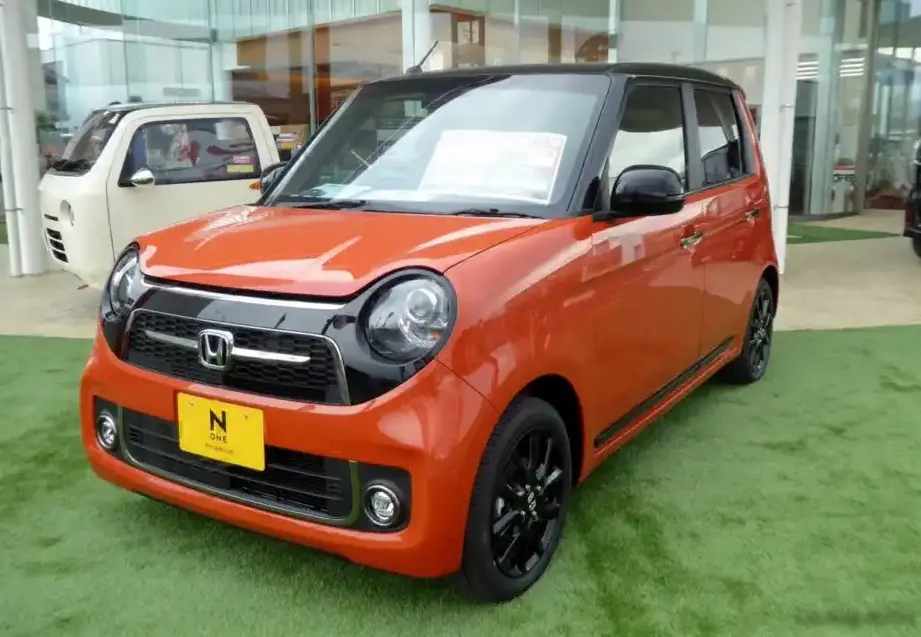
The Honda N-One II RS 0.7T (64 hp) is a Kei car produced by Honda, representing a continuation of the N-One model line introduced in 2012. Production of the second generation, the N-One II, began in 2020, with the RS 0.7T variant positioned as a sporty offering within the range. This model is exclusively sold in the Japanese domestic market (JDM), catering to the unique regulations and preferences of Japanese city driving. The N-One II aims to blend retro styling with modern technology and efficiency, appealing to a demographic seeking a compact and practical vehicle.
Technical Specifications
| Brand | Honda |
| Model | N-One |
| Generation | N-One II |
| Type (Engine) | RS 0.7 T (64 Hp) |
| Start of production | 2020 |
| Powertrain Architecture | Internal Combustion engine |
| Body type | Hatchback |
| Seats | 4 |
| Doors | 5 |
| Fuel consumption (urban) | 5.7 l/100 km (41.3 US mpg, 49.6 UK mpg) |
| Fuel consumption (extra urban) | 4.4 l/100 km (53.5 US mpg, 64.2 UK mpg) |
| Fuel Type | Petrol (Gasoline) |
| Weight-to-power ratio | 13.4 kg/Hp |
| Weight-to-torque ratio | 8.3 kg/Nm |
| Power | 64 Hp @ 6000 rpm |
| Power per litre | 97.3 Hp/l |
| Torque | 104 Nm @ 2600 rpm (76.71 lb.-ft. @ 2600 rpm) |
| Engine layout | Front, Transverse |
| Engine Model/Code | S07B |
| Engine displacement | 658 cm3 (40.15 cu. in.) |
| Number of cylinders | 3 |
| Engine configuration | Inline |
| Cylinder Bore | 60 mm (2.36 in.) |
| Piston Stroke | 77.6 mm (3.06 in.) |
| Compression ratio | 9.8:1 |
| Number of valves per cylinder | 4 |
| Fuel injection system | Multi-port manifold injection |
| Engine aspiration | Turbocharger, Intercooler |
| Valvetrain | DOHC |
| Kerb Weight | 860 kg (1895.98 lbs.) |
| Fuel tank capacity | 27 l (7.13 US gal | 5.94 UK gal) |
| Length | 3395 mm (133.66 in.) |
| Width | 1475 mm (58.07 in.) |
| Height | 1545 mm (60.83 in.) |
| Wheelbase | 2520 mm (99.21 in.) |
| Front track | 1295 mm (50.98 in.) |
| Rear track | 1295 mm (50.98 in.) |
| Ride height (ground clearance) | 140 mm (5.51 in.) |
| Minimum turning circle | 9.6 m (31.5 ft.) |
| Drivetrain Architecture | Front wheel drive |
| Number of gears and type of gearbox | 6 gears, manual transmission |
| Front suspension | Independent type McPherson |
| Rear suspension | Torsion |
| Front brakes | Disc |
| Rear brakes | Drum |
| Assisting systems | ABS (Anti-lock braking system) |
| Steering type | Steering rack and pinion |
| Power steering | Electric Steering |
| Tires size | 165/55 R15 |
Powertrain & Engine Architecture
The N-One II RS 0.7T is powered by Honda’s S07B engine, a 658cc inline-three cylinder petrol engine. This engine is turbocharged and intercooled, allowing it to produce 64 horsepower at 6000 rpm and 104 Nm (76.71 lb-ft) of torque at 2600 rpm. The engine utilizes multi-point fuel injection and a double overhead camshaft (DOHC) valvetrain. The turbocharger is a key component, providing a significant boost in power output for its small displacement. The engine is transversely mounted at the front of the vehicle. The RS variant is equipped with a 6-speed manual transmission, offering drivers a more engaging driving experience compared to the optional continuously variable transmission (CVT) available on other N-One II models.
Driving Characteristics
The 64 hp output and relatively lightweight construction (860 kg) of the N-One II RS 0.7T provide a surprisingly lively driving experience, particularly within the confines of urban environments. The turbocharger provides a noticeable boost in acceleration, making overtaking and merging onto highways manageable. The 6-speed manual transmission allows for precise control over the engine’s power band. Compared to the CVT-equipped models, the manual version offers a more direct connection between the driver and the vehicle. While not designed for high-speed cruising, the N-One II RS 0.7T is nimble and responsive in city traffic. The gear ratios are tuned for acceleration and efficiency, prioritizing usability over outright performance.
Equipment & Trim Levels
The RS trim level of the N-One II is considered the sportiest variant. Standard equipment includes sport seats, a leather-wrapped steering wheel, and unique exterior styling cues such as a rear spoiler and distinctive alloy wheels. Interior features typically include air conditioning, power windows, and a basic audio system. Optional extras could include a navigation system, a rearview camera, and advanced safety features like Honda Sensing, a suite of driver-assistance technologies. The interior design emphasizes functionality and space efficiency, maximizing the use of the compact cabin. Upholstery is typically cloth, with higher-grade materials available as options.
Chassis & Braking
The N-One II utilizes a front-engine, front-wheel-drive layout. The front suspension consists of independent McPherson struts, while the rear suspension employs a torsion beam setup. This configuration balances ride comfort with handling stability. The RS variant benefits from a slightly stiffer suspension tuning compared to other models, enhancing its cornering ability. Braking duties are handled by disc brakes at the front and drum brakes at the rear. Anti-lock Braking System (ABS) is standard. The relatively light weight of the vehicle contributes to its braking performance. The steering system is a rack and pinion type with electric power assistance, providing light and precise steering feel.
Market Reception & Comparison
The Honda N-One II, and particularly the RS variant, has been well-received in Japan. Critics praise its retro styling, efficient engine, and surprisingly spacious interior for its size. The RS 0.7T model is often lauded for its engaging driving experience thanks to the manual transmission. Compared to other Kei cars, such as the Suzuki Alto or Daihatsu Mira, the N-One II offers a more premium feel and a more sophisticated driving experience. Fuel economy is a strong point, with the N-One II achieving approximately 5.7 l/100 km in urban driving and 4.4 l/100 km on the highway. Reliability is generally considered to be excellent, consistent with Honda’s reputation.
Legacy
The Honda N-One II RS 0.7T represents a modern interpretation of the classic Kei car formula. Its combination of retro styling, efficient technology, and engaging driving dynamics has made it a popular choice among Japanese car buyers. While not available in many international markets, the N-One II showcases Honda’s ability to create innovative and practical vehicles tailored to specific market needs. The S07B engine, while small in displacement, has proven to be a reliable and efficient powerplant. On the used car market in Japan, the N-One II RS 0.7T holds its value well, reflecting its popularity and reputation for quality. Its compact size and fuel efficiency continue to make it a desirable option for urban commuters.