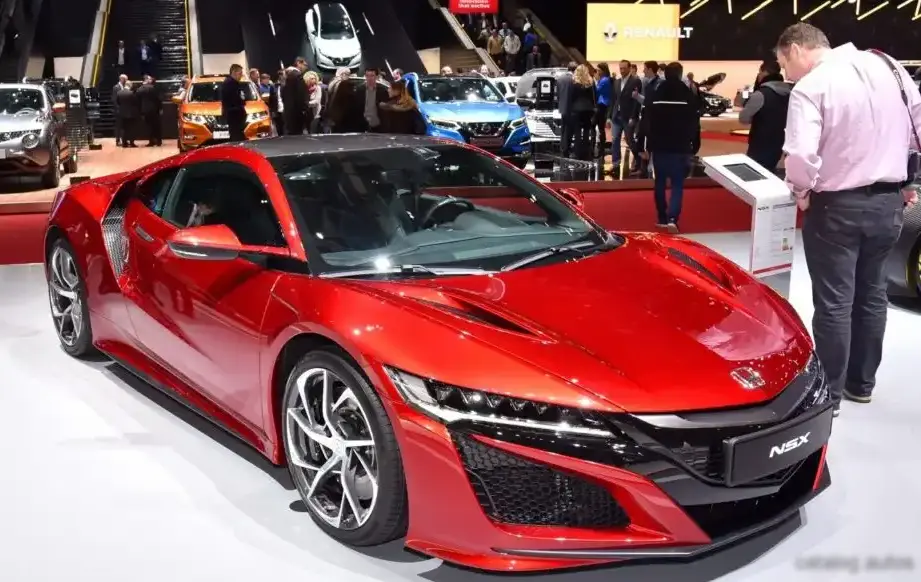
The Honda NSX II Coupe, produced from 2016 to 2022, represents a significant revival of the iconic NSX nameplate. This second-generation model moved away from the naturally aspirated engine of its predecessor, embracing a complex and technologically advanced hybrid powertrain. Built on a bespoke aluminum spaceframe, the NSX II aimed to deliver supercar performance with everyday usability. It served as Honda’s flagship sports car, competing with established rivals like the Porsche 911 and Audi R8. The 3.5 i-VTEC Bi-Turbo V6 variant, equipped with a 9-speed Dual Clutch Transmission (DCT) and Honda’s SH-AWD (Super Handling All-Wheel Drive) system, was the sole configuration offered throughout its production run, representing the pinnacle of Honda’s engineering capabilities.
Technical Specifications
| Brand | Honda |
| Model | NSX |
| Generation | NSX II Coupe |
| Type (Engine) | 3.5 i-VTEC Bi-Turbo V6 (581 Hp) Hybrid SH-AWD DCT |
| Start of production | 2016 |
| End of production | 2022 |
| Powertrain Architecture | FHEV (Full Hybrid Electric Vehicle) |
| Body type | Coupe |
| Seats | 2 |
| Doors | 2 |
| Fuel consumption (economy) – urban | 10.3 l/100 km (22.8 US mpg, 27.4 UK mpg, 9.7 km/l) |
| Fuel consumption (economy) – extra urban | 9.9 l/100 km (23.8 US mpg, 28.5 UK mpg, 10.1 km/l) |
| Fuel consumption (economy) – combined | 10 l/100 km (23.5 US mpg, 28.2 UK mpg, 10 km/l) |
| CO2 emissions | 228 g/km |
| Fuel Type | Petrol (Gasoline) |
| Maximum speed | 308 km/h (191.38 mph) |
| Weight-to-power ratio | 3.2 kg/Hp, 314.6 Hp/tonne |
| Weight-to-torque ratio | 2.9 kg/Nm, 349.2 Nm/tonne |
| Battery technology | Lithium-ion (Li-Ion) |
| Electric motor power (1) | 48 Hp @ 3000 rpm (147 Nm @ 500-2000 rpm / 108.42 lb.-ft. @ 500-2000 rpm) |
| Electric motor model/code (1) | H2 |
| Electric motor location (1) | Between the combustion engine and the transmission |
| Electric motor type (1) | Synchronous |
| Electric motor power (2) | 37 Hp @ 4000 rpm (73 Nm @ 0-2000 rpm / 53.84 lb.-ft. @ 0-2000 rpm) |
| Electric motor model/code (2) | H3 |
| Electric motor location (2) | Front axle, Transverse |
| Electric motor type (2) | Synchronous |
| Electric motor power (3) | 37 Hp @ 4000 rpm (73 Nm @ 0-2000 rpm / 53.84 lb.-ft. @ 0-2000 rpm) |
| Electric motor model/code (3) | H3 |
| Electric motor location (3) | Front axle, Transverse |
| Electric motor type (3) | Synchronous |
| System power | 581 Hp |
| System torque | 645 Nm @ 2000-6000 rpm (475.73 lb.-ft. @ 2000-6000 rpm) |
| Power | 507 Hp @ 6500-7500 rpm |
| Power per litre | 145.1 Hp/l |
| Torque | 550 Nm @ 2000-6000 rpm (405.66 lb.-ft. @ 2000-6000 rpm) |
| Maximum engine speed | 7500 rpm |
| Engine Model/Code | JNC1 |
| Engine displacement | 3493 cm3 (213.16 cu. in.) |
| Number of cylinders | 6 |
| Engine configuration | V-engine |
| Cylinder Bore | 91 mm (3.58 in.) |
| Piston Stroke | 89.5 mm (3.52 in.) |
| Compression ratio | 10:1 |
| Number of valves per cylinder | 4 |
| Fuel injection system | Direct injection |
| Engine aspiration | BiTurbo, Intercooler |
| Valvetrain | i-VTEC |
| Engine oil capacity | 7.9 l (8.35 US qt | 6.95 UK qt) |
| Coolant | 15.5 l (16.38 US qt | 13.64 UK qt) |
| Kerb Weight | 1847-1861 kg (4071.94 – 4102.8 lbs.) |
| Max. weight | 2040 kg (4497.43 lbs.) |
| Max load | 179-193 kg (394.63 – 425.49 lbs.) |
| Trunk (boot) space – minimum | 110 l (3.88 cu. ft.) |
| Fuel tank capacity | 59 l (15.59 US gal | 12.98 UK gal) |
| Length | 4487 mm (176.65 in.) |
| Width | 1920 mm (75.59 in.) |
| Width including mirrors | 2216 mm (87.24 in.) |
| Height | 1204 mm (47.4 in.) |
| Wheelbase | 2630 mm (103.54 in.) |
| Front track | 1659 mm (65.31 in.) |
| Rear (Back) track | 1620 mm (63.78 in.) |
| Ride height (ground clearance) | 104 mm (4.09 in.) |
| Minimum turning circle (turning diameter) | 12.1 m (39.7 ft.) |
| Drivetrain Architecture | The Internal combustion engine (ICE) and electric motor drive the rear wheels of the car with the ability to work in full electric or mixed mode. Two electric motors drive the front wheels. |
| Drive wheel | All wheel drive (4×4) |
| Number of gears and type of gearbox | 9 gears, automatic transmission DCT |
| Front suspension | Double wishbone |
| Rear suspension | Double wishbone |
| Front brakes | Ventilated discs |
| Rear brakes | Ventilated discs |
| Assisting systems | ABS (Anti-lock braking system) |
| Steering type | Steering rack and pinion |
| Power steering | Electric Steering |
| Tires size | Front wheel tires: 245/35 ZR19 93Y, Rear wheel tires: 305/30 ZR20 103Y |
| Wheel rims size | Front wheel rims: 8J x 19, Rear wheel rims: 11J x 20 |
Powertrain & Engine Architecture
At the heart of the NSX II lies a 3.5-liter, twin-turbocharged V6 engine, designated JNC1. This engine produces 507 horsepower and 405.66 lb-ft of torque. The engine utilizes a direct injection system and Honda’s i-VTEC variable valve timing technology to optimize performance and efficiency. However, the NSX isn’t solely reliant on its internal combustion engine. It incorporates a sophisticated Sport Hybrid SH-AWD system. This system features three electric motors: one integrated with the engine to provide torque fill and act as a generator, and two independent motors powering the front wheels. The combined output of the engine and electric motors results in a total system output of 581 horsepower and 475.73 lb-ft of torque. The 9-speed Dual Clutch Transmission (DCT) provides rapid and precise gear changes, contributing to the car’s dynamic performance. The DCT was specifically tuned for the NSX, prioritizing quick shifts and responsiveness.
Driving Characteristics
The NSX II delivers a remarkably balanced and engaging driving experience. The SH-AWD system allows for torque vectoring, distributing power between all four wheels to enhance cornering agility and stability. The electric motors provide instant torque, eliminating turbo lag and contributing to brisk acceleration. While the DCT offers incredibly fast shifts, some drivers noted a slight jerkiness at low speeds compared to more conventional automatic transmissions. The NSX’s steering is precise and well-weighted, providing excellent feedback to the driver. Compared to a hypothetical manual transmission version (which was never offered), the DCT prioritizes performance and consistency over driver engagement. The hybrid system also allows for limited all-electric driving, though range is minimal.
Equipment & Trim Levels
The NSX II was relatively well-equipped as standard. All models included leather upholstery, power-adjustable seats, a premium audio system, navigation, and a suite of advanced driver-assistance systems, including collision mitigation braking and lane departure warning. Optional extras included carbon fiber interior trim, upgraded audio systems, and various exterior styling enhancements. The interior design prioritized a driver-focused layout with a digital instrument cluster and a central infotainment display. While luxurious, the interior wasn’t overly opulent, reflecting the car’s performance-oriented nature.
Chassis & Braking
The NSX II features a lightweight aluminum spaceframe chassis, providing a rigid and strong foundation for the car. The suspension utilizes a double wishbone design at both the front and rear, optimized for handling and ride comfort. Brembo brakes with ventilated discs are standard, providing exceptional stopping power. The car’s electronic stability control system is finely tuned to work in conjunction with the SH-AWD system, maximizing grip and control. The relatively low curb weight (around 4,072 lbs) contributes to the car’s agility and responsiveness.
Market Reception & Comparison
The NSX II received generally positive reviews from automotive critics. Praise was directed towards its impressive performance, advanced technology, and engaging driving dynamics. However, some critics noted that the car lacked the raw emotional connection of some of its rivals, such as the Porsche 911. Fuel economy was respectable for a supercar, averaging around 23.5 mpg in combined driving. Reliability reports have been mixed, with some owners experiencing issues with the hybrid system and DCT. Compared to the base Porsche 911 Carrera, the NSX offered more advanced technology and all-wheel drive as standard, but the Porsche generally provided a more visceral driving experience.
Legacy
Despite its relatively short production run, the NSX II represents a significant achievement in automotive engineering. It showcased Honda’s ability to develop and implement cutting-edge hybrid technology in a high-performance sports car. On the used car market, the NSX II holds its value relatively well, particularly well-maintained examples with low mileage. The complexity of the hybrid system means that maintenance can be expensive, and specialized technicians are required for repairs. However, for enthusiasts seeking a technologically advanced and capable supercar, the NSX II remains a compelling option.