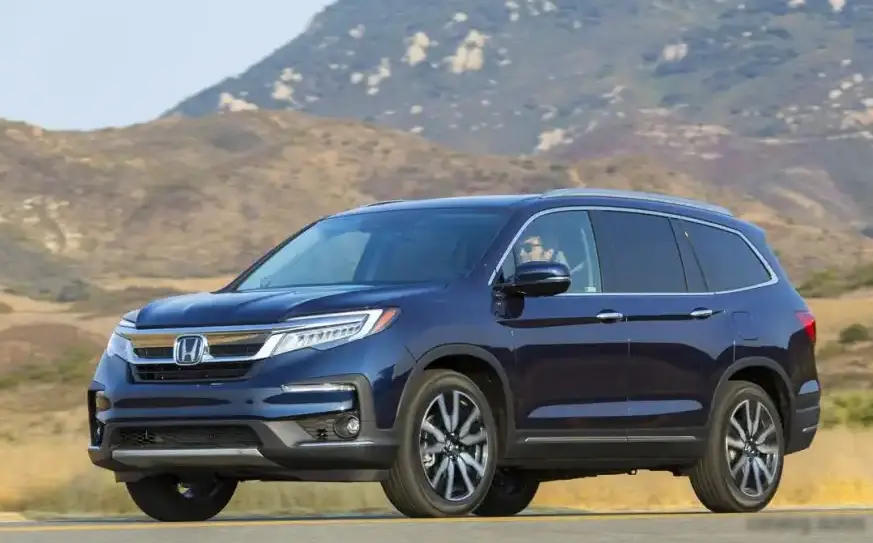
The Honda Pilot III, specifically the facelifted version introduced in 2019, represents a significant evolution of Honda’s three-row mid-size SUV. Produced from 2019 through December 2022, this generation Pilot aimed to refine the formula established by its predecessors, offering a blend of family-friendly practicality, respectable performance, and Honda’s reputation for reliability. The 3.5 V6 (280 Hp) SBW variant, utilizing a nine-speed automatic transmission with Shift-By-Wire (SBW) technology, occupied the mainstream position within the Pilot lineup, serving as the volume seller and a balance between affordability and features. It sat above the base LX trim and below the more luxurious Elite and Black Edition models.
Technical Specifications
| Brand | Honda |
| Model | Pilot |
| Generation | Pilot III (facelift 2019) |
| Type (Engine) | 3.5 V6 (280 Hp) SBW |
| Start of production | 2019 |
| End of production | December, 2022 |
| Powertrain Architecture | Internal Combustion engine |
| Body type | SUV, Crossover |
| Seats | 7-8 |
| Doors | 5 |
| Fuel consumption (urban) | 11.7 l/100 km (20.1 US mpg, 24.1 UK mpg, 8.5 km/l) |
| Fuel consumption (extra urban) | 8.7 l/100 km (27 US mpg, 32.5 UK mpg, 11.5 km/l) |
| Fuel consumption (combined) | 10.2 l/100 km (23.1 US mpg, 27.7 UK mpg, 9.8 km/l) |
| Fuel Type | Petrol (Gasoline) |
| Weight-to-power ratio | 6.7 kg/Hp, 150.3 Hp/tonne |
| Weight-to-torque ratio | 5.2 kg/Nm, 190.6 Nm/tonne |
| Power | 280 Hp @ 6000 rpm |
| Power per litre | 80.7 Hp/l |
| Torque | 355 Nm @ 4700 rpm (261.83 lb.-ft. @ 4700 rpm) |
| Engine layout | Front, Transverse |
| Engine Model/Code | J35Y6 |
| Engine displacement | 3471 cm3 (211.81 cu. in.) |
| Number of cylinders | 6 |
| Engine configuration | V-engine |
| Cylinder Bore | 89 mm (3.5 in.) |
| Piston Stroke | 93 mm (3.66 in.) |
| Compression ratio | 11.5:1 |
| Number of valves per cylinder | 4 |
| Fuel injection system | Direct injection |
| Engine aspiration | Naturally aspirated engine |
| Valvetrain | SOHC |
| Engine oil capacity | 5.4 l (5.71 US qt | 4.75 UK qt) |
| Coolant capacity | 7.4 l (7.82 US qt | 6.51 UK qt) |
| Kerb Weight | 1863-1871 kg (4107.21 – 4124.85 lbs.) |
| Trunk (boot) space – minimum | 467 l (16.49 cu. ft.) |
| Trunk (boot) space – maximum | 2375 l (83.87 cu. ft.) |
| Fuel tank capacity | 74 l (19.55 US gal | 16.28 UK gal) |
| Permitted trailer load with brakes (12%) | 1588 kg (3500.94 lbs.) |
| Length | 4991 mm (196.5 in.) |
| Width | 1996 mm (78.58 in.) |
| Height | 1793 mm (70.59 in.) |
| Wheelbase | 2819 mm (110.98 in.) |
| Front track | 1684 mm (66.3 in.) |
| Rear (Back) track | 1684 mm (66.3 in.) |
| Ride height (ground clearance) | 185 mm (7.28 in.) |
| Minimum turning circle (turning diameter) | 12 m (39.37 ft.) |
| Approach angle | 19.7° |
| Departure angle | 20.8° |
| Drivetrain Architecture | The Internal combustion engine (ICE) drives the front wheels of the vehicle. |
| Drive wheel | Front wheel drive |
| Number of gears and type of gearbox | 9 gears, automatic transmission SWB |
| Front suspension | Independent type McPherson |
| Rear suspension | Independent multi-link suspension |
| Front brakes | Ventilated discs, 320 mm |
| Rear brakes | Disc, 330 mm |
| Assisting systems | ABS (Anti-lock braking system) |
| Steering type | Steering rack and pinion |
| Power steering | Electric Steering |
| Tires size | 245/60 R18 105H; 245/50 R20 102H |
| Wheel rims size | 18; 20 |
INTRODUCTION
The 2019-2022 Honda Pilot facelift represented a mid-cycle refresh of the third-generation Pilot (introduced in 2016). This update brought revised styling, upgraded technology, and refinements to the powertrain. The 3.5-liter V6 engine, designated J35Y6, remained the sole engine option, but was paired with a new nine-speed automatic transmission featuring Honda’s Shift-By-Wire (SBW) system. This combination aimed to improve both fuel efficiency and driving experience. The Pilot continued to be manufactured primarily for the North American market, serving as a key model in Honda’s SUV lineup and competing with vehicles like the Toyota Highlander, Ford Explorer, and Nissan Pathfinder.
Powertrain & Engine Architecture
The heart of the 2019-2022 Honda Pilot 3.5 V6 SBW is the J35Y6 engine, a 3.5-liter naturally aspirated V6. This engine utilizes Honda’s i-VTEC (intelligent Variable Valve Timing and Lift Electronic Control) system, optimizing valve timing and lift for improved performance and efficiency across the rev range. Direct fuel injection further enhances combustion efficiency and power output. The engine produces 280 horsepower at 6,000 rpm and 262 lb-ft of torque at 4,700 rpm. The nine-speed automatic transmission, sourced from ZF, replaced the previous six-speed unit. The SBW system eliminates the traditional mechanical linkage between the gear selector and the transmission, using electronic signals for gear changes. This contributes to smoother shifts and a more modern feel. The transmission is tuned for comfortable cruising and adequate acceleration, prioritizing refinement over outright sportiness.
Driving Characteristics
The 3.5 V6 with the nine-speed automatic delivers a smooth and predictable driving experience. While not particularly sporty, the powertrain provides sufficient power for everyday driving and highway merging. The nine-speed transmission helps keep the engine in its optimal power band, but some drivers have noted occasional hesitation during downshifts. Compared to the earlier six-speed automatic, the nine-speed offers improved fuel economy, but the difference isn’t dramatic. The front-wheel-drive configuration of the base model provides adequate traction in most conditions, while the available all-wheel-drive system enhances stability and capability in inclement weather. The gear ratios are optimized for fuel efficiency at highway speeds, but can feel slightly tall for quick acceleration.
Equipment & Trim Levels
The 3.5 V6 SBW variant was typically offered in LX, EX, EX-L, and Touring trim levels. Standard features on the LX included Honda Sensing suite of safety technologies (including adaptive cruise control and lane keeping assist), a multi-angle rearview camera, and a 5-inch infotainment display. Higher trims added features like leather upholstery, a power moonroof, a premium audio system, and a larger 8-inch touchscreen display with Apple CarPlay and Android Auto integration. The EX-L trim, a popular choice, added leather seats, heated front seats, and a power liftgate. Optional extras included rear entertainment systems and navigation.
Chassis & Braking
The Pilot utilizes a unibody construction with independent front and rear suspension. The front suspension employs MacPherson struts, while the rear features a multi-link setup. This configuration provides a comfortable ride and predictable handling. Front-wheel-drive models have ventilated disc brakes at the front and solid disc brakes at the rear. All-wheel-drive models typically feature ventilated discs on all four wheels. Anti-lock brakes (ABS) and electronic stability control are standard equipment. The steering is electrically assisted, providing light and precise control.
Market Reception & Comparison
The 2019-2022 Honda Pilot facelift was generally well-received by automotive critics. The updated styling and improved technology were praised, as was the comfortable ride and spacious interior. The nine-speed automatic transmission received mixed reviews, with some testers noting occasional sluggishness. Compared to the Toyota Highlander, the Pilot offered a slightly more engaging driving experience but lacked the Highlander’s reputation for long-term reliability. The Ford Explorer, while offering a more powerful engine option, was often criticized for its interior quality and infotainment system. Fuel economy for the 3.5 V6 SBW Pilot was competitive within its class, averaging around 23 mpg combined.
Legacy
The J35Y6 engine, while not a groundbreaking design, has proven to be a reliable and durable powerplant. The nine-speed automatic transmission, while occasionally exhibiting minor quirks, has generally held up well over time. The 2019-2022 Honda Pilot 3.5 V6 SBW remains a popular choice in the used car market, offering a compelling combination of practicality, reliability, and value. Maintenance costs are generally reasonable, and parts availability is good. However, as with any vehicle, regular maintenance is crucial to ensure long-term reliability. The Pilot’s spacious interior and family-friendly features continue to make it a desirable option for buyers seeking a three-row SUV.