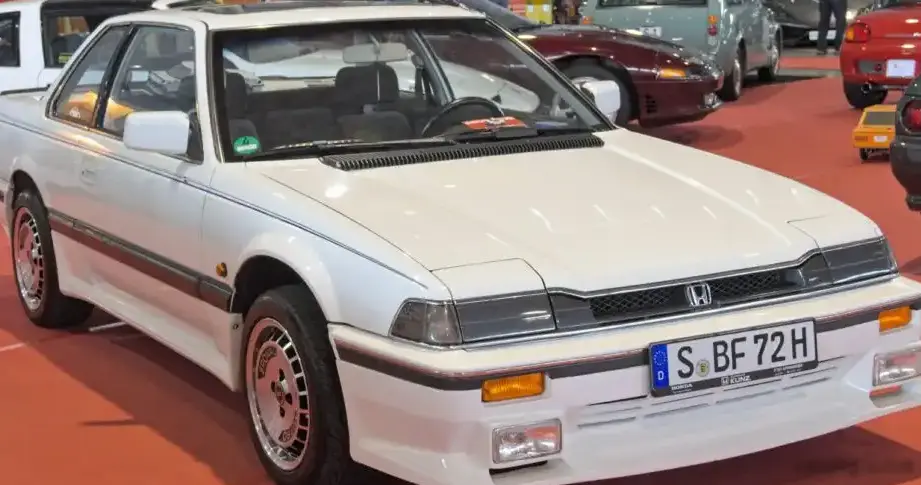
The Honda Prelude II (AB) 1.8 EX, produced between April 1983 and September 1987, represented a significant evolution in Honda’s personal coupe offerings. Positioned as a step up from the base model, the 1.8 EX aimed to provide a balance of sporty styling, reasonable performance, and comfortable features for the North American and European markets. It was part of the second generation of the Prelude, built on the AB platform, and offered a more refined experience than its predecessor. This variant, with its 105 horsepower engine and typically paired with a 5-speed manual transmission (though an automatic was available), served as a popular choice for buyers seeking an affordable and stylish coupe.
Technical Specifications
| Brand | Honda |
| Model | Prelude |
| Generation | Prelude II (AB) |
| Type (Engine) | 1.8 EX (105 Hp) |
| Start of production | April, 1983 |
| End of production | September, 1987 |
| Powertrain Architecture | Internal Combustion engine |
| Body type | Coupe |
| Seats | 4 |
| Doors | 2 |
| Fuel consumption (urban) | 10.4 l/100 km (22.6 US mpg, 27.2 UK mpg, 9.6 km/l) |
| Fuel consumption (extra urban) | 6.3 l/100 km (37.3 US mpg, 44.8 UK mpg, 15.9 km/l) |
| Fuel Type | Petrol (Gasoline) |
| Acceleration 0 – 100 km/h | 10.2 sec |
| Acceleration 0 – 62 mph | 10.2 sec |
| Acceleration 0 – 60 mph | 9.7 sec |
| Maximum speed | 185 km/h (114.95 mph) |
| Weight-to-power ratio | 9.3 kg/Hp, 107.7 Hp/tonne |
| Weight-to-torque ratio | 6.4 kg/Nm, 155.9 Nm/tonne |
| Power | 105 Hp @ 5500 rpm |
| Power per litre | 57.4 Hp/l |
| Torque | 152 Nm @ 4000 rpm (112.11 lb.-ft. @ 4000 rpm) |
| Engine layout | Front, Transverse |
| Engine Model/Code | A18A, ET-2 |
| Engine displacement | 1829 cm3 (111.61 cu. in.) |
| Number of cylinders | 4 |
| Engine configuration | Inline |
| Cylinder Bore | 80 mm (3.15 in.) |
| Piston Stroke | 91 mm (3.58 in.) |
| Compression ratio | 9.5:1 |
| Number of valves per cylinder | 3 |
| Fuel injection system | Carburettor |
| Engine aspiration | Naturally aspirated engine |
| Valvetrain | SOHC |
| Engine oil capacity | 3.5 l (3.7 US qt | 3.08 UK qt) |
| Coolant | 6 l (6.34 US qt | 5.28 UK qt) |
| Kerb Weight | 975 kg (2149.51 lbs.) |
| Max. weight | 1490 kg (3284.89 lbs.) |
| Max load | 515 kg (1135.38 lbs.) |
| Trunk (boot) space – minimum | 315 l (11.12 cu. ft.) |
| Fuel tank capacity | 60 l (15.85 US gal | 13.2 UK gal) |
| Max. roof load | 40 kg (88.18 lbs.) |
| Permitted trailer load with brakes (12%) | 1000 kg (2204.62 lbs.) |
| Permitted trailer load without brakes | 460 kg (1014.13 lbs.) |
| Permitted towbar download | 50 kg (110.23 lbs.) |
| Length | 4295 mm (169.09 in.) |
| Width | 1690 mm (66.54 in.) |
| Height | 1295 mm (50.98 in.) |
| Wheelbase | 2450 mm (96.46 in.) |
| Front track | 1470 mm (57.87 in.) |
| Rear (Back) track | 1470 mm (57.87 in.) |
| Minimum turning circle (turning diameter) | 11.2 m (36.75 ft.) |
| Drivetrain Architecture | The Internal combustion engine (ICE) drives the front wheels of the vehicle. |
| Drive wheel | Front wheel drive |
| Number of gears and type of gearbox | 5 gears, manual transmission |
| Front suspension | Double wishbone |
| Rear suspension | Independent coil spring |
| Front brakes | Ventilated discs, 228.6 mm |
| Rear brakes | Disc |
| Steering type | Steering rack and pinion |
| Power steering | Hydraulic Steering |
| Tires size | 185/70 R13 |
Powertrain & Engine Architecture
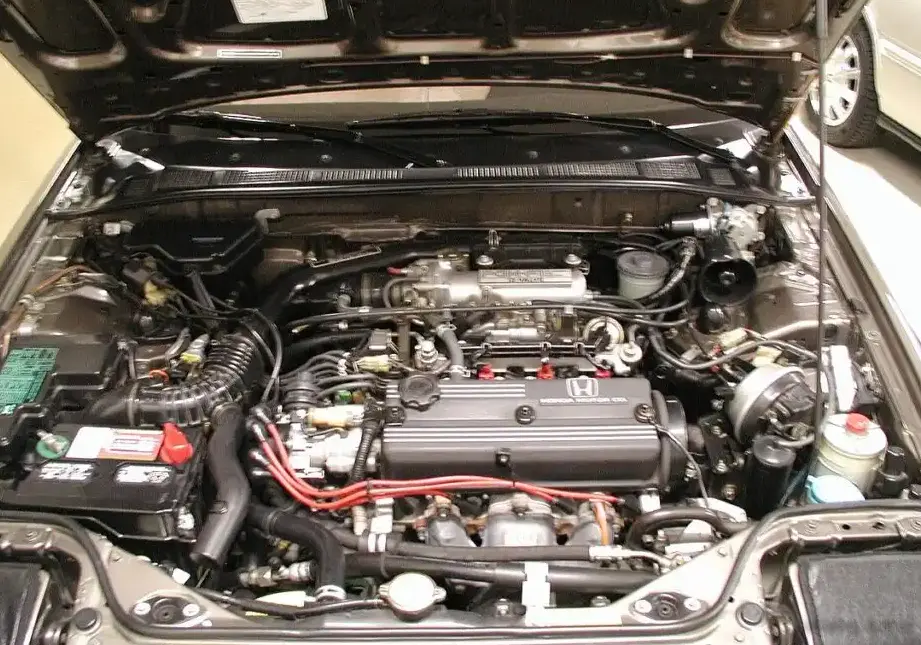
The heart of the 1.8 EX was the A18A engine, a 1.8-liter (1829cc) inline-four cylinder powerplant. This engine utilized a single overhead camshaft (SOHC) valvetrain with three valves per cylinder – two intake and one exhaust – a relatively advanced feature for its time. Fuel delivery was managed by a carburetor, a common setup for vehicles of this era, though it would later be replaced by fuel injection in subsequent Prelude generations. The A18A produced 105 horsepower at 5500 rpm and 152 Nm (112 lb-ft) of torque at 4000 rpm. The engine’s transverse mounting and front-wheel drive configuration were typical of Honda’s engineering philosophy during the 1980s. The standard transmission was a smooth-shifting 5-speed manual, but a 3-speed automatic transmission was also offered, albeit with a slight performance penalty. The automatic transmission was designed for comfort and ease of use, prioritizing smooth gear changes over outright acceleration.
Driving Characteristics
The 1.8 EX, when equipped with the 5-speed manual, offered a reasonably engaging driving experience. Acceleration to 60 mph took around 9.7 seconds, and top speed was approximately 115 mph. While not a sports car by modern standards, it provided adequate performance for everyday driving and occasional spirited runs. The automatic transmission version, while offering convenience, noticeably reduced acceleration times. The gear ratios in the automatic were tuned for fuel efficiency and smooth cruising, resulting in a less responsive feel. Handling was generally good, thanks to the independent suspension and relatively lightweight chassis. The steering, aided by hydraulic power steering, was precise and provided good feedback. Compared to the later, more powerful 2.0-liter versions of the Prelude, the 1.8 EX felt less potent, but it offered a more balanced and accessible driving experience for a wider range of drivers.
Equipment & Trim Levels
The 1.8 EX trim level offered a step up in features compared to the base model Prelude. Standard equipment typically included cloth upholstery, a basic AM/FM radio, and power steering. Optional extras included upgraded sound systems, sunroofs, and alloy wheels. The interior design was functional and relatively uncluttered, with a focus on ergonomics. The dashboard layout was straightforward, with easy-to-read gauges and well-placed controls. The EX trim also featured slightly upgraded interior trim and exterior detailing compared to the base model.
Chassis & Braking
The Prelude II (AB) utilized a front-wheel drive chassis with independent suspension at all four corners. The front suspension employed a double wishbone design, while the rear featured an independent coil spring setup. This suspension configuration provided a comfortable ride and good handling characteristics. Braking duties were handled by ventilated discs at the front and discs at the rear, providing adequate stopping power for the vehicle’s weight and performance. The chassis was relatively lightweight, contributing to the car’s nimble handling.
Market Reception & Comparison
The Honda Prelude II 1.8 EX was generally well-received by automotive critics. It was praised for its stylish design, comfortable interior, and reliable engine. However, some critics noted that the 1.8-liter engine lacked the power of larger-displacement engines offered in competing coupes. Compared to the more expensive and powerful 2.0-liter Prelude variants, the 1.8 EX offered a more affordable entry point into the Prelude lineup. Fuel economy was a strong point, with the 1.8 EX achieving around 23 mpg in the city and 37 mpg on the highway. Reliability was also a key strength, with the A18A engine proving to be durable and long-lasting.
Legacy
The Honda Prelude II 1.8 EX remains a popular choice among classic car enthusiasts. The A18A engine is known for its reliability and relatively simple maintenance requirements. Parts availability is generally good, although some components may be becoming increasingly difficult to find. Well-maintained examples of the 1.8 EX can still provide years of enjoyable driving. The car’s enduring appeal lies in its combination of sporty styling, comfortable features, and Honda’s reputation for build quality. Today, it represents a nostalgic reminder of the 1980s automotive landscape and a testament to Honda’s engineering prowess.