
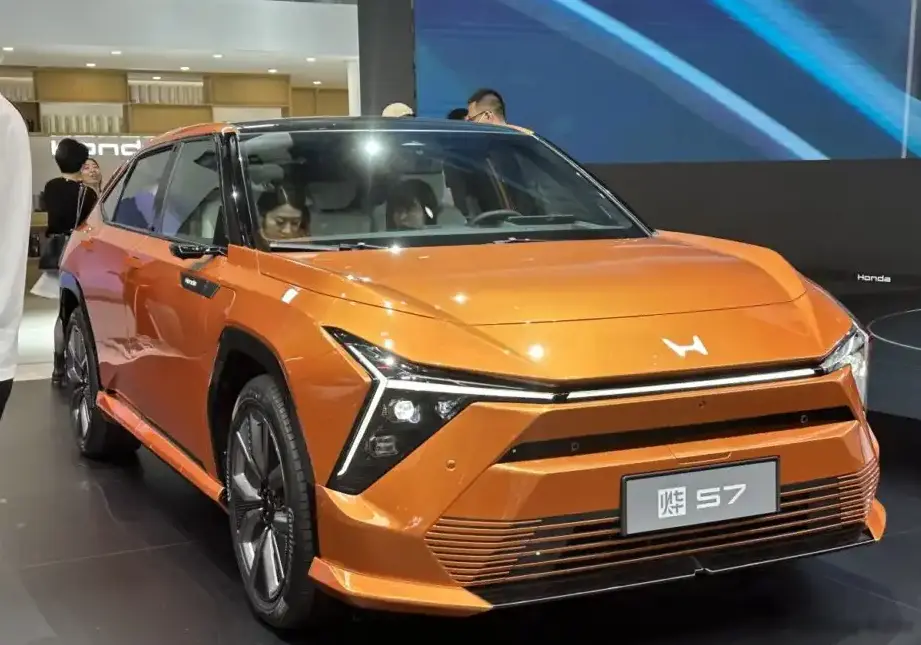
The Honda S7, launched in March 2025, represents Honda’s entry into the premium, all-electric SUV/Crossover segment. Positioned as a flagship model, the S7 leverages a dual-motor, all-wheel-drive (AWD) powertrain and a substantial 89.8 kWh battery pack to deliver a blend of performance, range, and technology. It is built upon a dedicated electric vehicle platform, aiming to compete with established players like the Tesla Model Y, Ford Mustang Mach-E, and Hyundai IONIQ 5. The S7 is a five-seater, five-door crossover designed for the North American and European markets, emphasizing spaciousness and practicality alongside its electric capabilities.
Technical Specifications
| Brand | Honda |
| Model | S7 |
| Generation | S7 |
| Type (Engine) | 89.8 kWh (476 Hp) Dual Motor AWD |
| Start of production | March, 2025 |
| Powertrain Architecture | BEV (Electric Vehicle) |
| Body type | SUV, Crossover |
| Seats | 5 |
| Doors | 5 |
| Fuel Type | Electricity |
| Acceleration 0 – 100 km/h | 4.6 sec |
| Acceleration 0 – 62 mph | 4.6 sec |
| Acceleration 0 – 60 mph | 4.4 sec |
| Maximum speed | 180 km/h (111.85 mph) |
| Weight-to-power ratio | 4.8 kg/Hp, 206.5 Hp/tonne |
| Weight-to-torque ratio | 3 kg/Nm, 334.1 Nm/tonne |
| Gross battery capacity | 89.8 kWh |
| Battery technology | Lithium nickel manganese cobalt oxides (Li-NMC) |
| Battery location | Below the floor |
| All-electric range (CLTC) | 620 km (385.25 mi) |
| Average Energy consumption (CLTC) | 15.5 kWh/100 km (24.94 kWh/100 mi) |
| MPGe | 135 |
| km/kWh | 6.5 |
| mi/kWh | 4 |
| Electric motor 1 power | 272 Hp |
| Electric motor 1 Torque | 420 Nm (309.78 lb.-ft.) |
| Electric motor 1 model/code | TZ220XSAMCF81 |
| Electric motor 1 location | Rear axle, Transverse |
| Electric motor 1 type | Synchronous |
| Electric motor 2 power | 204 Hp |
| Electric motor 2 Torque | 350 Nm (258.15 lb.-ft.) |
| Electric motor 2 model/code | TZ210XSAMCFA1 |
| Electric motor 2 location | Front axle, Transverse |
| Electric motor 2 type | Synchronous |
| System power | 476 Hp |
| System torque | 770 Nm (567.92 lb.-ft.) |
| Kerb Weight | 2305 kg (5081.66 lbs.) |
| Max. weight | 2775 kg (6117.83 lbs.) |
| Max load | 470 kg (1036.17 lbs.) |
| Trunk (boot) space – minimum | 471 l (16.63 cu. ft.) |
| Trunk (boot) space – maximum | 1485 l (52.44 cu. ft.) |
| Length | 4750 mm (187.01 in.) |
| Width | 1930 mm (75.98 in.) |
| Height | 1625 mm (63.98 in.) |
| Wheelbase | 2930 mm (115.35 in.) |
| Front track | 1641 mm (64.61 in.) |
| Rear (Back) track | 1654 mm (65.12 in.) |
| Minimum turning circle | 11.5 m (37.73 ft.) |
| Approach angle | 17° |
| Departure angle | 24° |
| Climb angle | 26.6° |
| Drivetrain Architecture | One electric motor drives the front wheels, one electric motor drives the rear wheels. |
| Drive wheel | All wheel drive (4×4) |
| Number of gears | 1 |
| Type of gearbox | automatic transmission |
| Front suspension | Coil spring, Double wishbone, Transverse stabilizer |
| Rear suspension | Independent multi-link spring suspension with stabilizer |
| Front brakes | Ventilated discs |
| Rear brakes | Ventilated discs |
| Assisting systems | ABS (Anti-lock braking system) |
| Steering type | Steering rack and pinion |
| Power steering | Electric Steering |
| Tires size | 265/45 R21 |
| Wheel rims size | 9J x 21 |
Powertrain & Engine Architecture
The Honda S7 utilizes a dual-motor, all-wheel-drive (AWD) BEV (Battery Electric Vehicle) powertrain. The front motor (TZ210XSAMCFA1) produces 204 horsepower and 350 Nm (258.15 lb.-ft.) of torque, while the rear motor (TZ220XSAMCF81) generates 272 horsepower and 420 Nm (309.78 lb.-ft.) of torque. Combined, the system delivers a total output of 476 horsepower and 770 Nm (567.92 lb.-ft.) of torque. Both motors are synchronous type, offering high efficiency and power density. The 89.8 kWh battery pack, employing Lithium Nickel Manganese Cobalt Oxide (Li-NMC) chemistry, is positioned under the vehicle floor to optimize weight distribution and maximize interior space. The S7 features a single-speed automatic transmission for each axle, simplifying the drivetrain and enhancing efficiency. The vehicle supports fast charging capabilities, allowing for significant range replenishment in a relatively short period.
Driving Characteristics
The S7’s dual-motor AWD system provides confident traction and responsive acceleration. The 0-60 mph sprint is achieved in approximately 4.4 seconds, and 0-100 km/h in 4.6 seconds, making it a quick and engaging vehicle. The instant torque delivery characteristic of electric motors provides brisk acceleration at any speed. The single-speed transmission offers seamless power delivery, and the AWD system intelligently distributes torque between the front and rear axles for optimal grip in various driving conditions. While specific gear ratios aren’t applicable to this single-speed setup, the programming focuses on maximizing efficiency and responsiveness. Compared to potential future performance variants, this configuration prioritizes a balance between performance and range, making it suitable for everyday driving and long-distance travel.
Equipment & Trim Levels
The Honda S7 comes standard with a comprehensive suite of features, including a large touchscreen infotainment system, a digital instrument cluster, advanced driver-assistance systems (ADAS) such as adaptive cruise control, lane-keeping assist, and automatic emergency braking, and premium interior materials. Standard upholstery is a high-quality synthetic leather, with optional upgrades to genuine leather available. Higher trim levels offer features like a panoramic sunroof, premium audio system, ventilated and heated seats, and a head-up display. The dashboard layout is minimalist and modern, emphasizing the vehicle’s technological sophistication.
Chassis & Braking
The S7 utilizes a coil spring, double wishbone suspension setup at the front, coupled with an independent multi-link spring suspension at the rear. Both ends incorporate a transverse stabilizer bar to minimize body roll during cornering. Ventilated disc brakes are employed on all four wheels, providing ample stopping power. The electronic braking system integrates regenerative braking, which helps to recapture energy and extend the vehicle’s range. The steering system is an electric power-assisted rack and pinion setup, offering precise and responsive steering feel.
Market Reception & Comparison
Initial reviews of the Honda S7 have been positive, with critics praising its spacious interior, comfortable ride, and impressive range. The S7’s CLTC range of 620 km (385.25 mi) is competitive within its segment. Fuel economy, expressed as 15.5 kWh/100 km (24.94 kWh/100 mi) or 135 MPGe, is also favorable. Compared to other trims, this base AWD configuration offers a compelling balance of performance and efficiency, making it an attractive option for buyers seeking a practical and capable electric SUV. Some reviewers have noted that the infotainment system could be more intuitive, and the price point is slightly higher than some competitors.
Legacy
The Honda S7 represents a significant step forward for Honda in the electric vehicle market. The longevity of the Li-NMC battery pack and the reliability of the dual-motor powertrain are yet to be fully determined, but Honda’s reputation for build quality and engineering suggests a durable and dependable vehicle. As the electric vehicle market matures, the S7 is expected to hold its value well and become a popular choice in the used car market, particularly among buyers seeking a well-equipped and efficient electric SUV.
