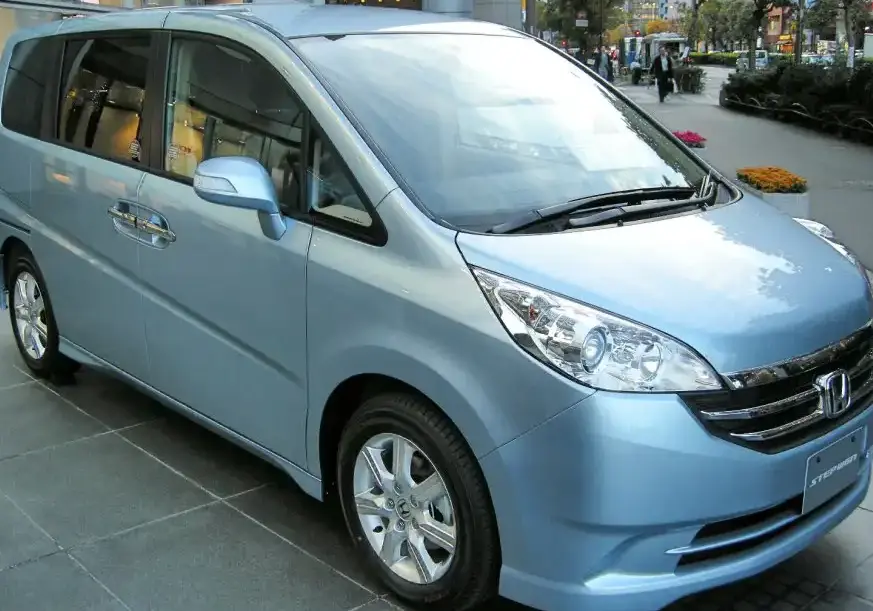
The Honda Stepwgn (RF) 2.0 i 16V, produced between 1996 and 2001, represents the first generation of Honda’s popular multi-purpose vehicle (MPV). Designed primarily for the Japanese domestic market (JDM), the Stepwgn aimed to provide a spacious and practical vehicle for families, blending the functionality of a van with the driving experience of a car. This particular variant, equipped with the 2.0-liter inline-four engine and a four-speed automatic transmission, occupied a mid-range position within the Stepwgn lineup, offering a balance between performance, fuel efficiency, and convenience. The RF series Stepwgn was built on Honda’s flexible platform, allowing for a unique low-floor design that maximized interior space and ease of access.
Technical Specifications
| Brand | Honda |
| Model | Stepwgn |
| Generation | Stepwgn I (RF) |
| Type (Engine) | 2.0 i 16V (135 Hp) |
| Start of production | 1996 |
| End of production | 2001 |
| Powertrain Architecture | Internal Combustion engine |
| Body type | Minivan |
| Seats | 8 |
| Doors | 4 |
| Fuel consumption (urban) | 8.77 l/100 km (26.8 US mpg) |
| Fuel consumption (extra urban) | 5.5 l/100 km (42.8 US mpg) |
| Fuel Type | Petrol (Gasoline) |
| Weight-to-power ratio | 11.1 kg/Hp |
| Weight-to-torque ratio | 8.2 kg/Nm |
| Power | 135 Hp @ 5500 rpm |
| Power per litre | 68.5 Hp/l |
| Torque | 184 Nm @ 4200 rpm (135.71 lb.-ft. @ 4200 rpm) |
| Engine layout | Front, Longitudinal |
| Engine displacement | 1972 cm3 (120.34 cu. in.) |
| Number of cylinders | 4 |
| Engine configuration | Inline |
| Cylinder Bore | 84 mm (3.31 in.) |
| Piston Stroke | 89 mm (3.5 in.) |
| Compression ratio | 9.6:1 |
| Number of valves per cylinder | 4 |
| Fuel injection system | Multi-port manifold injection |
| Engine aspiration | Naturally aspirated engine |
| Kerb Weight | 1500 kg (3306.93 lbs.) |
| Max. weight | 1940 kg (4276.97 lbs.) |
| Max load | 440 kg (970.03 lbs.) |
| Fuel tank capacity | 65 l (17.17 US gal) |
| Length | 4610 mm (181.5 in.) |
| Width | 1695 mm (66.73 in.) |
| Height | 1830 mm (72.05 in.) |
| Wheelbase | 2800 mm (110.24 in.) |
| Front track | 1485 mm (58.46 in.) |
| Rear track | 1480 mm (58.27 in.) |
| Drivetrain Architecture | Front wheel drive |
| Number of gears | 4 |
| Gearbox type | Automatic transmission |
| Front suspension | Coil spring |
| Rear suspension | Coil spring |
| Front brakes | Ventilated discs |
| Rear brakes | Disc |
| Assisting systems | ABS (Anti-lock braking system) |
| Steering type | Steering rack and pinion |
| Power steering | Hydraulic Steering |
| Tires size | 195/65 R15 |
Powertrain & Engine Architecture
The heart of the Stepwgn 2.0 i 16V is the Honda F20B engine, a 1972cc inline-four cylinder powerplant. This engine utilizes a single overhead camshaft (SOHC) design with four valves per cylinder, contributing to its respectable power output for its time. The F20B employed multi-point fuel injection, ensuring efficient fuel delivery and smooth operation. The engine’s 9.6:1 compression ratio was a compromise between performance and the ability to run on the readily available gasoline grades in Japan. Paired with this engine was a four-speed automatic transmission, a common choice for family-oriented vehicles prioritizing ease of use over outright performance. This transmission was electronically controlled, offering smoother shifts compared to older hydraulic systems.
Driving Characteristics
The 135 horsepower and 184 Nm (135.71 lb-ft) of torque produced by the 2.0-liter engine, when channeled through the four-speed automatic, provided adequate, though not exhilarating, performance. Acceleration was sufficient for everyday driving, but overtaking maneuvers required planning. Compared to the manual transmission versions of the Stepwgn, the automatic suffered a slight performance penalty due to the inherent losses in the torque converter. The automatic transmission’s gear ratios were tuned for fuel efficiency and comfortable cruising, rather than aggressive acceleration. The Stepwgn’s front-wheel-drive configuration contributed to predictable handling, but it wasn’t designed for sporty driving. The focus was on providing a stable and comfortable ride for passengers.
Equipment & Trim Levels
The 2.0 i 16V Stepwgn typically came equipped with features considered standard for a family vehicle in the late 1990s. This included power windows, power steering, air conditioning, and an AM/FM radio. Higher trim levels offered options such as alloy wheels, a more sophisticated audio system, and upgraded interior upholstery. The interior was designed with practicality in mind, featuring durable materials and a flexible seating arrangement. The Stepwgn’s defining feature was its spacious interior, capable of comfortably seating eight passengers. The low-floor design made entry and exit easy, particularly for children and the elderly.
Chassis & Braking
The Stepwgn’s chassis utilized a coil spring suspension system at both the front and rear, providing a comfortable ride quality. The front suspension incorporated a MacPherson strut design, while the rear utilized a torsion beam setup. Braking duties were handled by ventilated discs at the front and solid discs at the rear, providing adequate stopping power for the vehicle’s weight. An Anti-lock Braking System (ABS) was included as standard equipment, enhancing safety by preventing wheel lockup during hard braking. The steering system employed a rack-and-pinion setup with hydraulic power assistance, offering light and precise steering feel.
Market Reception & Comparison
The Honda Stepwgn was a resounding success in the Japanese market, quickly becoming a popular choice for families. Critics praised its spacious interior, practical design, and comfortable ride. The 2.0-liter automatic variant was particularly well-received by buyers who prioritized convenience and ease of use. Compared to other MPVs available at the time, such as the Toyota Previa, the Stepwgn offered a more affordable price point and a more compact footprint. Fuel economy was competitive for its class, averaging around 30 mpg in combined driving conditions. Reliability was also a strong point, with the Honda F20B engine proving to be durable and long-lasting.
Legacy
The first-generation Honda Stepwgn laid the foundation for a successful line of MPVs that continue to be popular today. The 2.0 i 16V variant, while not the most powerful or sporty version, remains a reliable and practical choice in the used car market. The F20B engine is known for its durability, and with proper maintenance, can provide many years of trouble-free service. The Stepwgn’s innovative low-floor design and spacious interior continue to influence MPV design today. While finding a well-maintained example may require some searching, the Stepwgn 2.0 i 16V represents a solid and dependable option for those seeking a spacious and practical family vehicle.