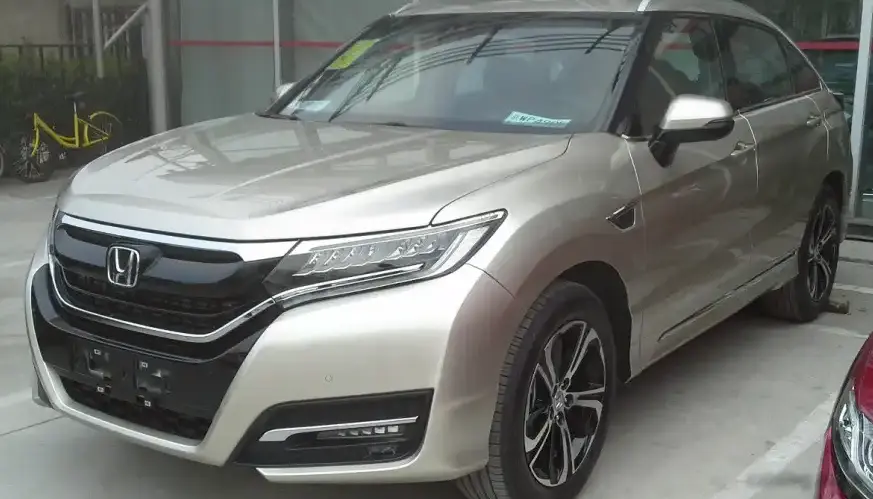
The Honda UR-V (facelift 2020) 240 Turbo, producing 193 horsepower, represents a significant offering in the mid-size SUV segment, primarily targeted towards the Chinese automotive market. Introduced as part of the UR-V’s facelift in 2020, this variant aimed to balance performance with fuel efficiency, appealing to a broad range of consumers. The UR-V itself is a larger SUV positioned above the CR-V in Honda’s lineup for the Chinese market, offering more space and a more premium experience. This specific 1.5-liter turbocharged engine paired with a continuously variable transmission (CVT) became a popular choice within the UR-V range.
Technical Specifications
| Brand | Honda |
| Model | UR-V |
| Generation | UR-V (facelift 2020) |
| Type (Engine) | 240 Turbo (193 Hp) CVT |
| Start of production | 2020 |
| Powertrain Architecture | Internal Combustion engine |
| Body type | SUV |
| Seats | 5 |
| Doors | 5 |
| Fuel consumption (combined) | 7.2 l/100 km (32.7 US mpg, 39.2 UK mpg, 13.9 km/l) |
| Fuel Type | Petrol (Gasoline) |
| Acceleration 0 – 100 km/h | 10.1 sec |
| Acceleration 0 – 62 mph | 10.1 sec |
| Acceleration 0 – 60 mph | 9.6 sec |
| Emission standard | China VI |
| Weight-to-power ratio | 9 kg/Hp, 110.6 Hp/tonne |
| Weight-to-torque ratio | 7.2 kg/Nm, 139.3 Nm/tonne |
| Power | 193 Hp @ 5600 rpm |
| Power per litre | 128.8 Hp/l |
| Torque | 243 Nm @ 2000-5000 rpm (179.23 lb.-ft. @ 2000-5000 rpm) |
| Engine layout | Front, Transverse |
| Engine Model/Code | L15B7 |
| Engine displacement | 1498 cm3 (91.41 cu. in.) |
| Number of cylinders | 4 |
| Engine configuration | Inline |
| Compression ratio | 10.3:1 |
| Fuel injection system | Direct injection |
| Engine aspiration | Turbocharger, Intercooler |
| Valvetrain | DOHC, VTEC |
| Engine oil capacity | 3.5 l (3.7 US qt | 3.08 UK qt) |
| Coolant capacity | 6.21 l (6.56 US qt | 5.46 UK qt) |
| Kerb Weight | 1745-1767 kg (3847.07 – 3895.57 lbs.) |
| Length | 4856 mm (191.18 in.) |
| Width | 1942 mm (76.46 in.) |
| Height | 1670 mm (65.75 in.) |
| Wheelbase | 2820 mm (111.02 in.) |
| Minimum turning circle | 11.4 m (37.4 ft.) |
| Drivetrain | Front wheel drive |
| Gearbox | automatic transmission G-Design Shift CVT |
| Front suspension | Independent, type McPherson with coil spring and anti-roll bar |
| Rear suspension | Independent multi-link spring suspension with stabilizer |
| Front brakes | Ventilated discs |
| Rear brakes | Disc |
| Tires size | 245/55 R19 103H |
| Wheel rims size | 19 |
Powertrain & Engine Architecture
The heart of the UR-V 240 Turbo is the L15B7 1.5-liter inline-four cylinder engine. This engine utilizes direct injection and is coupled with a single scroll turbocharger and intercooler to boost power output. Honda’s Variable Timing and Lift Electronic Control (VTEC) technology is employed to optimize valve timing and lift for improved performance and efficiency across the rev range. The engine produces 193 horsepower at 5600 rpm and 243 Nm (179.23 lb-ft) of torque between 2000 and 5000 rpm. This engine is part of Honda’s Earth Dreams Technology series, focusing on maximizing efficiency without sacrificing performance. The engine is transversely mounted in the front of the vehicle. The G-Design Shift CVT (Continuously Variable Transmission) is specifically tuned to work with the engine’s characteristics, providing smooth and efficient power delivery. Unlike traditional stepped automatic transmissions, the CVT offers an infinite number of gear ratios within its range, optimizing engine speed for fuel economy or acceleration.
Driving Characteristics
The 193 hp and 243 Nm of torque provide adequate performance for everyday driving situations. Acceleration from 0-60 mph takes approximately 9.6 seconds, which is competitive within its class, but not particularly sporty. The CVT transmission contributes to a smooth driving experience, although it can sometimes feel less responsive than a traditional automatic or manual transmission. The CVT is programmed to mimic gear changes under hard acceleration, providing a more engaging feel. The front-wheel-drive configuration offers good traction in most conditions, but may struggle in low-grip situations. Compared to higher-output versions of the UR-V, this variant prioritizes fuel economy and comfort over outright performance. The lower power output makes it more suitable for urban driving and long highway journeys where maintaining a consistent speed is more important than rapid acceleration.
Equipment & Trim Levels
The UR-V 240 Turbo typically came well-equipped, reflecting its position as a mid-range offering. Standard features generally included automatic climate control, a touchscreen infotainment system with smartphone integration (Apple CarPlay and Android Auto), a rearview camera, and a suite of safety features such as ABS, electronic stability control, and multiple airbags. Higher trim levels offered additional features like leather upholstery, a panoramic sunroof, a premium sound system, and advanced driver-assistance systems (ADAS) such as adaptive cruise control and lane departure warning. Interior upholstery was typically a combination of fabric and leatherette, with higher trims offering full leather options. The dashboard layout was modern and functional, with a focus on ease of use.
Chassis & Braking
The UR-V utilizes an independent suspension system on both the front and rear axles. The front suspension employs McPherson struts with coil springs and an anti-roll bar, while the rear suspension features a multi-link setup with a stabilizer bar. This configuration provides a comfortable ride quality and good handling characteristics. The braking system consists of ventilated discs on the front wheels and solid discs on the rear. ABS (Anti-lock Braking System) is standard, enhancing braking performance and stability. The steering system is a rack and pinion type, providing precise and responsive steering feel.
Market Reception & Comparison
The UR-V 240 Turbo was generally well-received in the Chinese market, praised for its spacious interior, comfortable ride, and fuel efficiency. Critics noted that the CVT transmission could feel somewhat lacking in responsiveness compared to traditional automatic transmissions. Compared to other trims in the UR-V lineup, the 240 Turbo offered a good balance between performance and economy. The higher-output engine options provided more exhilarating acceleration, but at the expense of fuel efficiency. The lower-powered variants were more affordable but lacked the punch of the 240 Turbo. Competitors in the Chinese market included the Toyota RAV4, Nissan X-Trail, and Volkswagen Tiguan.
Legacy
The Honda L15B7 engine and G-Design Shift CVT transmission have proven to be relatively reliable powertrains. While long-term durability can vary depending on maintenance and driving habits, these components are generally known for their robustness. In the used car market, the UR-V 240 Turbo represents a good value proposition, offering a spacious and well-equipped SUV at a competitive price. The combination of fuel efficiency and adequate performance makes it a practical choice for families and commuters. As with any used vehicle, a thorough inspection by a qualified mechanic is recommended before purchase.