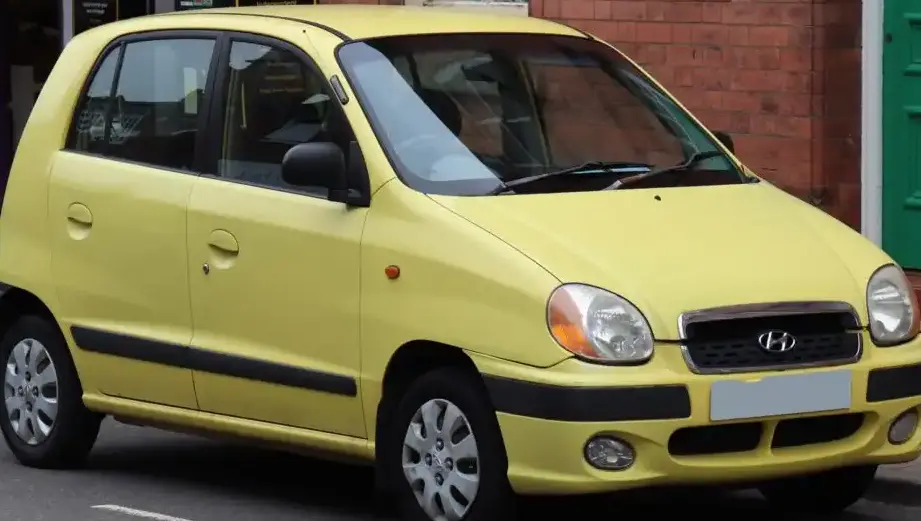
The Hyundai Atos Prime 1.0 i, produced between 1999 and 2001, represented an entry-level offering within the Atos Prime range (the Atos Prime being a facelift of the original Atos). Marketed primarily in Europe, Asia, and developing markets, this variant aimed to provide affordable and practical transportation. It occupied the lowest rung of the Atos Prime lineup, focusing on fuel efficiency and low running costs rather than outright performance. The Atos Prime itself was built upon the Hyundai’s 1HX0/A3 platform, a subcompact chassis shared with other models like the Kia Picanto.
Technical Specifications
| Brand | Hyundai |
| Model | Atos |
| Generation | Atos Prime |
| Type (Engine) | 1.0 i (56 Hp) |
| Start of production | 1999 |
| End of production | 2001 |
| Powertrain Architecture | Internal Combustion engine |
| Body type | Hatchback |
| Seats | 5 |
| Doors | 5 |
| Fuel consumption (urban) | 8 l/100 km (29.4 US mpg) |
| Fuel consumption (extra urban) | 5.4 l/100 km (43.6 US mpg) |
| Fuel Type | Petrol (Gasoline) |
| Acceleration 0 – 100 km/h | 16.5 sec |
| Acceleration 0 – 62 mph | 16.5 sec |
| Acceleration 0 – 60 mph | 15.7 sec |
| Maximum speed | 142 km/h (88.23 mph) |
| Weight-to-power ratio | 16.6 kg/Hp |
| Weight-to-torque ratio | 11.3 kg/Nm |
| Power | 56 Hp @ 5500 rpm |
| Power per litre | 56.1 Hp/l |
| Torque | 82 Nm @ 3100 rpm (60.48 lb.-ft. @ 3100 rpm) |
| Engine layout | Front, Transverse |
| Engine Model/Code | Epsilon / G4HC |
| Engine displacement | 999 cm3 (60.96 cu. in.) |
| Number of cylinders | 4 |
| Engine configuration | Inline |
| Cylinder Bore | 66 mm (2.6 in.) |
| Piston Stroke | 73 mm (2.87 in.) |
| Compression ratio | 9.5:1 |
| Number of valves per cylinder | 3 |
| Fuel injection system | Multi-port manifold injection |
| Engine aspiration | Naturally aspirated |
| Valvetrain | OHC |
| Engine oil capacity | 2.8 l (2.96 US qt | 2.46 UK qt) |
| Coolant capacity | 6 l (6.34 US qt | 5.28 UK qt) |
| Kerb Weight | 930 kg (2050.3 lbs.) |
| Max. weight | 1220 kg (2689.64 lbs.) |
| Max load | 290 kg (639.34 lbs.) |
| Trunk (boot) space – minimum | 219 l (7.73 cu. ft.) |
| Trunk (boot) space – maximum | 890 l (31.43 cu. ft.) |
| Fuel tank capacity | 35 l (9.25 US gal | 7.7 UK gal) |
| Length | 3495 mm (137.6 in.) |
| Width | 1495 mm (58.86 in.) |
| Height | 1580 mm (62.2 in.) |
| Wheelbase | 2380 mm (93.7 in.) |
| Front track | 1315 mm (51.77 in.) |
| Rear track | 1300 mm (51.18 in.) |
| Minimum turning circle | 9.1 m (29.86 ft.) |
| Drivetrain Architecture | Front wheel drive |
| Number of gears | 5 |
| Gearbox type | Manual transmission |
| Front suspension | Spring Strut |
| Rear suspension | Torsion |
| Front brakes | Disc |
| Rear brakes | Drum |
| Assisting systems | ABS (Anti-lock braking system) |
| Steering type | Steering rack and pinion |
| Power steering | Hydraulic |
| Tires size | 155/70 R13 |
Powertrain & Engine Architecture
The Atos Prime 1.0 i was powered by Hyundai’s Epsilon (G4HC) engine, a 999cc inline-four cylinder gasoline engine. This engine featured a single overhead camshaft (OHC) valvetrain with three valves per cylinder (two intake, one exhaust). The G4HC utilized a multi-point fuel injection system, providing a reasonable balance between fuel efficiency and drivability for its time. The engine’s relatively low compression ratio of 9.5:1 contributed to its ability to run on lower octane fuels, a consideration for many markets where it was sold. The 5-speed manual transmission was the only gearbox option available with this engine, prioritizing affordability over convenience. The engine was transversely mounted, driving the front wheels.
Driving Characteristics
With only 56 horsepower and 60 lb-ft of torque, the Atos Prime 1.0 i was not known for its brisk acceleration. Zero to 60 mph took approximately 15.7 seconds, and top speed was limited to around 88 mph. The 5-speed manual transmission helped to keep the engine in its optimal power band, but even with careful gear selection, overtaking maneuvers required significant planning. The gear ratios were relatively tall, emphasizing fuel economy over performance. Compared to higher-spec Atos Prime models with larger engines, the 1.0 i felt noticeably underpowered, particularly when fully loaded with passengers and cargo. However, its light weight (around 2050 lbs) mitigated some of the performance deficit.
Equipment & Trim Levels
The 1.0 i trim level was the base model of the Atos Prime. Standard equipment typically included basic steel wheels, black plastic bumpers, and a relatively spartan interior. Interior features generally consisted of cloth upholstery, a basic dashboard layout, and manual windows and door locks. Air conditioning was often an optional extra, as were power steering and a radio/cassette player. Safety features were also minimal, typically limited to seatbelts and an anti-lock braking system (ABS) on some models. The focus was on providing a functional and affordable vehicle, with minimal frills.
Chassis & Braking
The Atos Prime utilized a simple chassis design. Front suspension consisted of MacPherson strut coil springs, while the rear employed a torsion beam axle. This setup provided a comfortable, if somewhat unrefined, ride quality. Braking was handled by front disc brakes and rear drum brakes. The ABS system, when equipped, helped to improve braking performance and stability, particularly on slippery surfaces. The relatively light weight of the vehicle helped to compensate for the modest braking power.
Market Reception & Comparison
The Atos Prime 1.0 i was generally well-received as an affordable and economical city car. Critics praised its fuel efficiency and low running costs, but noted its lack of performance and refinement. Compared to other subcompact hatchbacks available at the time, such as the Fiat Punto or the Renault Clio, the Atos Prime offered a more basic package but at a lower price point. The 1.0 i engine was considered adequate for urban driving, but struggled on highways or when carrying a full load. Reliability was generally good, although the simple design meant that maintenance was relatively straightforward and inexpensive.
Legacy
The Hyundai Atos Prime 1.0 i has become a popular choice among budget-conscious used car buyers. Its simple mechanicals and readily available parts make it relatively easy and inexpensive to maintain. While not a particularly exciting vehicle to drive, its fuel efficiency and practicality have ensured its continued relevance. The G4HC engine, while not known for its longevity, is generally reliable if properly maintained. Today, these vehicles are often found in the hands of first-time car owners or as economical transportation for those on a tight budget. The Atos Prime 1.0 i represents a significant step in Hyundai’s early efforts to establish itself as a major player in the global automotive market.