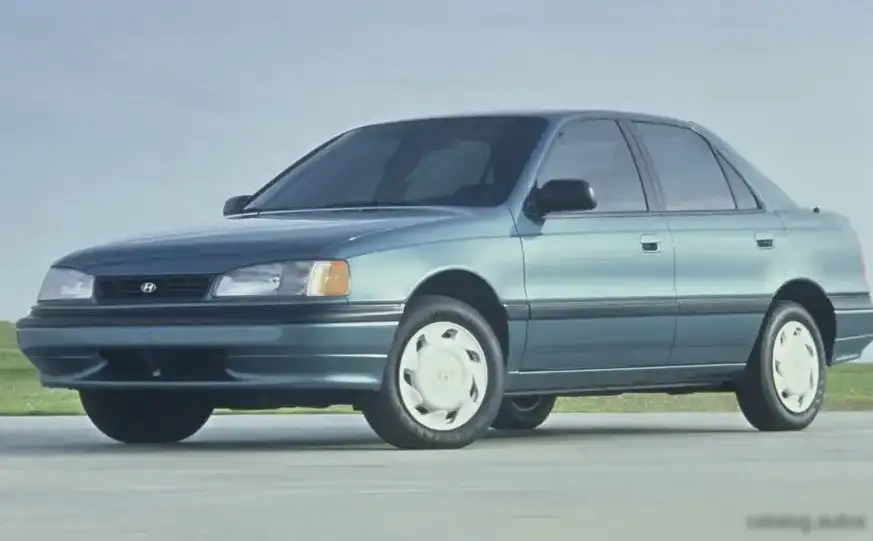
The Hyundai Elantra I 1.8 i.e. 16V, produced between 1990 and 1995, represented a significant step forward for the South Korean automaker as it aimed to establish a foothold in the global compact car market. This model, part of the first generation Elantra (also known as the Sonata in some markets), was designed to offer a blend of affordability, practicality, and increasingly, modern features. The 1.8 i.e. 16V variant occupied a mid-range position within the Elantra lineup, offering a step up in performance from the base models while remaining more accessible than potential future, higher-specification trims. It was primarily targeted at buyers seeking a reliable and reasonably well-equipped family sedan.
Technical Specifications
| Brand | Hyundai |
| Model | Elantra |
| Generation | Elantra I |
| Type (Engine) | 1.8 i.e. 16V (127 Hp) |
| Start of production | 1990 |
| End of production | 1995 |
| Powertrain Architecture | Internal Combustion engine |
| Body type | Sedan |
| Seats | 5 |
| Doors | 4 |
| Fuel consumption (urban) | 13.7 l/100 km (17.2 US mpg) |
| Fuel consumption (extra urban) | 7 l/100 km (33.6 US mpg) |
| Fuel consumption (combined) | 8.2 l/100 km (28.7 US mpg) |
| Fuel Type | Petrol (Gasoline) |
| Acceleration 0 – 100 km/h | 10 sec |
| Acceleration 0 – 62 mph | 10 sec |
| Acceleration 0 – 60 mph | 9.5 sec |
| Maximum speed | 190 km/h (118.06 mph) |
| Weight-to-power ratio | 8.7 kg/Hp |
| Weight-to-torque ratio | 6.7 kg/Nm |
| Power | 127 Hp @ 6000 rpm |
| Torque | 165 Nm @ 4400 rpm (121.7 lb.-ft. @ 4400 rpm) |
| Engine layout | Front, Transverse |
| Engine Model/Code | Sirius / G4CN |
| Engine displacement | 1836 cm3 (112.04 cu. in.) |
| Number of cylinders | 4 |
| Engine configuration | Inline |
| Cylinder Bore | 81.5 mm (3.21 in.) |
| Piston Stroke | 88 mm (3.46 in.) |
| Compression ratio | 9.2:1 |
| Number of valves per cylinder | 4 |
| Fuel injection system | Multi-port manifold injection |
| Engine aspiration | Naturally aspirated engine |
| Valvetrain | DOHC |
| Engine oil capacity | 3.7 l (3.91 US qt | 3.26 UK qt) |
| Coolant capacity | 6 l (6.34 US qt | 5.28 UK qt) |
| Kerb Weight | 1100 kg (2425.08 lbs.) |
| Max. weight | 1620 kg (3571.49 lbs.) |
| Max load | 520 kg (1146.4 lbs.) |
| Trunk (boot) space | 350 l (12.36 cu. ft.) |
| Fuel tank capacity | 52 l (13.74 US gal | 11.44 UK gal) |
| Length | 4360 mm (171.65 in.) |
| Width | 1675 mm (65.94 in.) |
| Height | 1385 mm (54.53 in.) |
| Wheelbase | 2500 mm (98.43 in.) |
| Front track | 1430 mm (56.3 in.) |
| Rear track | 1430 mm (56.3 in.) |
| Drivetrain Architecture | Front wheel drive |
| Number of gears | 5 gears, manual transmission |
| Front suspension | Wishbone |
| Rear suspension | Spring Strut |
| Front brakes | Ventilated discs |
| Rear brakes | Drum |
| Assisting systems | ABS (Anti-lock braking system) |
| Steering type | Steering rack and pinion |
| Power steering | Hydraulic Steering |
| Tires size | 175/65 R14 |
Powertrain & Engine Architecture
The heart of the Elantra I 1.8 i.e. 16V was the Hyundai Sirius engine, internally designated as the G4CN. This 1.8-liter inline-four cylinder engine featured a dual overhead camshaft (DOHC) valvetrain operating 16 valves (four per cylinder). The engine utilized a multi-port fuel injection system, a significant advancement over earlier carburetor-equipped models, contributing to improved fuel efficiency and smoother power delivery. The 9.2:1 compression ratio was a typical value for the era, balancing performance and fuel economy. The engine produced 127 horsepower at 6000 rpm and 165 Nm (121.7 lb-ft) of torque at 4400 rpm. The engine’s transverse mounting and front-wheel-drive configuration were becoming increasingly common in compact cars during the early 1990s, maximizing interior space and improving packaging efficiency. The standard transmission was a five-speed manual, though a four-speed automatic transmission was also offered, impacting performance and fuel economy.
Driving Characteristics
The 1.8L engine provided adequate, though not exhilarating, performance for the Elantra I. Acceleration from 0 to 60 mph took approximately 9.5 seconds, and top speed was around 118 mph. Compared to the base engine options, the 1.8 i.e. offered noticeably improved responsiveness, particularly during highway merging and overtaking maneuvers. The five-speed manual transmission allowed drivers to maximize engine power, while the optional four-speed automatic provided convenience at the expense of some performance. The automatic transmission’s gear ratios were tuned for fuel efficiency rather than outright acceleration. Handling was typical for a front-wheel-drive sedan of its time – predictable and safe, but not particularly sporty. The suspension was tuned for comfort, absorbing bumps reasonably well, but body roll was noticeable during cornering.
Equipment & Trim Levels
The 1.8 i.e. 16V trim generally included features such as power steering, a basic audio system, and cloth upholstery. Air conditioning was often an optional extra. Depending on the market and specific package selected, additional features could include power windows and locks, a sunroof, and upgraded interior trim. The interior design was functional and straightforward, prioritizing practicality over luxury. Dashboard layout was conventional for the period, with clearly marked gauges and easy-to-use controls. The Elantra I aimed to provide a comfortable and user-friendly driving experience.
Chassis & Braking
The Elantra I utilized a front independent wishbone suspension and a rear spring strut suspension. This setup provided a reasonable balance between ride comfort and handling. Braking duties were handled by ventilated discs at the front and drum brakes at the rear. An anti-lock braking system (ABS) was available as an option, enhancing safety by preventing wheel lockup during hard braking. The chassis was a traditional body-on-frame construction, providing adequate rigidity for everyday driving. Steering was rack-and-pinion, offering precise and responsive control.
Market Reception & Comparison
The Elantra I 1.8 i.e. 16V was generally well-received by automotive critics as a competent and affordable compact sedan. It was praised for its reliability, spacious interior, and relatively modern features. However, it was often criticized for its somewhat bland styling and unremarkable performance compared to some of its competitors, such as the Honda Civic or Toyota Corolla. Fuel economy was considered average for the time. Compared to other Elantra trims, the 1.8 i.e. offered a noticeable performance advantage over the base engines, making it a popular choice for buyers who wanted a bit more power without paying a premium for a higher-specification model.
Legacy
The Hyundai Elantra I 1.8 i.e. 16V, while not a groundbreaking vehicle, played a crucial role in establishing Hyundai as a credible player in the global automotive market. The Sirius engine proved to be a durable and reliable powerplant, and many examples are still on the road today. In the used car market, these Elantras are valued for their affordability and simplicity. Maintenance is relatively straightforward, and parts are generally readily available. While not a collector’s item, the Elantra I 1.8 i.e. 16V represents an important milestone in Hyundai’s history, demonstrating the company’s commitment to building quality and reliable vehicles.