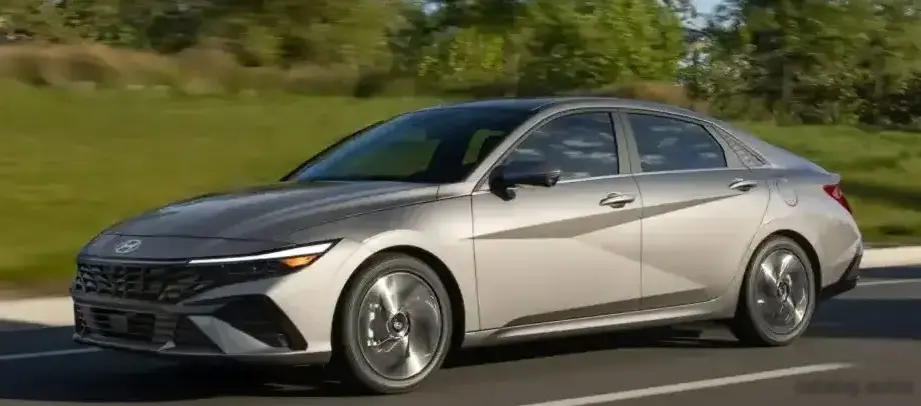
The Hyundai Elantra VII (CN7), specifically the facelifted model introduced in August 2023 featuring the 1.6 GDI (139 Hp) Hybrid DCT powertrain, represents a significant step in Hyundai’s commitment to fuel efficiency and modern automotive technology. This variant occupies a mid-range position within the CN7 Elantra lineup, offering a balance between performance, economy, and features. It builds upon the foundation of the seventh-generation Elantra, known for its bold styling and spacious interior, while incorporating a full hybrid electric vehicle (FHEV) system for reduced emissions and improved fuel consumption. The CN7 Elantra is primarily marketed towards consumers seeking a stylish, practical, and technologically advanced compact sedan.
Technical Specifications
| Brand | Hyundai |
| Model | Elantra |
| Generation | Elantra VII (CN7, facelift 2023) |
| Type (Engine) | 1.6 GDI (139 Hp) Hybrid DCT |
| Start of production | August, 2023 |
| Powertrain Architecture | FHEV (Full Hybrid Electric Vehicle) |
| Body type | Sedan |
| Seats | 5 |
| Doors | 4 |
| Fuel consumption (urban) | 4.4-4.8 l/100 km (53.5 – 49 US mpg) |
| Fuel consumption (extra urban) | 4.2-4.5 l/100 km (56 – 52.3 US mpg) |
| Fuel consumption (combined) | 4.4-4.7 l/100 km (53.5 – 50 US mpg) |
| Fuel Type | Petrol (Gasoline) |
| Emission standard | SULEV30 |
| Weight-to-power ratio | 9.7 kg/Hp |
| Weight-to-torque ratio | 5.1 kg/Nm |
| Gross battery capacity | 1.32 kWh |
| Battery voltage | 240 V |
| Battery technology | Lithium-polymer (LiPo) |
| Battery location | Under the rear seats |
| Electric motor power | 43 Hp |
| Electric motor Torque | 169 Nm (124.65 lb.-ft.) |
| Electric motor location | Between the combustion engine and the transmission |
| Electric motor type | Synchronous |
| System power | 139 Hp |
| System torque | 264 Nm (194.72 lb.-ft.) |
| Engine Power | 104 Hp @ 5700 rpm |
| Engine Torque | 148 Nm @ 4000 rpm (109.16 lb.-ft. @ 4000 rpm) |
| Engine layout | Front, Transverse |
| Engine Model/Code | Kappa II / G4LE |
| Engine displacement | 1580 cm3 (96.42 cu. in.) |
| Number of cylinders | 4 |
| Engine configuration | Inline |
| Cylinder Bore | 72 mm (2.83 in.) |
| Piston Stroke | 97 mm (3.82 in.) |
| Compression ratio | 13:1 |
| Number of valves per cylinder | 4 |
| Fuel injection system | Direct injection |
| Engine aspiration | Naturally aspirated engine |
| Valvetrain | DOHC, D-CVVT |
| Engine oil capacity | 4.1 l (4.33 US qt | 3.61 UK qt) |
| Coolant capacity | 5.9 l (6.23 US qt | 5.19 UK qt) |
| Kerb Weight | 1345-1370 kg (2965.22 – 3020.33 lbs.) |
| Max. weight | 1850 kg (4078.55 lbs.) |
| Max load | 480-505 kg (1058.22 – 1113.33 lbs.) |
| Trunk (boot) space | 402 l (14.2 cu. ft.) |
| Fuel tank capacity | 42 l (11.1 US gal | 9.24 UK gal) |
| Length | 4710 mm (185.43 in.) |
| Width | 1825 mm (71.85 in.) |
| Height | 1420 mm (55.91 in.) |
| Wheelbase | 2720 mm (107.09 in.) |
| Front track | 1579 mm (62.17 in.) |
| Rear track | 1593 mm (62.72 in.) |
| Front overhang | 920 mm (36.22 in.) |
| Rear overhang | 1070 mm (42.13 in.) |
| Ride height (ground clearance) | 140 mm (5.51 in.) |
| Drag coefficient (Cd) | 0.28 |
| Minimum turning circle | 10.8 m (35.43 ft.) |
| Drivetrain Architecture | Front wheel drive. FHEV. |
| Number of gears | 6 |
| Gearbox type | Automatic transmission DCT |
| Front suspension | Independent, McPherson with coil spring and anti-roll bar |
| Rear suspension | Independent multi-link spring suspension with stabilizer |
| Front brakes | Ventilated discs, 280 mm |
| Rear brakes | Disc, 262 mm |
| Assisting systems | ABS (Anti-lock braking system) |
| Steering type | Steering rack and pinion |
| Power steering | Electric Steering |
| Tires size | 225/45 R17 |
| Wheel rims size | 7J x 17 |
Powertrain & Engine Architecture
At the heart of the Elantra Hybrid is the Kappa II 1.6-liter GDI (Gasoline Direct Injection) four-cylinder engine, designated G4LE. This engine produces 104 horsepower at 5700 rpm and 148 Nm (109.16 lb.-ft.) of torque at 4000 rpm. The direct injection system optimizes fuel delivery for improved efficiency and power output. The engine utilizes a dual continuously variable valve timing (D-CVVT) system to further enhance performance and reduce emissions. Paired with the engine is a 43 horsepower electric motor, powered by a 1.32 kWh lithium-polymer battery pack located under the rear seats. The combined system output is 139 horsepower and 264 Nm (194.72 lb.-ft.) of torque. Power is delivered to the front wheels via a six-speed dual-clutch transmission (DCT), chosen for its quick and smooth shifts, contributing to both performance and fuel economy. The DCT allows for seamless transitions between electric and gasoline power, or a combination of both.
Driving Characteristics
The 1.6 GDI Hybrid DCT Elantra offers a refined and efficient driving experience. The electric motor provides instant torque, resulting in brisk acceleration from a standstill. The DCT transmission delivers quick and precise gear changes, enhancing responsiveness. While not a performance-oriented trim, the 139 hp combined output provides adequate power for everyday driving situations, including highway merging and overtaking. The hybrid system prioritizes fuel efficiency, and the vehicle can operate in electric-only mode at lower speeds and under light loads. Compared to higher-output Elantra trims, such as those with the 2.0-liter engine, this variant prioritizes fuel economy over outright performance. The gear ratios are tuned to maximize efficiency, which can sometimes result in the engine revving slightly higher during acceleration compared to a traditional automatic transmission.
Equipment & Trim Levels
The 1.6 GDI Hybrid DCT trim typically includes a comprehensive suite of standard features. These commonly include automatic climate control, a touchscreen infotainment system with Apple CarPlay and Android Auto compatibility, a rearview camera, and a suite of advanced driver-assistance systems (ADAS) such as lane keeping assist, forward collision avoidance assist, and adaptive cruise control. Interior upholstery is typically cloth, with options for leather upgrades available. Higher trim levels within the hybrid range may add features like a larger touchscreen display, premium audio system, heated and ventilated front seats, and a sunroof. The overall interior design emphasizes a modern and minimalist aesthetic.
Chassis & Braking
The Elantra Hybrid utilizes a McPherson strut front suspension and a multi-link rear suspension, providing a comfortable and controlled ride. The suspension is tuned to balance ride comfort with handling stability. The vehicle is equipped with ventilated disc brakes at the front and solid disc brakes at the rear. Anti-lock braking system (ABS) is standard, ensuring safe and effective braking performance. The Elantra’s chassis is designed to minimize weight, contributing to improved fuel efficiency and handling. Stabilizer bars are included at both the front and rear to reduce body roll during cornering.
Market Reception & Comparison
The Hyundai Elantra Hybrid, including the 1.6 GDI DCT variant, has been well-received by critics and consumers alike. It is praised for its fuel efficiency, stylish design, and comprehensive feature set. Compared to other trims in the Elantra lineup, the hybrid model offers significantly better fuel economy, making it an attractive option for environmentally conscious buyers. Its reliability has been generally positive, with Hyundai’s reputation for building durable vehicles. Competitors in the hybrid compact sedan segment include the Toyota Prius, Honda Insight, and Kia Niro, each offering a unique blend of features and performance.
Legacy
The 1.6 GDI Hybrid DCT powertrain in the CN7 Elantra represents a key step in Hyundai’s electrification strategy. The Kappa II engine, combined with the hybrid system and DCT transmission, has proven to be a reliable and efficient combination. In the used car market, these models are expected to hold their value well due to their fuel efficiency and modern features. The long-term durability of the hybrid components, particularly the battery pack, will be a key factor in determining the vehicle’s overall longevity. Hyundai’s extensive warranty coverage provides additional peace of mind for owners.