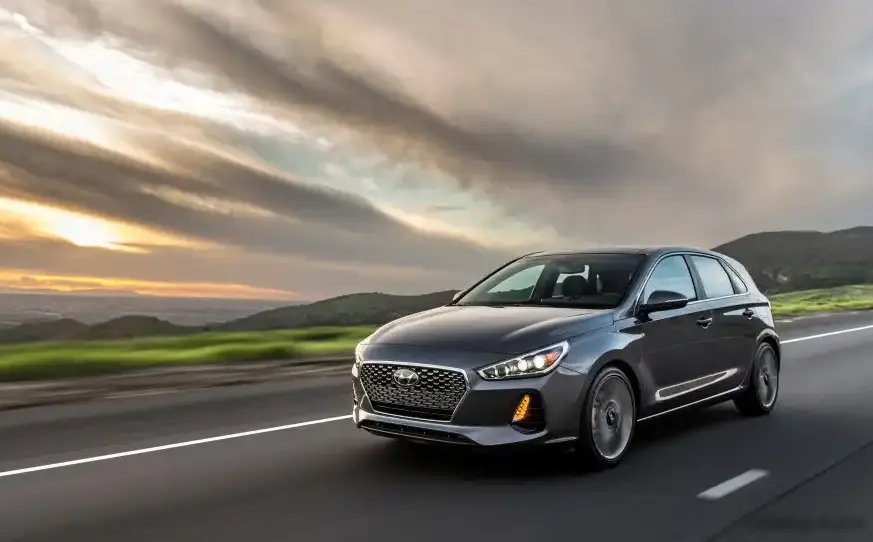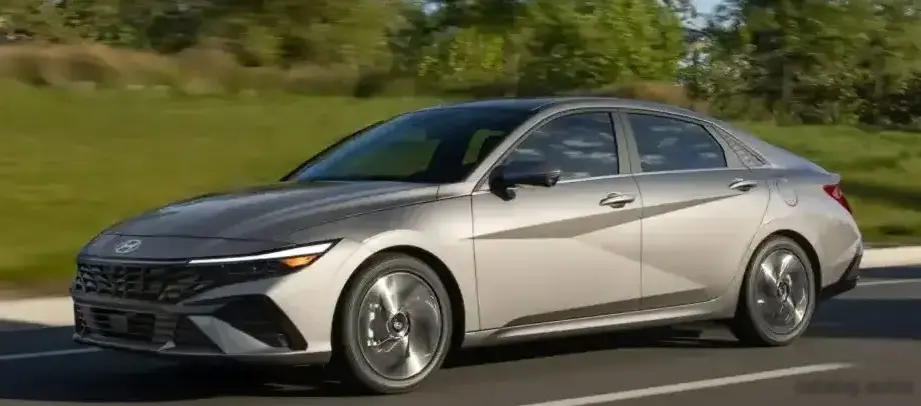
The Hyundai Elantra VII (CN7), specifically the facelifted 2023 model year equipped with the 2.0 MPI (147 horsepower) engine and Intelligent Variable Transmission (IVT), represents a significant iteration in Hyundai’s long-running compact sedan. Introduced in August 2023, this variant occupies a central position within the CN7 lineup, offering a balance between fuel efficiency, affordability, and modern features. The CN7 generation Elantra marked a departure in styling for the model, adopting a more aggressively sculpted design language dubbed “Parametric Dynamics.” This particular powertrain combination is primarily targeted towards buyers seeking a comfortable and economical daily driver, prioritizing ease of use over outright performance.
Technical Specifications
| Brand | Hyundai |
| Model | Elantra |
| Generation | Elantra VII (CN7, facelift 2023) |
| Type (Engine) | 2.0 MPI (147 Hp) IVT |
| Start of production | August, 2023 |
| Powertrain Architecture | Internal Combustion engine |
| Body type | Sedan |
| Seats | 5 |
| Doors | 4 |
| Fuel consumption (economy) – urban (EPA) | 7.6 l/100 km (30.9 US mpg) |
| Fuel consumption (economy) – extra urban (EPA) | 5.9 l/100 km (39.9 US mpg) |
| Fuel consumption (economy) – combined (EPA) | 6.9 l/100 km (34.1 US mpg) |
| Fuel Type | Petrol (Gasoline) |
| Emission standard | LEV3 ULEV70 |
| Weight-to-power ratio | 8.4 kg/Hp, 118.9 Hp/tonne |
| Weight-to-torque ratio | 6.9 kg/Nm, 144.8 Nm/tonne |
| Power | 147 Hp @ 6200 rpm |
| Power per litre | 73.5 Hp/l |
| Torque | 179 Nm @ 4500 rpm (132.02 lb.-ft. @ 4500 rpm) |
| Engine layout | Front, Transverse |
| Engine Model/Code | Smartstream / G4NS |
| Engine displacement | 1999 cm3 (121.99 cu. in.) |
| Number of cylinders | 4 |
| Engine configuration | Inline |
| Cylinder Bore | 81 mm (3.19 in.) |
| Piston Stroke | 97 mm (3.82 in.) |
| Compression ratio | 12.5:1 |
| Number of valves per cylinder | 4 |
| Fuel injection system | Multi-port manifold injection |
| Engine aspiration | Naturally aspirated engine |
| Valvetrain | DOHC, D-CVVT |
| Engine oil capacity | 4.3 l (4.54 US qt | 3.78 UK qt) |
| Coolant | 7.4 l (7.82 US qt | 6.51 UK qt) |
| Kerb Weight | 1236-1301 kg (2724.91 – 2868.21 lbs.) |
| Max. weight | 1750 kg (3858.09 lbs.) |
| Max load | 449-514 kg (989.88 – 1133.18 lbs.) |
| Trunk (boot) space – minimum | 402 l (14.2 cu. ft.) |
| Fuel tank capacity | 47 l (12.42 US gal | 10.34 UK gal) |
| Length | 4710 mm (185.43 in.) |
| Width | 1825 mm (71.85 in.) |
| Height | 1415 mm (55.71 in.) |
| Wheelbase | 2720 mm (107.09 in.) |
| Front track | 1579-1593 mm (62.17 – 62.72 in.) |
| Rear (Back) track | 1590-1604 mm (62.6 – 63.15 in.) |
| Front overhang | 920 mm (36.22 in.) |
| Rear overhang | 1070 mm (42.13 in.) |
| Ride height (ground clearance) | 135 mm (5.31 in.) |
| Drag coefficient (Cd) | 0.28 |
| Minimum turning circle (turning diameter) | 10.8 m (35.43 ft.) |
| Drivetrain Architecture | The Internal combustion engine (ICE) drives the front wheels of the vehicle. |
| Drive wheel | Front wheel drive |
| Number of gears and type of gearbox | automatic transmission IVT |
| Front suspension | Independent, type McPherson with coil spring and anti-roll bar |
| Rear suspension | Coil spring, Torsion |
| Front brakes | Ventilated discs, 280 mm |
| Rear brakes | Disc, 262 mm |
| Assisting systems | ABS (Anti-lock braking system) |
| Steering type | Steering rack and pinion |
| Power steering | Electric Steering |
| Tires size | 195/65 R15; 205/55 R16; 225/45 R17 |
| Wheel rims size | 6J x 15; 6.5J x 16; 7J x 17 |
INTRODUCTION
The 2023 Hyundai Elantra 2.0 MPI IVT is a front-wheel-drive compact sedan that builds upon the foundation of the CN7 generation Elantra, introduced in 2020 and refreshed in 2023. The CN7 platform, also underpinning the Kia Forte, represents a significant step forward in terms of design, technology, and overall refinement for Hyundai. This specific variant, powered by the naturally aspirated 2.0-liter Smartstream engine and paired with Hyundai’s IVT (Intelligent Variable Transmission), is positioned as a mainstream offering, appealing to buyers who prioritize fuel economy and a smooth driving experience over sporty performance. It slots below the more powerful turbocharged options in the Elantra lineup, and above any potential base-level engine configurations.
Powertrain & Engine Architecture
At the heart of the Elantra 2.0 MPI IVT lies the Hyundai Smartstream G4NS 2.0-liter inline-four cylinder engine. This engine utilizes multi-point fuel injection and a dual continuously variable valve timing (D-CVVT) system to optimize efficiency and power delivery. The G4NS engine produces 147 horsepower at 6,200 rpm and 179 Nm (132 lb-ft) of torque at 4,500 rpm. The engine’s architecture is designed for reduced friction and improved thermal efficiency. The IVT, marketed by Hyundai as a continuously variable transmission, functions similarly to a CVT but incorporates shift points programmed to mimic a traditional automatic gearbox, providing a more familiar driving experience. Unlike some CVTs, the IVT is designed to feel more responsive and less prone to the “rubber band” effect often associated with CVTs.
Driving Characteristics
The Elantra 2.0 MPI IVT delivers a comfortable and predictable driving experience. Acceleration is adequate for everyday driving situations, but it’s not particularly brisk. The IVT is programmed to hold lower “gear” ratios under hard acceleration, providing a reasonable response, but it doesn’t offer the immediate power delivery of a turbocharged engine or a traditional automatic transmission. The IVT prioritizes fuel efficiency, and as such, the engine tends to operate at lower rpm during cruising. Steering is light and precise, making the Elantra easy to maneuver in urban environments. The suspension is tuned for comfort, absorbing bumps and imperfections in the road surface effectively. Compared to the turbocharged Elantra variants, this 2.0L IVT model offers a more relaxed and refined driving experience, sacrificing some performance for improved fuel economy and a smoother ride.
Equipment & Trim Levels
The 2023 Elantra 2.0 MPI IVT typically comes standard with a comprehensive suite of features, including an 8-inch touchscreen infotainment system with Apple CarPlay and Android Auto compatibility, a rearview camera, automatic emergency braking, lane keeping assist, and driver attention warning. Higher trim levels add features such as a larger touchscreen display, wireless charging, a premium sound system, heated front seats, and a sunroof. Interior upholstery is typically cloth in the base trims, with leather options available on higher-spec models. The dashboard layout is modern and driver-focused, with a clean and intuitive design.
Chassis & Braking
The Elantra 2.0 MPI IVT utilizes a McPherson strut front suspension and a torsion beam rear suspension. This configuration provides a good balance between ride comfort and handling. Braking duties are handled by ventilated discs at the front and solid discs at the rear. Anti-lock braking system (ABS) is standard, along with electronic stability control and traction control. The chassis is designed to be lightweight and rigid, contributing to improved handling and fuel efficiency. The standard tire size varies depending on the trim level, ranging from 195/65R15 to 225/45R17.
Market Reception & Comparison
The 2023 Hyundai Elantra 2.0 MPI IVT has been generally well-received by automotive critics, praised for its value, fuel efficiency, and comfortable ride. However, some reviewers have noted that the engine can feel underpowered, particularly when accelerating uphill or when carrying a full load of passengers. Compared to the turbocharged Elantra models, the 2.0 MPI IVT offers significantly lower performance but also a lower price point. In terms of fuel economy, it typically achieves around 34 mpg combined, making it a competitive option in the compact sedan segment. Compared to rivals like the Honda Civic and Toyota Corolla, the Elantra offers a more modern design and a longer warranty.
Legacy
The Hyundai Smartstream G4NS engine and IVT transmission represent a significant advancement in Hyundai’s powertrain technology. While long-term reliability data is still emerging for this specific combination, Hyundai has a generally good reputation for building durable and reliable vehicles. The Elantra 2.0 MPI IVT is expected to hold its value reasonably well in the used car market, appealing to buyers seeking an affordable and fuel-efficient compact sedan. The CN7 generation Elantra, as a whole, has established Hyundai as a major player in the competitive compact car segment, and this 2.0L IVT variant contributes to that success by offering a practical and well-rounded package.