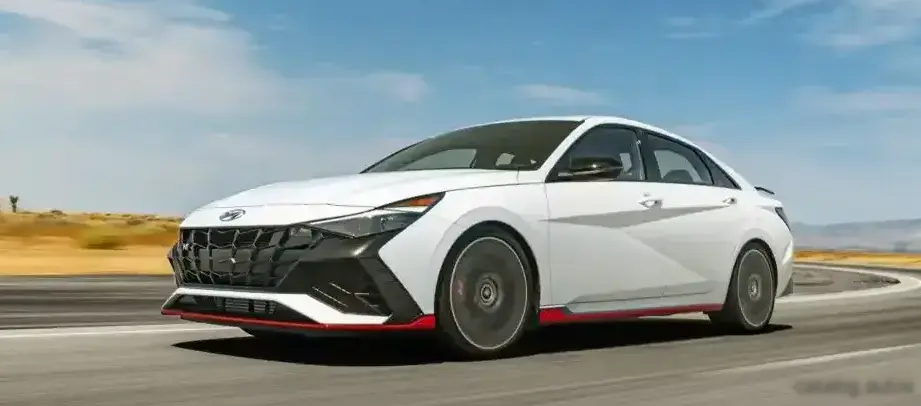
The Hyundai Elantra N 2.0 Turbo GDI, produced from 2021 to 2023, represents the high-performance variant of the seventh-generation Elantra (CN7). Positioned as the flagship model within the CN7 lineup, the ‘N’ designation signifies Hyundai’s performance division, mirroring similar strategies employed by other manufacturers like BMW’s M or Mercedes-Benz’s AMG. This model aimed to deliver a compelling driving experience, bridging the gap between mainstream compact sedans and dedicated sports cars. It was primarily marketed in North America, Europe, and select Asian markets, offering a more engaging alternative to competitors like the Volkswagen GTI and Honda Civic Si.
Technical Specifications
| Brand | Hyundai |
| Model | Elantra |
| Generation | Elantra VII (CN7) |
| Type (Engine) | N 2.0 Turbo GDI (276 Hp) |
| Start of production | 2021 |
| End of production | 2023 |
| Powertrain Architecture | Internal Combustion engine |
| Body type | Sedan |
| Seats | 5 |
| Doors | 4 |
| Fuel consumption (economy) – urban | 10.7 l/100 km (22 US mpg, 26.4 UK mpg, 9.3 km/l) |
| Fuel consumption (economy) – extra urban | 7.6 l/100 km (30.9 US mpg, 37.2 UK mpg, 13.2 km/l) |
| Fuel consumption (economy) – combined | 9.4 l/100 km (25 US mpg, 30.1 UK mpg, 10.6 km/l) |
| Fuel Type | Petrol (Gasoline) |
| Emission standard | WCC |
| Weight-to-power ratio | 5.2 kg/Hp, 191 Hp/tonne |
| Weight-to-torque ratio | 3.7 kg/Nm, 271.3 Nm/tonne |
| Power | 276 Hp @ 5500-6000 rpm |
| Power per litre | 138.1 Hp/l |
| Torque | 392 Nm @ 2100-4700 rpm (289.12 lb.-ft. @ 2100-4700 rpm) |
| Engine layout | Front, Transverse |
| Engine Model/Code | Theta II / G4KH |
| Engine displacement | 1998 cm3 (121.93 cu. in.) |
| Number of cylinders | 4 |
| Engine configuration | Inline |
| Cylinder Bore | 86 mm (3.39 in.) |
| Piston Stroke | 86 mm (3.39 in.) |
| Compression ratio | 9.5:1 |
| Number of valves per cylinder | 4 |
| Fuel injection system | Direct injection |
| Engine aspiration | Turbocharger, Intercooler |
| Valvetrain | MLA |
| Engine oil capacity | 5.2 l (5.49 US qt | 4.58 UK qt) |
| Coolant | 7.68 l (8.12 US qt | 6.76 UK qt) |
| Kerb Weight | 1445 kg (3185.68 lbs.) |
| Max. weight | 1860 kg (4100.6 lbs.) |
| Max load | 415 kg (914.92 lbs.) |
| Trunk (boot) space – minimum | 402 l (14.2 cu. ft.) |
| Fuel tank capacity | 47 l (12.42 US gal | 10.34 UK gal) |
| Length | 4676 mm (184.09 in.) |
| Width | 1826 mm (71.89 in.) |
| Height | 1415 mm (55.71 in.) |
| Wheelbase | 2720 mm (107.09 in.) |
| Front track | 1585 mm (62.4 in.) |
| Rear (Back) track | 1580 mm (62.2 in.) |
| Front overhang | 894 mm (35.2 in.) |
| Rear overhang | 1059 mm (41.69 in.) |
| Ride height (ground clearance) | 140 mm (5.51 in.) |
| Minimum turning circle (turning diameter) | 11.7 m (38.39 ft.) |
| Drivetrain Architecture | The Internal combustion engine (ICE) drives the front wheels of the vehicle. |
| Drive wheel | Front wheel drive |
| Number of gears and type of gearbox | 6 gears, manual transmission |
| Front suspension | Independent, type McPherson with coil spring and anti-roll bar |
| Rear suspension | Independent multi-link spring suspension with stabilizer |
| Front brakes | Ventilated discs, 360.68×30.48 mm |
| Rear brakes | Ventilated discs, 314.96×20.32 mm |
| Assisting systems | ABS (Anti-lock braking system) |
| Steering type | Steering rack and pinion |
| Power steering | Electric Steering |
| Tires size | 245/35 R19 |
| Wheel rims size | 8J x 19 |
Powertrain & Engine Architecture
At the heart of the Elantra N lies the Theta II 2.0-liter turbocharged gasoline direct injection (GDI) engine, designated G4KH. This engine is a significant departure from the naturally aspirated engines found in lower Elantra trims. The Theta II engine family has been a mainstay in Hyundai’s lineup, known for its durability and potential for performance upgrades. The ‘N’ variant benefits from a twin-scroll turbocharger, intercooling, and reinforced internal components to handle the increased boost pressure. The direct injection system optimizes fuel delivery for improved efficiency and power output. The engine utilizes a Multi-Layer Metal (MLa) timing chain for enhanced durability and reduced friction. The 6-speed manual transmission was the only transmission option offered, prioritizing driver engagement and performance. It features closely spaced gear ratios designed to maximize acceleration and maintain optimal engine RPMs.
Driving Characteristics
The Elantra N delivers a noticeably more spirited driving experience compared to standard Elantra models. The 276 horsepower and 289 lb-ft of torque provide brisk acceleration, with 0-60 mph times typically falling in the low-to-mid 5-second range. The manual transmission allows for precise gear control, and the engine responds quickly to throttle inputs. The suspension is tuned for performance, offering reduced body roll and improved handling. While the ride quality is firmer than in standard Elantras, it remains reasonably comfortable for daily driving. The steering is well-weighted and provides good feedback, enhancing driver confidence. The close-ratio gearbox keeps the engine in its powerband, making for an engaging and rewarding driving experience.
Equipment & Trim Levels
The Elantra N came generously equipped, reflecting its position as the performance flagship. Standard features included sport seats with enhanced bolstering, a leather-wrapped steering wheel, and unique ‘N’ badging both inside and out. Infotainment was handled by an 8-inch touchscreen display with Apple CarPlay and Android Auto compatibility. Safety features included forward collision avoidance assist, lane keeping assist, and blind-spot monitoring. Optional extras included a premium sound system, a sunroof, and a heads-up display. The interior featured aluminum sport pedals and unique trim accents to differentiate it from other Elantra models.
Chassis & Braking
The Elantra N features a reinforced chassis and upgraded suspension components compared to standard Elantra models. The front suspension utilizes McPherson struts with stiffer springs and dampers, while the rear suspension employs a multi-link setup with a stabilizer bar. Braking duties are handled by ventilated disc brakes on all four wheels, providing ample stopping power. The front brakes measure 360.68×30.48 mm, while the rear brakes are 314.96×20.32 mm. The car is equipped with an Anti-lock Braking System (ABS) and Electronic Stability Control (ESC) to enhance safety and control.
Market Reception & Comparison
The Elantra N was generally well-received by automotive critics, who praised its performance, handling, and value. It was often compared favorably to rivals like the Volkswagen GTI and Honda Civic Si, offering similar levels of performance at a lower price point. Fuel economy was respectable for a performance car, averaging around 25 mpg combined. Reliability has been generally good, although some owners have reported minor issues with the turbocharger and exhaust system. Compared to the standard Elantra trims, the ‘N’ model offered a significantly more engaging driving experience but came with a higher price tag and a firmer ride.
Legacy
The Hyundai Elantra N represents a significant step forward for Hyundai’s performance division. It demonstrated the brand’s ability to create a genuinely engaging and competitive sports sedan. On the used car market, the Elantra N holds its value well, reflecting its desirability and limited production numbers. The Theta II engine, while generally reliable, requires regular maintenance, including oil changes and spark plug replacements. The Elantra N has established a loyal following among enthusiasts and has helped to elevate Hyundai’s image as a performance brand.