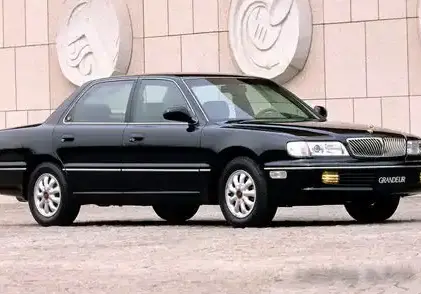
The Hyundai Grandeur I, known as the Azera in some export markets, represented a significant step forward for the South Korean automaker. Introduced in 1986 and produced through 1992, the Grandeur was Hyundai’s first truly large, domestically-developed sedan, aimed at establishing the brand as a competitor to established Japanese and European manufacturers. The 2.0i variant, producing 120 horsepower, occupied a middle ground in the Grandeur lineup, offering a balance between performance and affordability. It was positioned as a more accessible option compared to potential future larger engine offerings, targeting a broader segment of the Korean middle class.
Technical Specifications
| Brand | Hyundai |
| Model | Grandeur/Azera |
| Generation | Grandeur I (L) |
| Type (Engine) | 2.0i (120 Hp) |
| Start of production | 1986 |
| End of production | 1992 |
| Powertrain Architecture | Internal Combustion engine |
| Body type | Sedan |
| Seats | 5 |
| Doors | 4 |
| Fuel consumption (urban) | 12 l/100 km (19.6 US mpg) |
| Fuel consumption (extra urban) | 10 l/100 km (23.5 US mpg) |
| Fuel consumption (combined) | 11 l/100 km (21.4 US mpg) |
| Fuel Type | Petrol (Gasoline) |
| Acceleration 0 – 100 km/h | 12.9 sec |
| Acceleration 0 – 62 mph | 12.9 sec |
| Acceleration 0 – 60 mph | 12.3 sec |
| Maximum speed | 180 km/h (111.85 mph) |
| Weight-to-power ratio | 11.6 kg/Hp |
| Weight-to-torque ratio | 8.7 kg/Nm |
| Power | 120 Hp @ 5000 rpm |
| Torque | 159 Nm @ 3500 rpm (117.27 lb.-ft. @ 3500 rpm) |
| Engine layout | Front, Transverse |
| Engine displacement | 1997 cm3 (121.86 cu. in.) |
| Number of cylinders | 4 |
| Engine configuration | Inline |
| Cylinder Bore | 85 mm (3.35 in.) |
| Piston Stroke | 88 mm (3.46 in.) |
| Compression ratio | 8.9:1 |
| Number of valves per cylinder | 2 |
| Fuel injection system | Multi-port manifold injection |
| Engine aspiration | Naturally aspirated |
| Kerb Weight | 1390 kg (3064.43 lbs.) |
| Trunk (boot) space | 460 l (16.24 cu. ft.) |
| Fuel tank capacity | 72 l (19.02 US gal) |
| Length | 4865 mm (191.54 in.) |
| Width | 1725 mm (67.91 in.) |
| Height | 1450 mm (57.09 in.) |
| Wheelbase | 2690 mm (105.91 in.) |
| Front track | 1455 mm (57.28 in.) |
| Rear track | 1405 mm (55.31 in.) |
| Ride height | 165 mm (6.5 in.) |
| Drag coefficient (Cd) | 0.42 |
| Minimum turning circle | 11.2 m (36.75 ft.) |
| Drivetrain Architecture | Front wheel drive |
| Number of gears | 5 |
| Gearbox type | Manual transmission |
| Front suspension | Independent coil spring |
| Front brakes | Ventilated discs |
| Rear brakes | Disc |
| Tires size | 195/70 R14 |
| Wheel rims size | 14 |
Powertrain & Engine Architecture
The heart of the Grandeur I 2.0i was the Mitsubishi-sourced 4G63 inline-four cylinder engine. While Hyundai would later develop its own engines, this initial powerplant was a licensed and refined version of the Mitsubishi design. The 1997cc engine featured a cast iron block and an aluminum cylinder head, employing a multi-port fuel injection system for improved efficiency and responsiveness. The engine utilized a single overhead camshaft (SOHC) design with two valves per cylinder. The 120 horsepower output at 5000 rpm and 159 Nm (117 lb-ft) of torque at 3500 rpm were considered adequate for the vehicle’s weight, but not particularly sporty. The engine was transversely mounted, driving the front wheels. The standard transmission was a five-speed manual, although an optional four-speed automatic transmission was available, impacting performance slightly.
Driving Characteristics
The 2.0i Grandeur with the manual transmission offered reasonable acceleration, achieving 0-60 mph in approximately 12.3 seconds. The automatic transmission increased this time to around 12.9 seconds. The engine felt somewhat strained at higher speeds, and passing maneuvers required careful planning. The front-wheel-drive configuration provided predictable handling, but the suspension, while comfortable, wasn’t particularly sporty. Compared to potential future V6-powered Grandeur models, the 2.0i prioritized fuel economy and ease of driving over outright performance. The gear ratios in the five-speed manual were well-spaced, allowing the engine to operate efficiently at highway speeds. The automatic transmission, while convenient, felt less responsive and contributed to a noticeable decrease in fuel efficiency.
Equipment & Trim Levels
The Grandeur I 2.0i typically came equipped with features considered standard for a mid-size sedan of its era. These included power steering, a basic audio system, cloth upholstery, and manual windows and locks. Higher trim levels offered options such as air conditioning, power windows and locks, a more advanced audio system, and upgraded interior trim. The interior design was relatively simple and functional, reflecting the car’s focus on practicality and affordability. The dashboard layout was straightforward, with clearly labeled controls. Exterior features included steel wheels with hubcaps, and relatively basic exterior trim.
Chassis & Braking
The Grandeur I utilized a front-engine, front-wheel-drive layout. The front suspension consisted of independent coil springs, providing a comfortable ride. The rear suspension employed a semi-independent torsion beam setup, which was a cost-effective solution. Braking duties were handled by ventilated disc brakes at the front and solid disc brakes at the rear. The braking system was adequate for normal driving conditions, but lacked the stopping power of more modern systems. The 195/70 R14 tires provided reasonable grip, but were not designed for high-performance driving.
Market Reception & Comparison
The Hyundai Grandeur I was generally well-received in the Korean market. It was praised for its spacious interior, comfortable ride, and relatively affordable price. Critics noted that the 2.0i engine, while adequate, lacked the refinement and power of some of its Japanese competitors. Fuel economy was considered average for its class. Compared to the potential for larger engine options, the 2.0i was seen as a sensible choice for buyers prioritizing practicality and value. It offered a significant upgrade in size and comfort compared to Hyundai’s smaller offerings at the time, and helped establish the brand’s reputation for building larger, more sophisticated vehicles.
Legacy
The Hyundai Grandeur I 2.0i played a crucial role in establishing Hyundai as a major player in the Korean automotive market. While the 4G63 engine proved to be reasonably reliable, long-term durability could be affected by maintenance practices. Today, the Grandeur I is considered a classic car in Korea, and well-maintained examples are sought after by collectors. The 2.0i variant, while not the most powerful or desirable version, remains a relatively affordable entry point into the world of classic Hyundai vehicles. Its simplicity and relatively low running costs make it an appealing option for enthusiasts looking for a unique and historically significant vehicle.