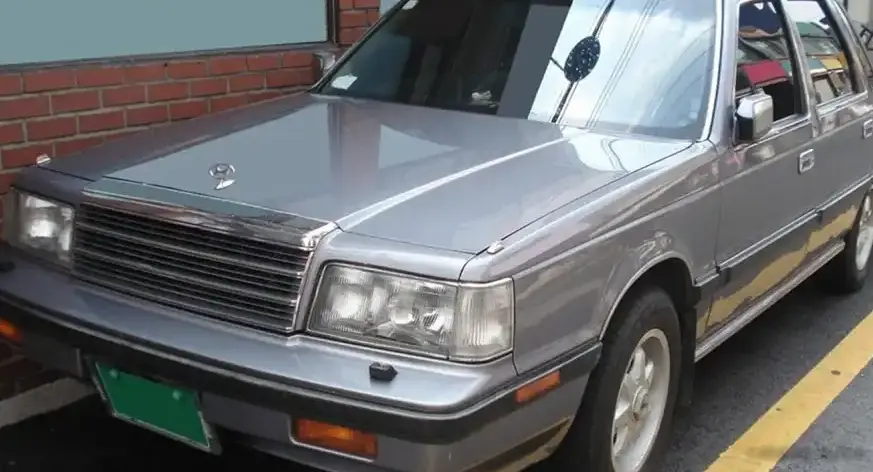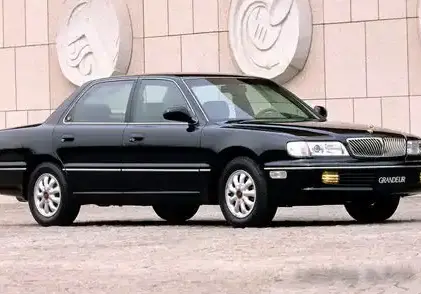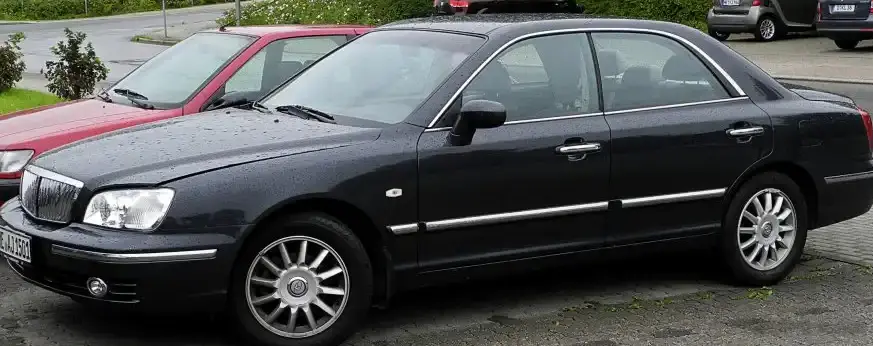
The Hyundai Grandeur III (XG), particularly the facelifted version introduced in 2003, represented a significant step forward for the South Korean automaker in terms of design, refinement, and overall market positioning. Positioned as Hyundai’s flagship sedan, the Grandeur aimed to compete with established Japanese and American luxury vehicles. The 3.0i V6 Automatic variant, produced from 2003 to 2005, served as a mid-to-upper trim level, offering a balance of performance and comfort for buyers seeking a spacious and well-equipped sedan. It was sold as the Hyundai Azera in some export markets, including the United States.
Technical Specifications
| Brand | Hyundai |
| Model | Grandeur/Azera |
| Generation | Grandeur III (XG, facelift 2003) |
| Type (Engine) | 3.0i V6 (182 Hp) Automatic |
| Start of production | 2003 |
| End of production | 2005 |
| Powertrain Architecture | Internal Combustion engine |
| Body type | Sedan |
| Seats | 5 |
| Doors | 4 |
| Fuel Type | Petrol (Gasoline) |
| Maximum speed | 210 km/h (130.49 mph) |
| Weight-to-power ratio | 9.2 kg/Hp, 109.2 Hp/tonne |
| Weight-to-torque ratio | 7.4 kg/Nm, 135.1 Nm/tonne |
| Power | 182 Hp @ 5500 rpm |
| Power per litre | 61.2 Hp/l |
| Torque | 225 Nm @ 4000 rpm (165.95 lb.-ft. @ 4000 rpm) |
| Engine Model/Code | Sigma / G6CT |
| Engine displacement | 2972 cm3 (181.36 cu. in.) |
| Number of cylinders | 6 |
| Engine configuration | V-engine |
| Cylinder Bore | 91.1 mm (3.59 in.) |
| Piston Stroke | 76 mm (2.99 in.) |
| Compression ratio | 10:1 |
| Number of valves per cylinder | 4 |
| Fuel injection system | Multi-port manifold injection |
| Engine aspiration | Naturally aspirated engine |
| Valvetrain | DOHC |
| Engine oil capacity | 4.3 l (4.54 US qt | 3.78 UK qt) |
| Coolant | 11.2 l (11.83 US qt | 9.85 UK qt) |
| Kerb Weight | 1666 kg (3672.9 lbs) |
| Trunk (boot) space – minimum | 410 l (14.48 cu. ft.) |
| Fuel tank capacity | 70 l (18.49 US gal | 15.4 UK gal) |
| Length | 4875 mm (191.93 in.) |
| Width | 1800 mm (70.87 in.) |
| Height | 1420 mm (55.91 in.) |
| Wheelbase | 2750 mm (108.27 in.) |
| Front track | 1540 mm (60.63 in.) |
| Rear (Back) track | 1520 mm (59.84 in.) |
| Ride height (ground clearance) | 160 mm (6.3 in.) |
| Minimum turning circle (turning diameter) | 12.6 m (41.34 ft.) |
| Drivetrain Architecture | The Internal combustion engine (ICE) drives the front wheels of the vehicle. |
| Drive wheel | Front wheel drive |
| Number of gears and type of gearbox | 4 gears, automatic transmission |
| Front suspension | Double wishbone |
| Rear suspension | Independent multi-link suspension |
| Front brakes | Ventilated discs |
| Rear brakes | Disc |
| Assisting systems | ABS (Anti-lock braking system) |
| Steering type | Steering rack and pinion |
| Power steering | Hydraulic Steering |
| Tires size | 205/60 R16 V |
| Wheel rims size | 16 |
Powertrain & Engine Architecture
The heart of the 3.0i Grandeur was the Hyundai Sigma engine, specifically the G6CT variant. This 2.972-liter (181.36 cubic inches) V6 engine utilized a naturally aspirated configuration with a 60-degree V-angle. It featured a double overhead camshaft (DOHC) valvetrain with four valves per cylinder, contributing to its respectable power output. The engine employed multi-port fuel injection, a common technology at the time, delivering fuel directly into the intake ports. The 10:1 compression ratio was a standard figure for engines of this era. The G6CT engine was known for its relatively smooth operation and decent reliability, though it wasn’t considered a particularly high-performance unit.
Paired with the Sigma engine was a four-speed automatic transmission. While not as sophisticated as some of the newer automatic transmissions emerging at the time, it provided smooth and adequate shifting for everyday driving. The transmission was tuned for comfort rather than outright performance, with gear ratios optimized for fuel efficiency and relaxed cruising. The front-wheel-drive configuration was standard for this model.
Driving Characteristics
The 182 horsepower and 166 lb-ft of torque delivered by the 3.0i V6 were sufficient for comfortable highway cruising and city driving. Acceleration was adequate, but not particularly brisk. Compared to the base 2.5L V6 engine, the 3.0L offered a noticeable improvement in performance, especially when fully loaded with passengers or cargo. However, it didn’t possess the sporty character of some of its competitors. The automatic transmission, while smooth, could feel somewhat sluggish during quick acceleration maneuvers. The focus was clearly on providing a refined and comfortable driving experience, rather than a sporty one. The gear ratios were spaced to prioritize fuel economy and minimize engine noise at highway speeds.
Equipment & Trim Levels
The 3.0i V6 Automatic trim typically included a generous array of standard features. These often included power windows, power locks, power mirrors, air conditioning, a CD player, and cloth upholstery. Higher-spec versions could be equipped with leather seats, a sunroof, upgraded audio systems, and woodgrain interior trim. Safety features such as ABS (Anti-lock Braking System) were standard. The Grandeur III aimed to provide a premium feel, and the interior materials and build quality were generally considered to be above average for a Korean car of that era.
Chassis & Braking
The Grandeur III utilized a front double wishbone suspension and a rear independent multi-link suspension. This setup provided a comfortable ride quality, absorbing bumps and imperfections in the road effectively. The front brakes were ventilated discs, offering good stopping power, while the rear brakes were solid discs. The hydraulic power steering provided light and easy steering effort. The suspension was tuned for comfort, prioritizing ride quality over sharp handling. Stabilizer bars were included both front and rear to reduce body roll during cornering, but the car wasn’t designed for aggressive driving.
Market Reception & Comparison
The 3.0i V6 Automatic Grandeur was generally well-received by critics as a comfortable and spacious family sedan. It offered a good value proposition compared to some of its more expensive Japanese and American rivals. However, some reviewers noted that the engine lacked the refinement and performance of some competitors. Fuel economy was considered average for a V6 engine of that size. Compared to the base 2.5L model, the 3.0L offered a significant performance upgrade, but at a higher price point. The 3.0L was also more expensive to maintain due to the increased complexity of the engine and its associated components.
Legacy
The Hyundai Grandeur III, and specifically the 3.0i V6 Automatic variant, played a crucial role in establishing Hyundai as a credible competitor in the mid-size sedan segment. The Sigma engine proved to be reasonably reliable, although routine maintenance was essential. Today, these cars are relatively affordable on the used car market, but finding well-maintained examples can be challenging. Parts availability is generally good, but some components may be becoming increasingly difficult to source. The Grandeur III is remembered as a comfortable and spacious sedan that offered a good value for the money, and it helped pave the way for Hyundai’s continued success in the global automotive market.