
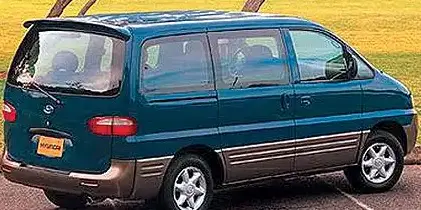
The Hyundai H-1, marketed as the Starex in some regions, is a multipurpose vehicle (MPV) produced by the South Korean manufacturer Hyundai. The first generation, known as the H-1 I Starex, was produced from 1997 to 2007, with significant updates occurring throughout its lifespan. The 2.4 i 16V 4WD SWB (135 Hp) variant, produced from 2002 to 2007, represented a popular configuration aimed at providing a balance of passenger capacity, all-weather capability, and reasonable fuel economy within the H-1 lineup. This short wheelbase (SWB) model was particularly prevalent in markets where maneuverability in urban environments was a priority.
Technical Specifications
| Brand | Hyundai |
| Model | H-1 |
| Generation | H-1 I Starex |
| Type | 2.4 i 16V 4WD SWB (135 Hp) |
| Start of production | 2002 |
| End of production | 2007 |
| Powertrain Architecture | Internal Combustion engine |
| Body type | Minivan |
| Seats | 7 |
| Doors | 4 |
| Fuel Type | Petrol (Gasoline) |
| Maximum speed | 145 km/h (90.1 mph) |
| Weight-to-power ratio | 13.3 kg/Hp, 75.4 Hp/tonne |
| Power | 135 Hp @ 4500 rpm |
| Power per litre | 57.4 Hp/l |
| Engine layout | Front, Longitudinal |
| Engine displacement | 2351 cm3 (143.47 cu. in.) |
| Number of cylinders | 4 |
| Engine configuration | Inline |
| Compression ratio | 8.6:1 |
| Number of valves per cylinder | 4 |
| Fuel injection system | Multi-port manifold injection |
| Engine aspiration | Naturally aspirated engine |
| Engine oil capacity | 4.3 l (4.54 US qt | 3.78 UK qt) |
| Kerb Weight | 1790 kg (3946.27 lbs) |
| Max. weight | 2550 kg (5621.79 lbs) |
| Max load | 760 kg (1675.51 lbs) |
| Trunk (boot) space – minimum | 364 l (12.85 cu. ft) |
| Trunk (boot) space – maximum | 3295 l (116.36 cu. ft) |
| Fuel tank capacity | 65 l (17.17 US gal | 14.3 UK gal) |
| Length | 4695 mm (184.84 in) |
| Width | 1820 mm (71.65 in) |
| Height | 1880 mm (74.02 in) |
| Wheelbase | 2810 mm (110.63 in) |
| Front track | 1570 mm (61.81 in) |
| Rear (Back) track | 1545 mm (60.83 in) |
| Drive wheel | All wheel drive (4×4) |
| Number of gears and type of gearbox | 5 gears, manual transmission |
| Front suspension | Double wishbone |
| Rear suspension | Leaf spring |
| Front brakes | Ventilated discs |
| Rear brakes | Disc |
| Assisting systems | ABS (Anti-lock braking system) |
| Steering type | Steering rack and pinion |
| Power steering | Hydraulic Steering |
| Tires size | 195/80 R14 |
Powertrain & Engine Architecture
The 2.4 i 16V variant of the H-1 I Starex utilizes a 2.4-liter inline-four cylinder gasoline engine. This engine, internally designated with various codes depending on the specific market, is a naturally aspirated powerplant featuring a multi-port fuel injection system. The 16-valve configuration (four valves per cylinder) contributes to improved breathing and overall engine efficiency. The engine produces 135 horsepower at 4500 rpm. The engine’s longitudinal mounting within the front engine bay, coupled with a five-speed manual transmission, directs power to all four wheels via a part-time four-wheel-drive system. This system typically allows the driver to select between two-wheel drive and four-wheel drive modes, enhancing traction in adverse weather conditions or on loose surfaces.
Driving Characteristics
The 135 hp engine, paired with the five-speed manual transmission, provided adequate, though not particularly brisk, performance for the H-1. Acceleration was modest, and the vehicle was more suited to relaxed cruising and hauling passengers or cargo than spirited driving. The all-wheel-drive system significantly improved traction, particularly on slippery surfaces, making it a popular choice in regions with inclement weather. The manual transmission offered drivers greater control over gear selection, allowing them to optimize power delivery for various driving conditions. Compared to potential higher-output engine options (not commonly available in the SWB 4WD configuration), this variant prioritized fuel efficiency and affordability over outright performance.
Equipment & Trim Levels
The 2.4 i 16V 4WD SWB trim typically represented a mid-range offering within the H-1 lineup. Standard equipment generally included air conditioning, power steering, and basic audio system. Interior upholstery was typically cloth, with a functional, durable design. Depending on the market and optional packages, features such as power windows, central locking, and upgraded audio systems were available. The short wheelbase configuration prioritized interior space for passengers while maintaining a relatively compact exterior footprint. The H-1 was designed with practicality in mind, offering a versatile interior layout with multiple seating configurations.
Chassis & Braking
The H-1 I Starex employed a body-on-frame construction, providing a robust and durable chassis. The front suspension utilized a double wishbone setup, while the rear suspension featured a leaf spring design. This combination aimed to balance ride comfort with load-carrying capacity. The braking system consisted of ventilated discs on the front wheels and solid discs on the rear wheels. An Anti-lock Braking System (ABS) was included as standard equipment, enhancing braking performance and stability, particularly in emergency situations. The 195/80 R14 tires provided a reasonable balance of grip and ride comfort.
Market Reception & Comparison
The Hyundai H-1 I Starex 2.4 i 16V 4WD SWB was generally well-received as a practical and versatile MPV. Critics praised its spacious interior, all-wheel-drive capability, and relatively affordable price point. However, some reviewers noted the engine’s modest power output and the vehicle’s somewhat basic interior appointments. Compared to other MPVs available at the time, the H-1 offered a unique combination of features and value. Its body-on-frame construction differentiated it from many of its competitors, which utilized unibody designs. Fuel economy was reasonable for a vehicle of its size and weight, but not exceptional.
Legacy
The Hyundai H-1 I Starex, particularly the 2.4 i 16V 4WD SWB variant, has proven to be a durable and reliable vehicle. Many examples remain on the road today, testament to its robust construction and relatively simple mechanical design. While not known for its high performance or luxurious features, the H-1 has earned a reputation as a dependable workhorse. In the used car market, these models are often sought after by those seeking an affordable and practical MPV with all-wheel-drive capability. Maintenance costs are generally reasonable, and parts availability remains good in many regions. The H-1 laid the foundation for Hyundai’s continued success in the MPV segment, paving the way for subsequent generations of the Starex/H-1.
