
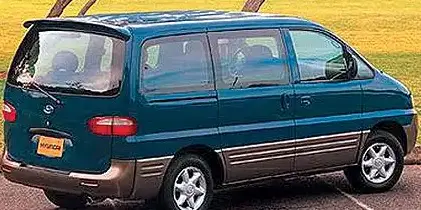
The Hyundai H-1, marketed as the Starex in some markets, is a van produced by the South Korean manufacturer Hyundai. The first generation, known as the H-1 (and internally as the ARES platform), was introduced in 1997, with production continuing through 2007 in many regions. The 2.5 TD variant, producing 80 horsepower, was a significant offering within the lineup from 1998 to 2002. This model served as a workhorse vehicle, particularly popular in developing markets where affordability and practicality were paramount. It was positioned as the entry-level diesel option, offering a more economical alternative to the gasoline-powered versions and the later, more powerful turbodiesel variants.
Technical Specifications
| Brand | Hyundai |
| Model | H-1 / Starex |
| Generation | H-1 I Starex |
| Type (Engine) | 2.5 TD (80 Hp) |
| Start of production | 1998 |
| End of production | 2002 |
| Powertrain Architecture | Internal Combustion engine |
| Body type | Minivan |
| Seats | 7 |
| Doors | 4 |
| Fuel Type | Diesel |
| Acceleration 0 – 100 km/h | 21.5 sec |
| Acceleration 0 – 62 mph | 21.5 sec |
| Acceleration 0 – 60 mph | 20.4 sec |
| Maximum speed | 145 km/h (90.1 mph) |
| Weight-to-power ratio | 23.1 kg/Hp, 43.4 Hp/tonne |
| Weight-to-torque ratio | 8.9 kg/Nm, 112.7 Nm/tonne |
| Power | 80 Hp @ 4000 rpm |
| Power per litre | 32.3 Hp/l |
| Torque | 208 Nm @ 1800 rpm (153.41 lb.-ft. @ 1800 rpm) |
| Engine layout | Front, Longitudinal |
| Engine Model/Code | D4BF |
| Engine displacement | 2477 cm3 (151.16 cu. in.) |
| Number of cylinders | 4 |
| Engine configuration | Inline |
| Cylinder Bore | 91.1 mm (3.59 in.) |
| Piston Stroke | 95 mm (3.74 in.) |
| Compression ratio | 21:1 |
| Number of valves per cylinder | 2 |
| Fuel injection system | Precombustion chamber injection |
| Engine aspiration | Turbocharger |
| Valvetrain | OHC |
| Engine oil capacity | 6.5 l (6.87 US qt | 5.72 UK qt) |
| Kerb Weight | 1845 kg (4067.53 lbs.) |
| Max. weight | 2550 kg (5621.79 lbs.) |
| Max load | 705 kg (1554.26 lbs.) |
| Trunk (boot) space – minimum | 364 l (12.85 cu. ft.) |
| Trunk (boot) space – maximum | 3295 l (116.36 cu. ft.) |
| Fuel tank capacity | 65 l (17.17 US gal | 14.3 UK gal) |
| Length | 4695 mm (184.84 in.) |
| Width | 1820 mm (71.65 in.) |
| Height | 1885 mm (74.21 in.) |
| Wheelbase | 2810 mm (110.63 in.) |
| Front track | 1570 mm (61.81 in.) |
| Rear (Back) track | 1545 mm (60.83 in.) |
| Drivetrain Architecture | Rear wheel drive |
| Number of gears and type of gearbox | 5 gears, manual transmission |
| Front suspension | Double wishbone |
| Rear suspension | Leaf spring |
| Front brakes | Ventilated discs |
| Rear brakes | Drum |
| Assisting systems | ABS (Anti-lock braking system) |
| Steering type | Steering rack and pinion |
| Power steering | Hydraulic Steering |
| Tires size | 195/80 R14 |
Powertrain & Engine Architecture
The heart of the H-1 2.5 TD was the D4BF engine, a 2.5-liter inline-four cylinder diesel. This engine utilized precombustion chamber injection, a system common in diesel engines of the era. This system involved injecting fuel into a precombustion chamber connected to the main cylinder, promoting more complete combustion. The engine was turbocharged, which helped to increase power output despite its relatively modest displacement. The turbocharger boosted the engine to 80 horsepower at 4000 rpm and 208 Nm (153.41 lb.-ft) of torque at 1800 rpm. The engine featured an overhead camshaft (OHC) valvetrain with two valves per cylinder. The transmission was a five-speed manual, chosen for its durability and cost-effectiveness. The longitudinal engine layout was typical for rear-wheel-drive vans of this period.
Driving Characteristics
The 80-horsepower 2.5 TD engine, paired with the five-speed manual transmission, provided adequate, but not exhilarating, performance. Acceleration from 0 to 100 km/h (0-62 mph) took approximately 21.5 seconds, and top speed was around 145 km/h (90 mph). The engine’s torque peak at 1800 rpm meant that it offered reasonable pulling power at lower speeds, making it suitable for carrying passengers or cargo. Compared to the later, more powerful 2.5 TD variants, this version felt noticeably slower, especially when fully loaded. The manual transmission allowed for greater driver control, but the gear ratios were optimized for fuel economy and load-carrying capacity rather than sporty driving. The rear-wheel-drive configuration provided a stable platform for hauling, but could be prone to oversteer if pushed hard in slippery conditions.
Equipment & Trim Levels
The H-1 2.5 TD was generally equipped with basic, functional features. Standard equipment typically included power steering, ABS brakes, and a relatively simple interior with cloth upholstery. Air conditioning was often an optional extra, as were power windows and central locking. The dashboard layout was straightforward and utilitarian, prioritizing practicality over aesthetics. Trim levels were often limited, with the 2.5 TD serving as the base model. Optional extras could include upgraded audio systems and different seating configurations.
Chassis & Braking
The H-1 featured a body-on-frame construction, providing a robust and durable chassis. The front suspension utilized a double wishbone setup, while the rear suspension employed leaf springs. Leaf springs were a cost-effective solution for supporting heavy loads, but they could result in a somewhat firm ride. The braking system consisted of ventilated discs at the front and drum brakes at the rear. ABS (Anti-lock Braking System) was included as standard, enhancing safety by preventing wheel lockup during hard braking. The steering was a rack and pinion system with hydraulic power assistance, providing reasonable maneuverability.
Market Reception & Comparison
The H-1 2.5 TD was well-received in markets where affordability and practicality were key considerations. Critics generally praised its spacious interior, robust construction, and relatively low running costs. However, the engine’s performance was often criticized as being underpowered, especially when compared to more modern vans. Compared to the gasoline-powered H-1 variants, the 2.5 TD offered significantly better fuel economy. Against competitors like the Toyota HiAce and Mitsubishi L300, the H-1 offered a competitive price point and a generous amount of space. The reliability of the D4BF engine was generally good, but maintenance costs could be higher than those of some competitors due to the complexity of the precombustion chamber injection system.
Legacy
The Hyundai H-1 2.5 TD, while not known for its performance, established Hyundai as a viable competitor in the van segment. The D4BF engine proved to be reasonably durable, and many examples are still in use today. In the used car market, these vans are valued for their affordability and practicality. However, potential buyers should be aware of the age-related issues common to older diesel engines, such as injector wear and turbocharger problems. The H-1 laid the groundwork for Hyundai’s continued success in the commercial vehicle market, and its legacy can be seen in the more modern Starex/H-1 models that followed.
