
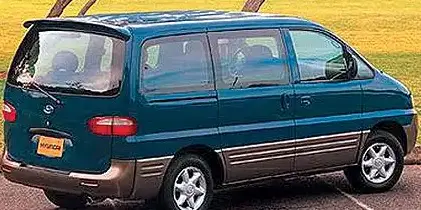
The Hyundai H-1, marketed as the Starex in some markets, is a multipurpose vehicle (MPV) produced by the South Korean manufacturer Hyundai. The first generation, known as the H-1, was introduced in 1997, with a significant refresh and the designation “I” arriving in 2002. This article focuses on the 2.5 TD variant with 99 horsepower and an automatic transmission, produced between 2002 and 2007. This configuration was primarily aimed at markets outside of North America, where large MPVs were less common, offering a practical and relatively affordable people-carrying solution. The H-1 I Starex competed with vehicles like the Mercedes-Benz Vito and Volkswagen Transporter, though typically at a lower price point.
Technical Specifications
| Brand | Hyundai |
| Model | H-1 |
| Generation | H-1 I Starex |
| Type (Engine) | 2.5 TD (99 Hp) Automatic |
| Start of production | 2002 |
| End of production | 2007 |
| Powertrain Architecture | Internal Combustion engine |
| Body type | Minivan |
| Seats | 7 |
| Doors | 4 |
| Fuel Type | Diesel |
| Maximum speed | 148 km/h (91.96 mph) |
| Weight-to-power ratio | 19.4 kg/Hp, 51.5 Hp/tonne |
| Weight-to-torque ratio | 8.5 kg/Nm, 117.1 Nm/tonne |
| Power | 99 Hp @ 3800 rpm |
| Power per litre | 40 Hp/l |
| Torque | 225 Nm @ 2000 rpm (165.95 lb.-ft. @ 2000 rpm) |
| Engine layout | Front, Longitudinal |
| Engine displacement | 2476 cm3 (151.09 cu. in.) |
| Number of cylinders | 4 |
| Engine configuration | Inline |
| Cylinder Bore | 91.1 mm (3.59 in.) |
| Piston Stroke | 95 mm (3.74 in.) |
| Compression ratio | 21:1 |
| Number of valves per cylinder | 2 |
| Fuel injection system | Precombustion chamber injection |
| Engine aspiration | Turbocharger, Intercooler |
| Valvetrain | OHC |
| Engine oil capacity | 6.1 l (6.45 US qt | 5.37 UK qt) |
| Kerb Weight | 1922 kg (4237.28 lbs.) |
| Max. weight | 2550 kg (5621.79 lbs.) |
| Max load | 628 kg (1384.5 lbs.) |
| Trunk (boot) space – minimum | 364 l (12.85 cu. ft.) |
| Trunk (boot) space – maximum | 3295 l (116.36 cu. ft.) |
| Fuel tank capacity | 65 l (17.17 US gal | 14.3 UK gal) |
| Length | 4695 mm (184.84 in.) |
| Width | 1820 mm (71.65 in.) |
| Height | 1885 mm (74.21 in.) |
| Wheelbase | 2810 mm (110.63 in.) |
| Front track | 1570 mm (61.81 in.) |
| Rear (Back) track | 1545 mm (60.83 in.) |
| Drivetrain Architecture | The Internal combustion engine (ICE) drives the rear wheels of the vehicle. |
| Drive wheel | Rear wheel drive |
| Number of gears and type of gearbox | 4 gears, automatic transmission |
| Front suspension | Double wishbone |
| Rear suspension | Leaf spring |
| Front brakes | Ventilated discs |
| Rear brakes | Drum |
| Assisting systems | ABS (Anti-lock braking system) |
| Steering type | Steering rack and pinion |
| Power steering | Hydraulic Steering |
| Tires size | 195/80 R14 |
| Wheel rims size | 14 |
Powertrain & Engine Architecture
The heart of the H-1 I Starex 2.5 TD Automatic is a 2.5-liter inline-four cylinder diesel engine. This engine, often identified by engine codes such as D4BA, utilizes a precombustion chamber injection system. This older technology, while less refined than modern common-rail direct injection, offered a balance of reliability and cost-effectiveness. The turbocharger with intercooler helps to boost power output, bringing it to 99 horsepower at 3800 rpm and 225 Nm (165.95 lb-ft) of torque at 2000 rpm. The automatic transmission is a four-speed unit, designed for smooth operation but not particularly focused on fuel efficiency or performance. The engine is longitudinally mounted in the front of the vehicle, driving the rear wheels.
Driving Characteristics
The 99 hp automatic configuration of the H-1 I Starex prioritizes usability over outright performance. Acceleration is modest, and the four-speed automatic transmission doesn’t offer the close ratios found in more modern gearboxes. This results in a noticeable delay in response when overtaking or climbing hills. However, the engine’s torque delivery is relatively strong at lower RPMs, making it suitable for carrying heavy loads or navigating urban environments. Compared to the manual transmission versions, the automatic suffers a slight performance penalty, and fuel economy is typically lower. Higher-output versions, though available in some markets, were not common in this configuration.
Equipment & Trim Levels
The 2.5 TD Automatic trim level of the H-1 I Starex typically included features such as air conditioning, power windows, and central locking. Interior upholstery was generally cloth, with a functional, rather than luxurious, design. Optional extras could include a radio/cassette player (later upgraded to CD players), power mirrors, and upgraded interior trim. The H-1 was designed with practicality in mind, offering a spacious interior with flexible seating arrangements. The rear seats could be folded or removed to create a larger cargo area. Safety features were relatively basic for the period, typically including ABS brakes as standard equipment.
Chassis & Braking
The H-1 I Starex utilizes a body-on-frame construction, providing a robust and durable platform. The front suspension consists of a double wishbone setup, while the rear suspension employs leaf springs. This configuration is geared towards load-carrying capacity rather than sporty handling. The braking system features ventilated discs on the front wheels and drum brakes on the rear. While adequate for normal driving conditions, the braking performance is not particularly strong, especially when the vehicle is heavily loaded. The steering is a hydraulic rack and pinion system, offering reasonable precision but lacking in feel.
Market Reception & Comparison
The H-1 I Starex 2.5 TD Automatic was generally well-received in markets where affordability and practicality were prioritized. Critics noted its spacious interior, robust construction, and relatively low price point. However, the engine’s performance and the transmission’s refinement were often criticized. Compared to the higher-powered versions, the 99 hp automatic offered a more economical option, but at the expense of performance. Fuel economy was reasonable for a vehicle of its size and type, but not class-leading. Reliability was generally good, although the precombustion chamber injection system required regular maintenance.
Legacy
The Hyundai H-1 I Starex 2.5 TD Automatic has proven to be a durable and reliable vehicle, with many examples still in use today. The engine, while not particularly sophisticated, is known for its longevity when properly maintained. The automatic transmission, however, can be prone to wear and tear, especially if subjected to heavy use. In the used car market, these vehicles are often sought after for their affordability and practicality, making them a popular choice for families and small businesses. While not a performance icon, the H-1 I Starex 2.5 TD Automatic represents a significant step forward for Hyundai in terms of MPV design and engineering, establishing a foothold in a competitive segment.
