Technical Specifications
| Brand | Hyundai |
| Model | i10 |
| Generation | i10 III |
| Type (Engine) | 1.0 MPi (67 Hp) Automatic |
| Start of production | August, 2019 |
| End of production | April, 2023 |
| Powertrain Architecture | Internal Combustion engine |
| Body type | Hatchback |
| Seats | 5 |
| Doors | 5 |
| Fuel consumption (combined) | 5.3 l/100 km |
| Fuel consumption (US mpg) | 44.4 US mpg |
| Fuel consumption (UK mpg) | 53.3 UK mpg |
| Fuel consumption (km/l) | 18.9 km/l |
| CO2 emissions | 121 g/km |
| Fuel Type | Petrol (Gasoline) |
| Acceleration 0 – 100 km/h | 17.3 sec |
| Acceleration 0 – 62 mph | 17.3 sec |
| Acceleration 0 – 60 mph | 16.4 sec |
| Maximum speed | 156 km/h (96.93 mph) |
| Emission standard | Euro 6d-TEMP |
| Power | 67 Hp @ 5500 rpm |
| Power per litre | 67.1 Hp/l |
| Torque | 96 Nm @ 3750 rpm (70.81 lb.-ft. @ 3750 rpm) |
| Engine layout | Front, Transverse |
| Engine Model/Code | G3LA, G3LD |
| Engine displacement | 998 cm3 (60.9 cu. in.) |
| Number of cylinders | 3 |
| Engine configuration | Inline |
| Cylinder Bore | 71 mm (2.8 in.) |
| Piston Stroke | 84 mm (3.31 in.) |
| Compression ratio | 11:1 |
| Number of valves per cylinder | 4 |
| Fuel injection system | Multi-port manifold injection |
| Engine aspiration | Naturally aspirated engine |
| Valvetrain | DOHC |
| Engine oil capacity | 3.1 l (3.28 US qt | 2.73 UK qt) |
| Coolant capacity | 4.5 l (4.76 US qt | 3.96 UK qt) |
| Trunk (boot) space – minimum | 252 l (8.9 cu. ft.) |
| Fuel tank capacity | 36 l (9.51 US gal | 7.92 UK gal) |
| Length | 3670 mm (144.49 in.) |
| Width | 1680 mm (66.14 in.) |
| Height | 1480 mm (58.27 in.) |
| Wheelbase | 2425 mm (95.47 in.) |
| Front track | 1467-1479 mm (57.76 – 58.23 in.) |
| Rear track | 1478-1490 mm (58.19 – 58.66 in.) |
| Front overhang | 705 mm (27.76 in.) |
| Rear overhang | 540 mm (21.26 in.) |
| Ride height (ground clearance) | 149 mm (5.87 in.) |
| Minimum turning circle | 10.0 m (32.81 ft.) |
| Drivetrain Architecture | Front wheel drive |
| Number of gears and type of gearbox | 5 gears, automatic transmission |
| Front suspension | Independent type McPherson |
| Rear suspension | Torsion |
| Front brakes | Ventilated discs, 252 mm |
| Rear brakes | Disc, 234 mm |
| Assisting systems | ABS (Anti-lock braking system) |
| Steering type | Steering rack and pinion |
| Power steering | Electric Steering |
| Tires size | 185/55 R15; 195/45 R16 |
| Wheel rims size | 15; 16 |
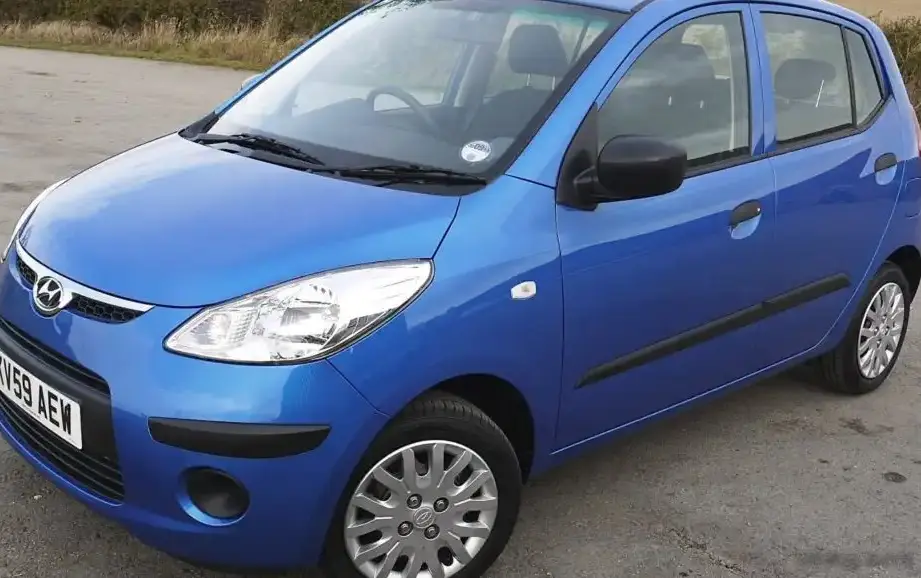
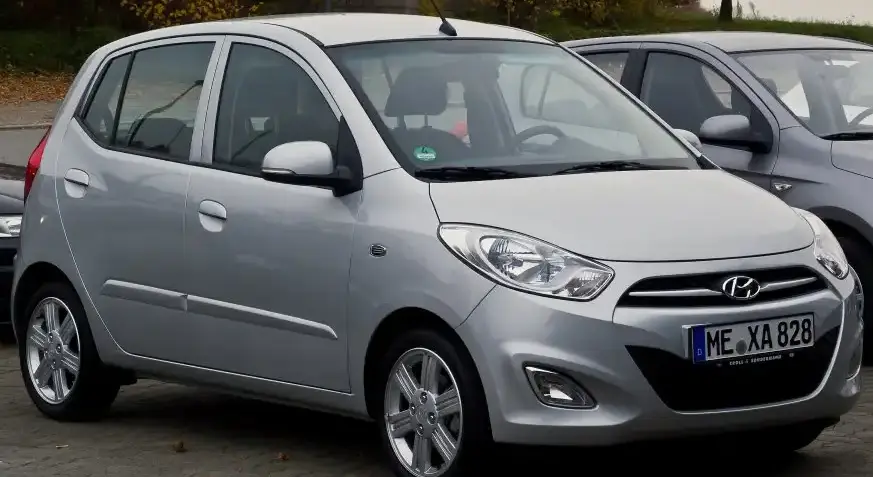
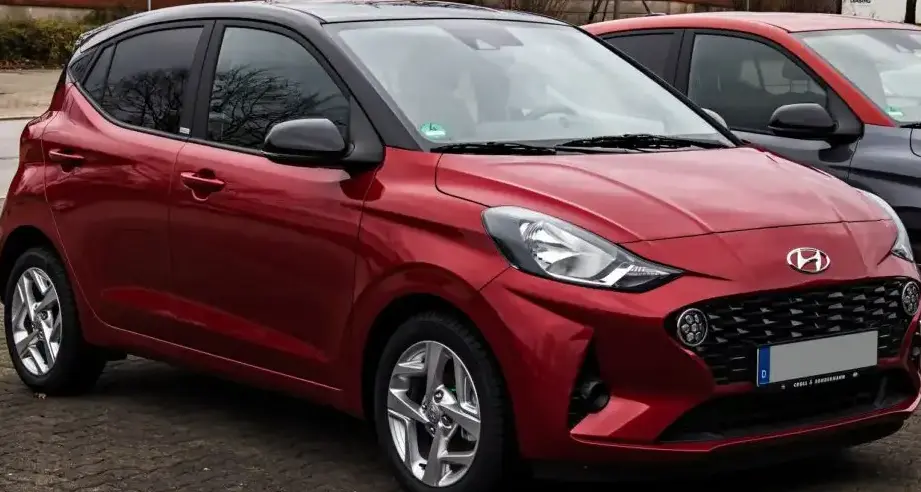
The Hyundai i10 III 1.0 MPi (67 hp) Automatic is a city car manufactured by Hyundai from August 2019 to April 2023. It was positioned as the entry-level powertrain option within the third generation i10 (AH2 platform), specifically targeting buyers in European and Asian markets seeking affordable and convenient transportation. This variant offered an automatic transmission in a segment often dominated by manual gearboxes, providing a balance between cost and ease of use. The i10 III represented a significant evolution of the i10 line, incorporating improvements in safety features, interior refinement, and overall styling.
Powertrain & Engine Architecture
The i10 1.0 MPi Automatic is powered by Hyundai’s G3LA (or G3LD in some markets) three-cylinder gasoline engine. This engine is naturally aspirated, meaning it doesn’t utilize turbocharging or supercharging. It employs a multi-point fuel injection system, delivering fuel directly into the intake ports for optimized combustion. The engine features a double overhead camshaft (DOHC) valvetrain with four valves per cylinder, enhancing airflow and combustion efficiency. The compact 998cc displacement is designed to minimize friction and weight, contributing to fuel economy. The engine is paired with a four-speed automatic transmission. This transmission, while offering the convenience of automatic operation, is a simpler design compared to modern continuously variable transmissions (CVTs) or dual-clutch transmissions (DCTs), prioritizing affordability and reliability over peak performance or fuel efficiency.
Driving Characteristics
The 1.0 MPi Automatic i10 delivers modest performance, best suited for urban driving conditions. With only 67 horsepower, acceleration is relatively slow, requiring approximately 17.3 seconds to reach 62 mph. The four-speed automatic transmission contributes to this, with relatively wide gear ratios that can result in the engine operating at higher RPMs during acceleration. Compared to the manual transmission version of the same engine, the automatic version feels noticeably slower due to the transmission’s inherent efficiency losses. Higher-spec i10 models equipped with the 1.2-liter engine offered significantly improved performance, but at a higher price point. The automatic transmission prioritizes smooth shifts and ease of use, making it ideal for novice drivers or those frequently navigating stop-and-go traffic. The gear ratios are tuned for drivability rather than outright speed.
Equipment & Trim Levels
The 1.0 MPi Automatic typically served as the base or mid-range trim level in the i10 III lineup. Standard equipment generally included air conditioning, central locking, electric front windows, a basic audio system with USB connectivity, and essential safety features like ABS and multiple airbags. Higher trim levels added features such as alloy wheels, a touchscreen infotainment system with Apple CarPlay and Android Auto compatibility, rear parking sensors, and a leather-wrapped steering wheel. Interior upholstery was typically cloth, with a simple and functional dashboard layout. Optional extras included metallic paint finishes and upgraded audio systems. The focus was on providing essential features at an affordable price point.
Chassis & Braking
The i10 III utilizes a front-wheel-drive layout with an independent MacPherson strut suspension at the front and a torsion beam suspension at the rear. This setup provides a comfortable ride quality, particularly on smoother road surfaces. The front brakes are ventilated discs, offering adequate stopping power for the vehicle’s weight and performance. The rear brakes are discs, an upgrade from the drums found on some earlier i10 models. Electric power steering provides light and easy steering feel, making maneuvering in tight spaces effortless. Stabilizer bars were included to reduce body roll during cornering, though the i10 is not designed for spirited driving. The suspension tuning prioritizes comfort over handling precision.
Market Reception & Comparison
The Hyundai i10 III 1.0 MPi Automatic was generally well-received as an affordable and practical city car. Critics praised its ease of use, comfortable ride, and generous standard equipment for its price point. However, the engine’s lack of power and the transmission’s limited number of gears were common criticisms. Compared to other city cars in its class, such as the Kia Picanto, Volkswagen Up!, and Toyota Aygo, the i10 offered a competitive package with a longer warranty and a reputation for reliability. Fuel economy was respectable, around 5.3 l/100km, but not class-leading. The automatic transmission, while convenient, resulted in slightly lower fuel economy compared to the manual version. It represented a solid value proposition for budget-conscious buyers.
Legacy
The Hyundai i10 III 1.0 MPi Automatic has proven to be a reliable and durable powertrain combination. The three-cylinder engine, while not particularly powerful, is known for its longevity and relatively low maintenance costs. The four-speed automatic transmission is also generally reliable, though it may require fluid changes and occasional servicing. In the used car market, these i10s represent a good value proposition for buyers seeking an affordable and economical city car. Their simple mechanical design and readily available parts contribute to their ongoing appeal. While not a performance icon, the i10 1.0 MPi Automatic fulfilled its intended purpose as a practical and dependable mode of transportation for a wide range of drivers, and continues to be a viable option for those seeking basic, reliable transportation.