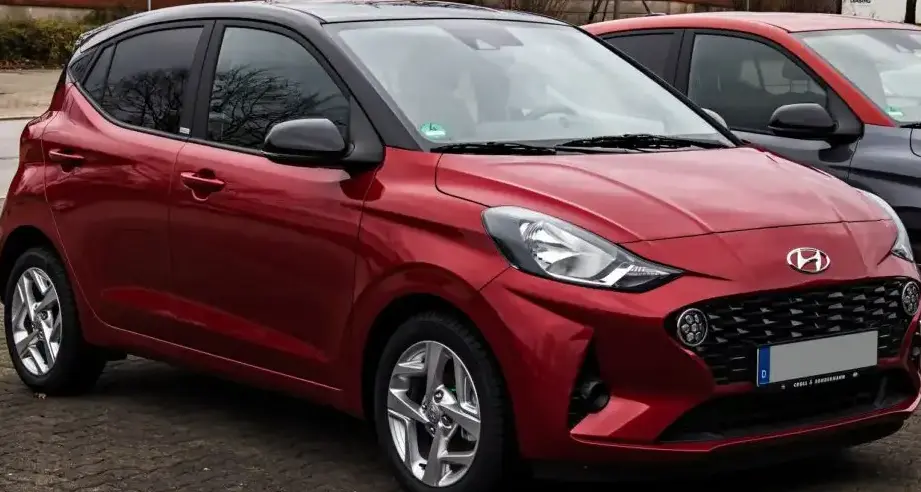
The Hyundai i10 III 1.0 MPi (67 Hp) Standard is a front-wheel-drive, five-door hatchback that served as the entry point to the third generation of Hyundai’s city car, produced from August 2019 to April 2023. Positioned within the PA3 platform family, this variant was designed to offer affordable and efficient transportation, primarily targeting urban drivers and first-time car buyers. It represented a significant update over its predecessor, boasting a more refined interior, improved safety features, and a slightly larger overall footprint while maintaining its compact dimensions. The “Standard” trim level signified a focus on value, offering essential features at a competitive price point.
Technical Specifications
| Brand | Hyundai |
| Model | i10 |
| Generation | i10 III |
| Type (Engine) | 1.0 MPi (67 Hp) Standard |
| Start of production | August, 2019 |
| End of production | April, 2023 |
| Powertrain Architecture | Internal Combustion engine |
| Body type | Hatchback |
| Seats | 4 |
| Doors | 5 |
| Fuel consumption (combined) | 5 l/100 km (47 US mpg, 56.5 UK mpg, 20 km/l) |
| CO2 emissions | 115 g/km |
| Fuel Type | Petrol (Gasoline) |
| Acceleration 0 – 100 km/h | 15 sec |
| Acceleration 0 – 62 mph | 15 sec |
| Acceleration 0 – 60 mph | 14.3 sec |
| Maximum speed | 156 km/h (96.93 mph) |
| Emission standard | Euro 6d-TEMP |
| Weight-to-power ratio | 14 kg/Hp, 71.7 Hp/tonne |
| Weight-to-torque ratio | 9.7 kg/Nm, 102.7 Nm/tonne |
| Power | 67 Hp @ 5500 rpm |
| Power per litre | 67.1 Hp/l |
| Torque | 96 Nm @ 3750 rpm (70.81 lb.-ft. @ 3750 rpm) |
| Engine layout | Front, Transverse |
| Engine Model/Code | G3LA, G3LD |
| Engine displacement | 998 cm3 (60.9 cu. in.) |
| Number of cylinders | 3 |
| Engine configuration | Inline |
| Cylinder Bore | 71 mm (2.8 in.) |
| Piston Stroke | 84 mm (3.31 in.) |
| Compression ratio | 11:1 |
| Number of valves per cylinder | 4 |
| Fuel injection system | Multi-port manifold injection |
| Engine aspiration | Naturally aspirated engine |
| Valvetrain | DOHC |
| Engine oil capacity | 3.1 l (3.28 US qt | 2.73 UK qt) |
| Coolant | 4.5 l (4.76 US qt | 3.96 UK qt) |
| Kerb Weight | 935 kg (2061.32 lbs.) |
| Max. weight | 1350 kg (2976.24 lbs.) |
| Max load | 415 kg (914.92 lbs.) |
| Trunk (boot) space – minimum | 252 l (8.9 cu. ft.) |
| Fuel tank capacity | 36 l (9.51 US gal | 7.92 UK gal) |
| Length | 3670 mm (144.49 in.) |
| Width | 1680 mm (66.14 in.) |
| Height | 1480 mm (58.27 in.) |
| Wheelbase | 2425 mm (95.47 in.) |
| Front track | 1467-1479 mm (57.76 – 58.23 in.) |
| Rear (Back) track | 1478-1490 mm (58.19 – 58.66 in.) |
| Front overhang | 705 mm (27.76 in.) |
| Rear overhang | 540 mm (21.26 in.) |
| Ride height (ground clearance) | 149 mm (5.87 in.) |
| Minimum turning circle | 10.0 m (32.81 ft.) |
| Drivetrain Architecture | The Internal combustion engine (ICE) drives the front wheels of the vehicle. |
| Drive wheel | Front wheel drive |
| Number of gears and type of gearbox | 5 gears, manual transmission |
| Front suspension | Independent type McPherson |
| Rear suspension | Torsion |
| Front brakes | Ventilated discs, 252 mm |
| Rear brakes | Disc, 234 mm |
| Assisting systems | ABS (Anti-lock braking system) |
| Steering type | Steering rack and pinion |
| Power steering | Electric Steering |
| Tires size | 175/65 R14; 185/55 R15; 195/45 R16 |
| Wheel rims size | 14; 15; 16 |
Powertrain & Engine Architecture
The heart of the i10 III 1.0 MPi Standard is the Hyundai G3LA (or G3LD in some markets) inline-three cylinder engine. This naturally aspirated engine, displacing 998 cc, utilizes a multi-point fuel injection system and a double overhead camshaft (DOHC) valvetrain with four valves per cylinder. The engine’s design prioritizes fuel efficiency and low emissions, making it suitable for city driving. The 67 horsepower peak is achieved at 5500 rpm, while the 96 Nm (70.81 lb-ft) of torque is delivered at 3750 rpm. This engine is known for its simplicity and relatively low maintenance requirements. The standard transmission for this variant was a five-speed manual gearbox, chosen for its cost-effectiveness and contribution to fuel economy. The engine’s compact size and lightweight construction contribute to the i10’s nimble handling.
Driving Characteristics
The 1.0 MPi engine, paired with the five-speed manual transmission, provides adequate, though not exhilarating, performance. Acceleration from 0 to 60 mph takes approximately 14.3 seconds, and the top speed is around 96.93 mph. The gear ratios are tuned for maximizing fuel efficiency rather than outright speed. In real-world driving, the engine feels responsive enough for navigating urban environments, but struggles when fully loaded or attempting quick overtaking maneuvers on highways. The light clutch and easy-to-shift gearbox make it a forgiving car for new drivers. Compared to higher-spec i10 models with larger engines, this variant feels noticeably slower, but offers a more economical driving experience.
Equipment & Trim Levels
The “Standard” trim level of the i10 III 1.0 MPi was designed to be the most affordable option. Standard features typically included air conditioning, electric front windows, central locking, a basic audio system with USB connectivity, and ABS brakes with Electronic Stability Control (ESC). Interior upholstery was typically cloth, and the dashboard featured a functional, if somewhat basic, design. Optional extras available for this trim included alloy wheels, a touchscreen infotainment system with Apple CarPlay and Android Auto compatibility, and rear parking sensors. The focus was on providing essential features without adding unnecessary cost.
Chassis & Braking
The i10 III utilizes a McPherson strut front suspension and a torsion beam rear suspension. This setup provides a comfortable ride quality, particularly on smooth roads. The front brakes are ventilated discs measuring 252 mm, while the rear brakes are solid discs measuring 234 mm. ABS (Anti-lock Braking System) is standard, enhancing safety during emergency braking situations. The relatively lightweight construction of the i10 contributes to its agile handling. Stabilizer bars were fitted to both the front and rear axles to reduce body roll during cornering.
Market Reception & Comparison
The Hyundai i10 III 1.0 MPi Standard received generally positive reviews for its affordability, fuel efficiency, and practicality. Critics praised its comfortable ride and easy-to-use controls. However, the engine’s lack of power was a common criticism, particularly when compared to competitors offering larger engines. In terms of fuel economy, the i10 1.0 MPi consistently outperformed many of its rivals, achieving around 5 l/100 km in combined driving. Reliability was also a strong point, with the G3LA engine proving to be durable and relatively trouble-free. Compared to the 1.2 MPi variants, the 1.0 MPi offered lower running costs but sacrificed performance.
Legacy
The Hyundai i10 III 1.0 MPi Standard has proven to be a reliable and economical city car, maintaining a good reputation in the used car market. The G3LA engine is known for its longevity, and maintenance costs are generally low. While not a performance car, it provides a practical and affordable solution for urban commuting and first-time car buyers. Its fuel efficiency and low emissions continue to make it an attractive option for environmentally conscious drivers. The i10 III, in general, helped solidify Hyundai’s position as a major player in the European city car segment.