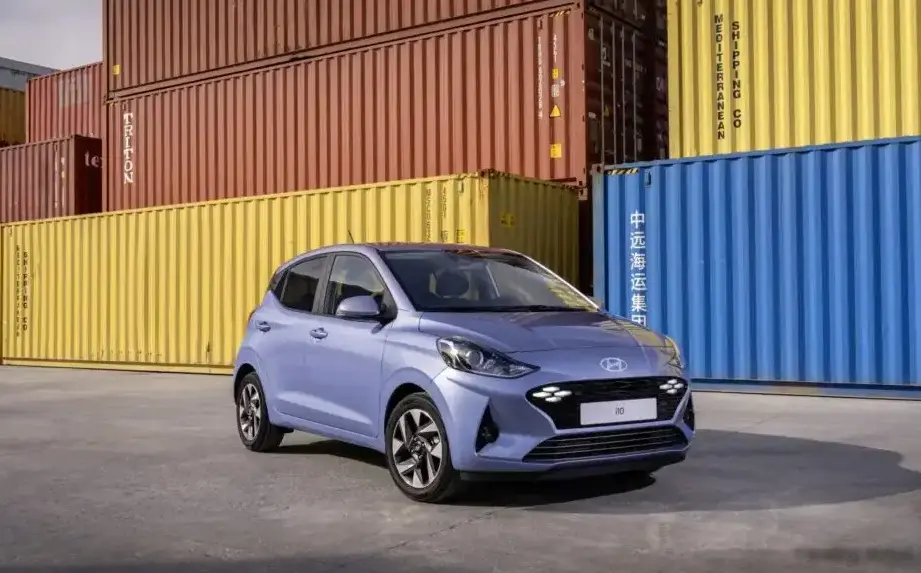
The Hyundai i10 III (facelift, introduced in April 2023 and running through May 2024) represents a mid-cycle refresh of the third-generation i10, Hyundai’s city car offering primarily aimed at the European market. This variant, equipped with the 1.0-liter three-cylinder engine producing 67 horsepower, served as the entry point into the i10 lineup. Positioned as the most affordable option, it targeted buyers prioritizing fuel efficiency and low running costs over outright performance. The facelift brought subtle styling updates and enhanced standard equipment, solidifying the i10’s position as a competitive player in the A-segment.
Technical Specifications
| Brand | Hyundai |
| Model | i10 |
| Generation | i10 III (facelift 2023) |
| Type (Engine) | 1.0 (67 Hp) |
| Start of production | April, 2023 |
| End of production | May, 2024 |
| Powertrain Architecture | Internal Combustion engine |
| Body type | Hatchback |
| Seats | 5 |
| Doors | 5 |
| Fuel consumption at Low speed (WLTP) | 6.4 l/100 km (36.8 US mpg, 44.1 UK mpg, 15.6 km/l) |
| Fuel consumption at Medium speed (WLTP) | 4.8-4.9 l/100 km (49 – 48 US mpg, 58.9 – 57.6 UK mpg, 20.8 – 20.4 km/l) |
| Fuel consumption at high speed (WLTP) | 4.5 l/100 km (52.3 US mpg, 62.8 UK mpg, 22.2 km/l) |
| Fuel consumption at very high speed (WLTP) | 5.7-5.8 l/100 km (41.3 – 40.6 US mpg, 49.6 – 48.7 UK mpg, 17.5 – 17.2 km/l) |
| Combined fuel consumption (WLTP) | 5.2-5.3 l/100 km (45.2 – 44.4 US mpg, 54.3 – 53.3 UK mpg, 19.2 – 18.9 km/l) |
| CO2 emissions (WLTP) | 119-120 g/km |
| Fuel Type | Petrol (Gasoline) |
| Acceleration 0 – 100 km/h | 14.8 sec |
| Acceleration 0 – 62 mph | 14.8 sec |
| Acceleration 0 – 60 mph | 14.1 sec |
| Maximum speed | 156 km/h (96.93 mph) |
| Emission standard | Euro 6d |
| Weight-to-power ratio | 13.7 kg/Hp, 72.7 Hp/tonne |
| Weight-to-torque ratio | 9.6 kg/Nm, 104.2 Nm/tonne |
| Power | 67 Hp @ 5500 rpm |
| Torque | 96 Nm @ 3750 rpm (70.81 lb.-ft. @ 3750 rpm) |
| Engine layout | Front, Transverse |
| Engine Model/Code | G3LD |
| Engine displacement | 998 cm3 (60.9 cu. in.) |
| Number of cylinders | 3 |
| Engine configuration | Inline |
| Cylinder Bore | 71 mm (2.8 in.) |
| Piston Stroke | 84 mm (3.31 in.) |
| Compression ratio | 11:1 |
| Number of valves per cylinder | 4 |
| Fuel injection system | Multi-port manifold injection |
| Engine aspiration | Naturally aspirated engine |
| Valvetrain | DOHC |
| Engine oil capacity | 3.1 l (3.28 US qt | 2.73 UK qt) |
| Coolant | 4.5 l (4.76 US qt | 3.96 UK qt) |
| Kerb Weight | 921-993 kg (2030.46 – 2189.19 lbs.) |
| Max. weight | 1410 kg (3108.52 lbs.) |
| Max load | 417-489 kg (919.33 – 1078.06 lbs.) |
| Trunk (boot) space – minimum | 252 l (8.9 cu. ft.) |
| Trunk (boot) space – maximum | 1050 l (37.08 cu. ft.) |
| Fuel tank capacity | 36 l (9.51 US gal | 7.92 UK gal) |
| Max. roof load | 60 kg (132.28 lbs.) |
| Permitted trailer load with brakes (12%) | 300 kg (661.39 lbs.) |
| Permitted trailer load without brakes | 300 kg (661.39 lbs.) |
| Permitted towbar download | 75 kg (165.35 lbs.) |
| Length | 3670 mm (144.49 in.) |
| Width | 1680 mm (66.14 in.) |
| Height | 1480 mm (58.27 in.) |
| Wheelbase | 2425 mm (95.47 in.) |
| Front track | 1467 mm (57.76 in.) |
| Rear (Back) track | 1478 mm (58.19 in.) |
| Minimum turning circle | 9.7 m (31.82 ft.) |
| Drivetrain Architecture | The Internal combustion engine (ICE) drives the front wheels of the vehicle. |
| Drive wheel | Front wheel drive |
| Number of gears and type of gearbox | 5 gears, manual transmission |
| Front suspension | Independent type McPherson |
| Rear suspension | Torsion |
| Front brakes | Ventilated discs, 252 mm |
| Rear brakes | Disc, 234 mm |
| Assisting systems | ABS (Anti-lock braking system) |
| Steering type | Steering rack and pinion |
| Power steering | Electric Steering |
| Tires size | 185/55 R15; 195/45 R16 |
| Wheel rims size | 6.0J x 15; 6.5J x 16 |
Powertrain & Engine Architecture
The heart of this i10 variant is the Hyundai G3LD, a 998cc three-cylinder petrol engine. This engine is part of Hyundai-Kia’s Kappa family of engines, known for its compact size and focus on efficiency. The G3LD utilizes a multi-point fuel injection system and a double overhead camshaft (DOHC) valvetrain with four valves per cylinder. This configuration helps optimize combustion and contribute to the engine’s relatively smooth operation for a three-cylinder unit. The engine produces 67 horsepower at 5500 rpm and 96 Nm (70.81 lb-ft) of torque at 3750 rpm. The engine is paired with a 5-speed manual transmission, delivering power to the front wheels. The G3LD also incorporates a Start & Stop System to further improve fuel economy in urban driving conditions.
Driving Characteristics
The 1.0-liter i10 offers modest performance, prioritizing fuel economy over acceleration. The 0-60 mph time of around 14.1 seconds and a top speed of 96.93 mph reflect this. In real-world driving, the engine feels adequate for city commutes and short trips, but struggles when fully loaded or attempting to overtake at higher speeds. The 5-speed manual transmission is well-matched to the engine’s characteristics, offering reasonable gear spacing. Compared to higher-spec i10 models with larger engines, this variant feels noticeably slower, but the lighter engine weight contributes to nimble handling in urban environments. The gear ratios are tuned for maximizing fuel efficiency, meaning the engine can feel strained when climbing hills or accelerating quickly.
Equipment & Trim Levels
The base-level i10 1.0 typically came equipped with essential features such as air conditioning, central locking, electric front windows, and a basic audio system. Safety features included ABS, Electronic Stability Control (ESC), and multiple airbags. Higher trim levels added features like alloy wheels, a touchscreen infotainment system with Apple CarPlay and Android Auto compatibility, rear parking sensors, and a leather-wrapped steering wheel. Interior upholstery was typically cloth, with a simple and functional dashboard layout. Optional extras included a panoramic sunroof and a navigation system.
Chassis & Braking
The i10 III utilizes a front-wheel-drive layout with an independent McPherson strut suspension at the front and a torsion beam suspension at the rear. This setup provides a comfortable ride quality, particularly on smooth roads. The braking system consists of ventilated discs at the front and discs at the rear. ABS (Anti-lock Braking System) is standard, enhancing braking performance and stability. The relatively lightweight nature of the 1.0-liter i10 contributes to its agile handling characteristics.
Market Reception & Comparison
The Hyundai i10 1.0 was generally well-received by critics as an affordable and practical city car. Its fuel efficiency was a major selling point, and its compact size made it easy to maneuver in congested urban areas. Compared to other A-segment competitors like the Kia Picanto and Volkswagen up!, the i10 offered a compelling combination of value, features, and warranty coverage. However, some reviewers noted the engine’s lack of power, particularly when compared to larger-engined rivals. The 1.0-liter version was often seen as a sensible choice for buyers prioritizing economy over performance.
Legacy
The Hyundai i10 III 1.0 has proven to be a reliable and durable city car. The G3LD engine, while not particularly powerful, is known for its longevity and relatively low maintenance costs. In the used car market, these models represent a good value proposition for buyers seeking an affordable and economical vehicle. Common issues are relatively minor, often related to wear and tear on components like the clutch and brakes. The i10’s reputation for reliability and low running costs has helped it maintain a strong presence in the used car market.