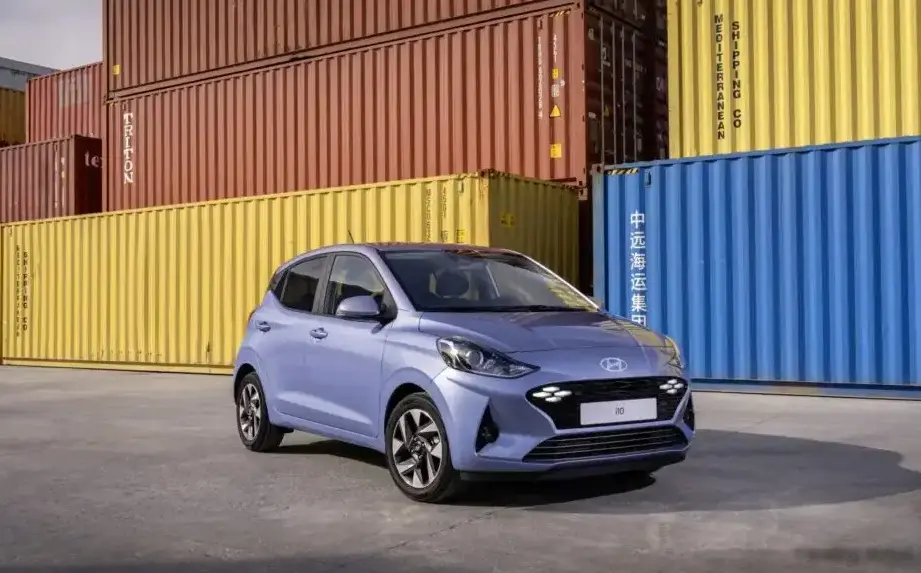
The Hyundai i10 III, specifically the facelifted version introduced in May 2024, represents the third generation of Hyundai’s city car. The 1.0 T-GDI (90 hp) variant is a key offering within the i10 lineup, positioned as a balance between fuel efficiency and respectable performance. This model falls within the broader context of the Hyundai i10’s role as a competitive entry-level hatchback, primarily targeted at the European and Asian markets, though increasingly available in other regions. The facelift brought styling updates and enhanced technology, building upon the foundation laid by the original i10 III, which debuted on the K1 platform (internally known as the HX platform). This particular engine and transmission combination aims to appeal to buyers seeking a modern, well-equipped city car without the higher costs associated with more powerful engines or automatic transmissions.
Technical Specifications
| Brand | Hyundai |
| Model | i10 |
| Generation | i10 III (facelift 2023) |
| Type (Engine) | 1.0 T-GDI (90 Hp) |
| Start of production | May, 2024 |
| Powertrain Architecture | Internal Combustion engine |
| Body type | Hatchback |
| Seats | 5 |
| Doors | 5 |
| Combined fuel consumption (WLTP) | 5.4 l/100 km (43.6 US mpg, 52.3 UK mpg, 18.5 km/l) |
| CO2 emissions (WLTP) | 123 g/km |
| Fuel Type | Petrol (Gasoline) |
| Acceleration 0 – 100 km/h | 11.4 sec |
| Acceleration 0 – 62 mph | 11.4 sec |
| Acceleration 0 – 60 mph | 10.8 sec |
| Maximum speed | 175 km/h (108.74 mph) |
| Emission standard | Euro 6e |
| Weight-to-power ratio | 11.4 kg/Hp, 87.9 Hp/tonne |
| Weight-to-torque ratio | 6 kg/Nm, 168 Nm/tonne |
| Power | 90 Hp @ 4500-5500 rpm |
| Power per litre | 90.2 Hp/l |
| Torque | 172 Nm @ 1500-3500 rpm (126.86 lb.-ft. @ 1500-3500 rpm) |
| Engine layout | Front, Transverse |
| Engine Model/Code | G3LE |
| Engine displacement | 998 cm3 (60.9 cu. in.) |
| Number of cylinders | 3 |
| Engine configuration | Inline |
| Cylinder Bore | 71 mm (2.8 in.) |
| Piston Stroke | 84 mm (3.31 in.) |
| Number of valves per cylinder | 4 |
| Fuel injection system | Direct injection |
| Engine aspiration | Turbocharger, Intercooler |
| Engine oil capacity | 3.6 l (3.8 US qt | 3.17 UK qt) |
| Coolant | 4.5 l (4.76 US qt | 3.96 UK qt) |
| Kerb Weight | 1024-1045 kg (2257.53 – 2303.83 lbs.) |
| Max. weight | 1470 kg (3240.8 lbs.) |
| Max load | 425-446 kg (936.96 – 983.26 lbs.) |
| Trunk (boot) space – minimum | 252 l (8.9 cu. ft.) |
| Trunk (boot) space – maximum | 1050 l (37.08 cu. ft.) |
| Fuel tank capacity | 36 l (9.51 US gal | 7.92 UK gal) |
| Max. roof load | 60 kg (132.28 lbs.) |
| Permitted trailer load with brakes (12%) | 310 kg (683.43 lbs.) |
| Permitted trailer load without brakes | 310 kg (683.43 lbs.) |
| Permitted towbar download | 75 kg (165.35 lbs.) |
| Length | 3670 mm (144.49 in.) |
| Width | 1680 mm (66.14 in.) |
| Height | 1480 mm (58.27 in.) |
| Wheelbase | 2425 mm (95.47 in.) |
| Front track | 1467 mm (57.76 in.) |
| Rear (Back) track | 1478 mm (58.19 in.) |
| Front overhang | 540 mm (21.26 in.) |
| Rear overhang | 705 mm (27.76 in.) |
| Ride height (ground clearance) | 152 mm (5.98 in.) |
| Drivetrain Architecture | The Internal combustion engine (ICE) drives the front wheels of the vehicle. |
| Drive wheel | Front wheel drive |
| Number of gears and type of gearbox | 5 gears, manual transmission |
| Front suspension | Independent type McPherson |
| Rear suspension | Torsion |
| Front brakes | Ventilated discs |
| Rear brakes | Disc |
| Assisting systems | ABS (Anti-lock braking system) |
| Steering type | Steering rack and pinion |
| Power steering | Electric Steering |
| Tires size | 195/45 R16 |
| Wheel rims size | 6.5J x 16 |
Powertrain & Engine Architecture
The heart of this i10 variant is the Hyundai G3LE, a 998cc turbocharged three-cylinder engine. This engine utilizes direct fuel injection and a single scroll turbocharger with an intercooler to deliver a surprisingly punchy 90 horsepower and 172 Nm (126.86 lb-ft) of torque. The engine’s architecture is designed for efficiency, featuring a lightweight aluminum block and cylinder head. The G3LE engine is part of Hyundai-Kia’s ‘Kappa’ engine family, known for its compact size and fuel-saving technologies. A 5-speed manual transmission is standard, chosen for its simplicity and cost-effectiveness. While an automatic transmission is available on other i10 trims, it is not offered with this specific 1.0 T-GDI engine.
Driving Characteristics
The 1.0 T-GDI with the 5-speed manual provides a reasonably engaging driving experience for a city car. Acceleration to 60 mph takes around 10.8 seconds, which is adequate for urban driving and short highway trips. The turbocharger provides a noticeable boost in power, particularly in the mid-range, making overtaking easier than with naturally aspirated engines of similar displacement. The gear ratios are tuned for fuel economy, meaning the engine can feel slightly strained at higher speeds. However, the light weight of the i10 (around 1024-1045 kg) helps to mitigate this. Compared to the base 1.0 MPI engine, the T-GDI offers significantly more power and torque, resulting in a more responsive and enjoyable driving experience. It doesn’t match the performance of larger-engined rivals, but it provides a good balance between performance and efficiency.
Equipment & Trim Levels
The 1.0 T-GDI typically comes in mid-range trim levels, offering a good level of standard equipment. This usually includes air conditioning, a touchscreen infotainment system with Apple CarPlay and Android Auto compatibility, Bluetooth connectivity, and power windows. Safety features such as ABS, ESC (Electronic Stability Control), and multiple airbags are also standard. Optional extras often include alloy wheels, a rear-view camera, parking sensors, and a premium audio system. Interior upholstery is typically cloth, with a focus on durability and practicality. The dashboard layout is modern and functional, with a clear instrument cluster and intuitive controls.
Chassis & Braking
The i10 III utilizes a McPherson strut front suspension and a torsion beam rear suspension. This setup provides a comfortable ride quality, well-suited for navigating city streets. The steering is light and precise, making it easy to maneuver in tight spaces. The braking system consists of ventilated discs on the front wheels and discs on the rear, providing adequate stopping power. ABS (Anti-lock Braking System) is standard, enhancing safety in emergency braking situations. The relatively low weight of the vehicle contributes to its nimble handling and efficient braking performance.
Market Reception & Comparison
The 1.0 T-GDI i10 has been generally well-received by automotive critics. It’s praised for its fuel efficiency, surprisingly strong performance for its size, and well-equipped interior. Compared to other trims in the i10 lineup, the T-GDI offers a noticeable performance upgrade over the naturally aspirated engines, while remaining more affordable than the higher-powered options. Fuel economy is competitive, averaging around 5.4 l/100 km (43.6 US mpg). Reliability has been generally good, with few reported issues with the engine or transmission. However, some owners have noted that the ride can be a bit firm on rough roads.
Legacy
The Hyundai i10 III 1.0 T-GDI has established itself as a popular choice in the city car segment. The G3LE engine has proven to be a reliable and efficient powerplant, and the i10’s overall build quality is commendable. On the used car market, these models hold their value reasonably well, particularly those with low mileage and a full service history. The combination of affordability, fuel efficiency, and decent performance makes it a practical and appealing option for buyers seeking a small, modern hatchback. As Hyundai continues to develop its range of electric vehicles, the i10 1.0 T-GDI represents a transitional model, showcasing the brand’s commitment to both internal combustion engine technology and efficient design.