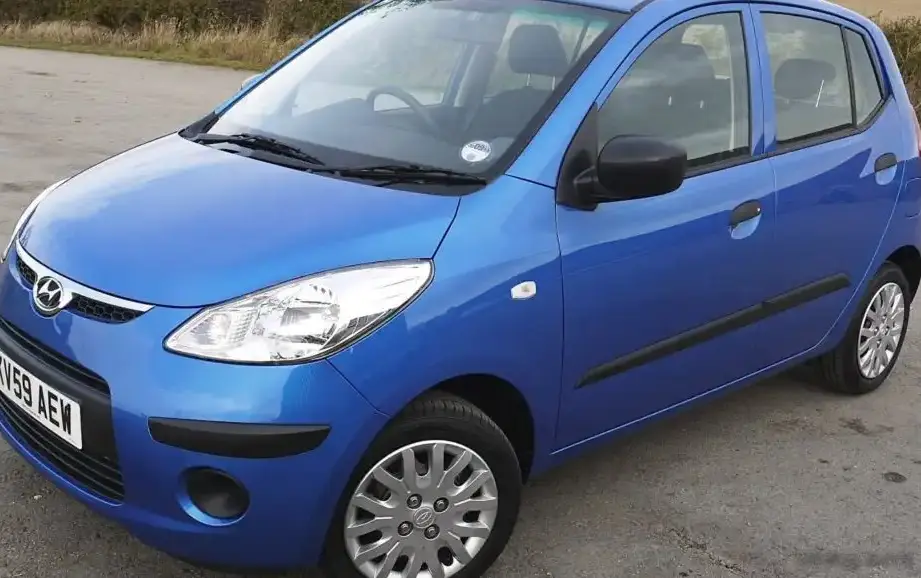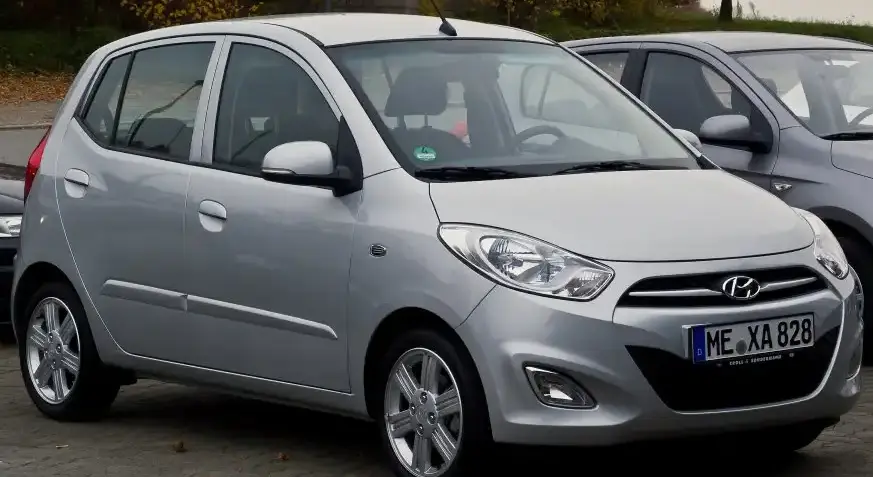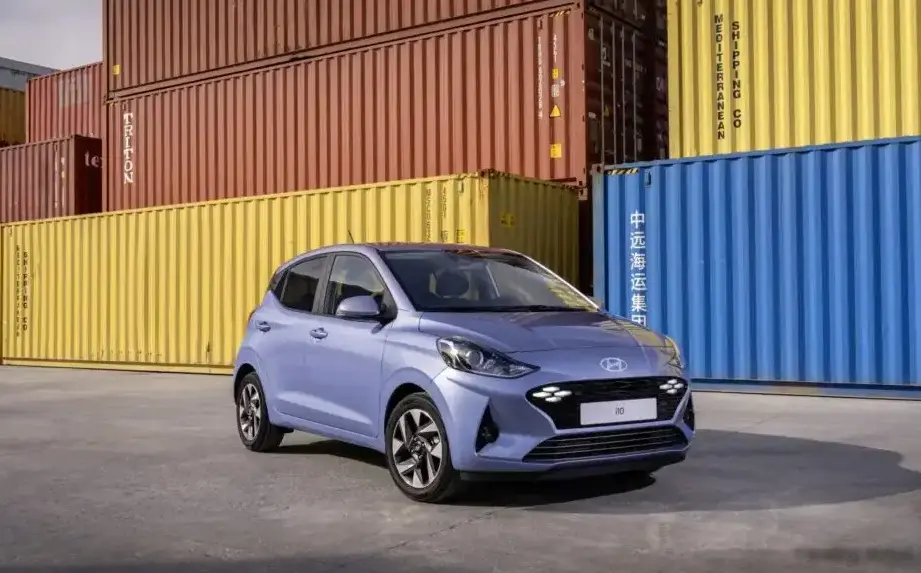
The Hyundai i10 III (facelift, introduced in April 2023 and running through May 2024) represents a significant refresh of Hyundai’s city car offering. The 1.2-liter (84 horsepower) variant occupied a central position within the i10 III lineup, serving as a balance between affordability and acceptable performance for urban driving. This facelift built upon the foundation of the PA3 platform, first introduced with the i10 III in 2019, aiming to enhance styling, technology, and overall refinement. The 1.2L engine, paired with a five-speed manual transmission, was designed to appeal to buyers prioritizing fuel efficiency and ease of use in congested city environments. This version was particularly important in European markets where small, economical cars are highly sought after.
Technical Specifications
| Brand | Hyundai |
| Model | i10 |
| Generation | i10 III (facelift 2023) |
| Type (Engine) | 1.2 (84 Hp) |
| Start of production | April, 2023 |
| End of production | May, 2024 |
| Powertrain Architecture | Internal Combustion engine |
| Body type | Hatchback |
| Seats | 5 |
| Doors | 5 |
| Fuel consumption at Low speed (WLTP) | 6.4 l/100 km (36.8 US mpg, 44.1 UK mpg, 15.6 km/l) |
| Fuel consumption at Medium speed (WLTP) | 5.1 l/100 km (46.1 US mpg, 55.4 UK mpg, 19.6 km/l) |
| Fuel consumption at high speed (WLTP) | 4.7-4.8 l/100 km (50 – 49 US mpg, 60.1 – 58.9 UK mpg, 21.3 – 20.8 km/l) |
| Fuel consumption at very high speed (WLTP) | 5.9-6 l/100 km (39.9 – 39.2 US mpg, 47.9 – 47.1 UK mpg, 16.9 – 16.7 km/l) |
| Combined fuel consumption (WLTP) | 5.4-5.5 l/100 km (43.6 – 42.8 US mpg, 52.3 – 51.4 UK mpg, 18.5 – 18.2 km/l) |
| CO2 emissions (WLTP) | 124-125 g/km |
| Fuel Type | Petrol (Gasoline) |
| Acceleration 0 – 100 km/h | 12.6 sec |
| Acceleration 0 – 62 mph | 12.6 sec |
| Acceleration 0 – 60 mph | 12 sec |
| Maximum speed | 171 km/h (106.25 mph) |
| Emission standard | Euro 6d |
| Weight-to-power ratio | 11.1 kg/Hp, 90.1 Hp/tonne |
| Weight-to-torque ratio | 7.9 kg/Nm, 126.6 Nm/tonne |
| Power | 84 Hp @ 6000 rpm |
| Power per litre | 70.2 Hp/l |
| Torque | 118 Nm @ 4200 rpm (87.03 lb.-ft. @ 4200 rpm) |
| Engine layout | Front, Transverse |
| Engine Model/Code | G4LF |
| Engine displacement | 1197 cm3 (73.05 cu. in.) |
| Number of cylinders | 4 |
| Engine configuration | Inline |
| Cylinder Bore | 71 mm (2.8 in.) |
| Piston Stroke | 75.6 mm (2.98 in.) |
| Compression ratio | 11:1 |
| Number of valves per cylinder | 4 |
| Fuel injection system | Multi-port manifold injection |
| Engine aspiration | Naturally aspirated engine |
| Valvetrain | DOHC |
| Engine oil capacity | 3.4 l (3.59 US qt | 2.99 UK qt) |
| Coolant | 4.8 l (5.07 US qt | 4.22 UK qt) |
| Kerb Weight | 932-1007 kg (2054.71 – 2220.05 lbs.) |
| Max. weight | 1430 kg (3152.61 lbs.) |
| Max load | 423-498 kg (932.56 – 1097.9 lbs.) |
| Trunk (boot) space – minimum | 252 l (8.9 cu. ft.) |
| Trunk (boot) space – maximum | 1050 l (37.08 cu. ft.) |
| Fuel tank capacity | 36 l (9.51 US gal | 7.92 UK gal) |
| Max. roof load | 60 kg (132.28 lbs.) |
| Permitted trailer load with brakes (12%) | 300 kg (661.39 lbs.) |
| Permitted trailer load without brakes | 300 kg (661.39 lbs.) |
| Permitted towbar download | 75 kg (165.35 lbs.) |
| Length | 3670 mm (144.49 in.) |
| Width | 1680 mm (66.14 in.) |
| Height | 1480 mm (58.27 in.) |
| Wheelbase | 2425 mm (95.47 in.) |
| Front track | 1467 mm (57.76 in.) |
| Rear (Back) track | 1478 mm (58.19 in.) |
| Minimum turning circle (turning diameter) | 9.7 m (31.82 ft.) |
| Drivetrain Architecture | The Internal combustion engine (ICE) drives the front wheels of the vehicle. |
| Drive wheel | Front wheel drive |
| Number of gears and type of gearbox | 5 gears, manual transmission |
| Front suspension | Independent type McPherson |
| Rear suspension | Torsion |
| Front brakes | Ventilated discs, 252 mm |
| Rear brakes | Disc, 234 mm |
| Assisting systems | ABS (Anti-lock braking system) |
| Steering type | Steering rack and pinion |
| Power steering | Electric Steering |
| Tires size | 185/55 R15; 195/45 R16 |
| Wheel rims size | 6.0J x 15; 6.5J x 16 |
INTRODUCTION
The Hyundai i10 III, and specifically the 1.2-liter 84 horsepower version, is a front-wheel-drive, five-door hatchback designed primarily for urban commuting. Introduced in 2019 and receiving a facelift in 2023, the i10 III aimed to provide a practical, affordable, and well-equipped package for buyers in the city car segment. The 1.2L engine option represented a sweet spot in the range, offering a balance between fuel economy and usability. It was a key model for Hyundai in Europe, competing with vehicles like the Fiat 500, Volkswagen Up!, and Toyota Aygo X.
Powertrain & Engine Architecture
The heart of this i10 variant is the Hyundai G4LF 1.2-liter naturally aspirated four-cylinder engine. This engine utilizes a multi-point fuel injection system and a double overhead camshaft (DOHC) valvetrain. The G4LF engine is known for its relatively simple design, contributing to its reliability and ease of maintenance. The engine produces 84 horsepower at 6000 rpm and 118 Nm (87 lb-ft) of torque at 4200 rpm. The five-speed manual transmission is a conventional setup, offering precise shifts and a direct connection to the engine. The transmission’s gear ratios are tuned for maximizing fuel efficiency and providing adequate acceleration in urban conditions. Unlike some competitors, this engine does not feature direct injection or turbocharging, prioritizing simplicity and cost-effectiveness over outright performance.
Driving Characteristics
The 1.2-liter i10 delivers a predictable and easy-to-manage driving experience. Acceleration is adequate for city driving, with a 0-60 mph time of around 12 seconds. However, it’s not designed for rapid acceleration or highway cruising. The five-speed manual transmission allows drivers to keep the engine in its optimal power band, but the limited horsepower means overtaking maneuvers require careful planning. The steering is light and precise, making it easy to maneuver in tight spaces. The suspension is tuned for comfort, absorbing bumps and imperfections in the road surface reasonably well. Compared to higher-output versions (which weren’t widely available in this generation), the 1.2L feels less strained during acceleration, but also lacks the same level of responsiveness. The manual transmission provides a more engaging driving experience than an automatic would, offering greater control over the engine’s power delivery.
Equipment & Trim Levels
The 1.2-liter i10 typically came equipped with a reasonable level of standard features. Base models included air conditioning, central locking, electric front windows, and a basic audio system. Higher trim levels, such as SE or Premium, added features like alloy wheels, a touchscreen infotainment system with Apple CarPlay and Android Auto compatibility, a rear-view camera, and parking sensors. Interior upholstery was typically cloth, with options for different colors and patterns. Safety features included ABS, ESC (Electronic Stability Control), and multiple airbags. Optional extras included a panoramic sunroof and upgraded audio systems.
Chassis & Braking
The i10 III utilizes a McPherson strut front suspension and a torsion beam rear suspension. This setup provides a good balance between ride comfort and handling. The front brakes are ventilated discs, while the rear brakes are discs. ABS (Anti-lock Braking System) is standard, providing enhanced braking performance in emergency situations. The relatively lightweight construction of the i10 contributes to its nimble handling and efficient braking. Stabilizer bars are fitted to both the front and rear axles to reduce body roll during cornering.
Market Reception & Comparison
The Hyundai i10 1.2L was generally well-received by automotive critics as a practical and affordable city car. It was praised for its fuel efficiency, comfortable ride, and generous equipment levels. However, some critics noted its lack of outright performance and its relatively basic interior materials. Compared to the more powerful (but less common) engine options, the 1.2L offered better fuel economy and lower running costs, making it a popular choice for budget-conscious buyers. Its fuel economy figures of 5.4-5.5 l/100km (43.6-42.8 US mpg) were competitive within its segment. Reliability was also a strong point, with the G4LF engine proving to be durable and dependable.
Legacy
The Hyundai i10 III 1.2L has established itself as a reliable and affordable used car option. The G4LF engine is known for its longevity, and maintenance costs are generally low. The i10’s compact size and easy maneuverability make it an ideal choice for urban drivers. While it may not offer the same level of refinement or performance as some of its competitors, its practicality, fuel efficiency, and affordability have ensured its continued popularity in the used car market. The facelifted 2023 models benefit from updated styling and improved technology, further enhancing their appeal.