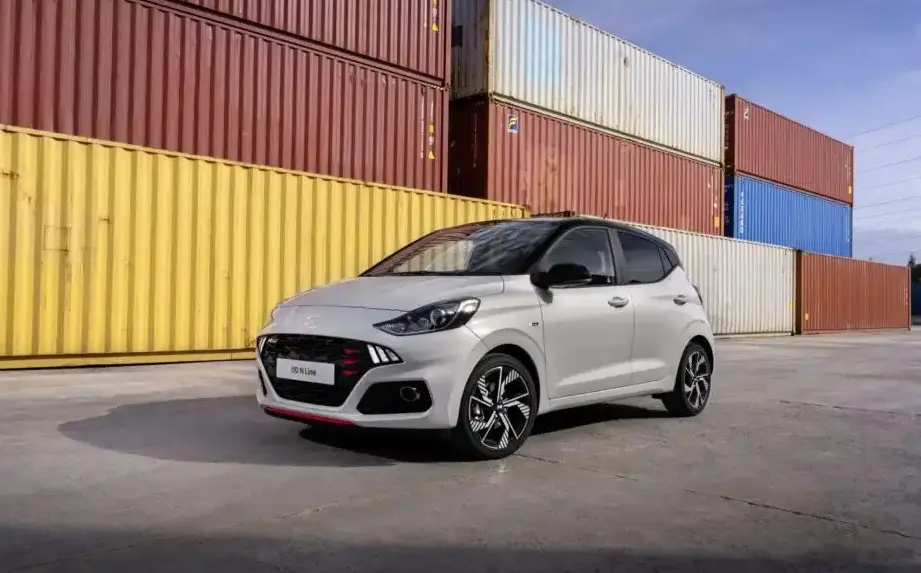
The Hyundai i10 III N Line 1.0 T-GDi, introduced in April 2023 and running through May 2024, represents a sporty iteration of Hyundai’s city car, positioned as the performance-oriented trim within the facelifted third generation (facelift 2023) i10 range. Built on the HA3 platform, this variant aimed to appeal to buyers seeking a more engaging driving experience without sacrificing the i10’s core strengths of affordability, practicality, and ease of use. The N Line trim, while not a full-fledged ‘N’ performance model, brought visual and mechanical enhancements to distinguish it from the standard i10. This specific 100 horsepower, turbocharged engine and five-speed manual transmission combination occupied the mid-range of the i10 lineup, offering a step up in performance from the base 1.0-liter naturally aspirated engine.
Technical Specifications
| Brand | Hyundai |
| Model | i10 |
| Generation | i10 III (facelift 2023) |
| Type (Engine) | N Line 1.0 T-GDi (100 Hp) |
| Start of production | April, 2023 |
| End of production | May, 2024 |
| Powertrain Architecture | Internal Combustion engine |
| Body type | Hatchback |
| Seats | 5 |
| Doors | 5 |
| Fuel consumption at Low speed (WLTP) | 6.6 l/100 km (35.6 US mpg, 42.8 UK mpg, 15.2 km/l) |
| Fuel consumption at Medium speed (WLTP) | 5.2 l/100 km (45.2 US mpg, 54.3 UK mpg, 19.2 km/l) |
| Fuel consumption at high speed (WLTP) | 4.6 l/100 km (51.1 US mpg, 61.4 UK mpg, 21.7 km/l) |
| Fuel consumption at very high speed (WLTP) | 5.8 l/100 km (40.6 US mpg, 48.7 UK mpg, 17.2 km/l) |
| Combined fuel consumption (WLTP) | 5.4 l/100 km (43.6 US mpg, 52.3 UK mpg, 18.5 km/l) |
| CO2 emissions (WLTP) | 123 g/km |
| Fuel Type | Petrol (Gasoline) |
| Acceleration 0 – 100 km/h | 10.5 sec |
| Acceleration 0 – 62 mph | 10.5 sec |
| Acceleration 0 – 60 mph | 10 sec |
| Maximum speed | 185 km/h (114.95 mph) |
| Emission standard | Euro 6d |
| Weight-to-power ratio | 10.2 kg/Hp, 97.7 Hp/tonne |
| Weight-to-torque ratio | 6 kg/Nm, 168 Nm/tonne |
| Power | 100 Hp @ 4500 rpm |
| Power per litre | 100.2 Hp/l |
| Torque | 172 Nm @ 1500 rpm (126.86 lb.-ft. @ 1500 rpm) |
| Engine layout | Front, Transverse |
| Engine Model/Code | G3LE |
| Engine displacement | 998 cm3 (60.9 cu. in.) |
| Number of cylinders | 3 |
| Engine configuration | Inline |
| Cylinder Bore | 71 mm (2.8 in.) |
| Piston Stroke | 84 mm (3.31 in.) |
| Compression ratio | 10.5:1 |
| Number of valves per cylinder | 4 |
| Fuel injection system | Direct injection |
| Engine aspiration | Turbocharger, Intercooler |
| Valvetrain | DOHC |
| Engine oil capacity | 3.6 l (3.8 US qt, 3.17 UK qt) |
| Coolant | 4.5 l (4.76 US qt, 3.96 UK qt) |
| Kerb Weight | 1024-1045 kg (2257.53 – 2303.83 lbs.) |
| Max. weight | 1470 kg (3240.8 lbs.) |
| Max load | 425-446 kg (936.96 – 983.26 lbs.) |
| Trunk (boot) space – minimum | 252 l (8.9 cu. ft.) |
| Trunk (boot) space – maximum | 1050 l (37.08 cu. ft.) |
| Fuel tank capacity | 36 l (9.51 US gal, 7.92 UK gal) |
| Max. roof load | 60 kg (132.28 lbs.) |
| Permitted trailer load with brakes (12%) | 300 kg (661.39 lbs.) |
| Permitted trailer load without brakes | 300 kg (661.39 lbs.) |
| Permitted towbar download | 75 kg (165.35 lbs.) |
| Length | 3670 mm (144.49 in.) |
| Width | 1680 mm (66.14 in.) |
| Height | 1483 mm (58.39 in.) |
| Wheelbase | 2425 mm (95.47 in.) |
| Front track | 1467 mm (57.76 in.) |
| Rear (Back) track | 1478 mm (58.19 in.) |
| Minimum turning circle (turning diameter) | 9.7 m (31.82 ft.) |
| Drivetrain Architecture | The Internal combustion engine (ICE) drives the front wheels of the vehicle. |
| Drive wheel | Front wheel drive |
| Number of gears and type of gearbox | 5 gears, manual transmission |
| Front suspension | Independent type McPherson |
| Rear suspension | Torsion |
| Front brakes | Ventilated discs, 252 mm |
| Rear brakes | Disc, 234 mm |
| Assisting systems | ABS (Anti-lock braking system) |
| Steering type | Steering rack and pinion |
| Power steering | Electric Steering |
| Tires size | 195/45 R16 |
| Wheel rims size | 6.5J x 16 |
Powertrain & Engine Architecture
The heart of the i10 N Line 1.0 T-GDi is Hyundai’s G3LE engine, a 998cc, three-cylinder turbocharged gasoline engine. This engine utilizes direct fuel injection and a single scroll turbocharger with an intercooler to deliver 100 horsepower at 4500 rpm and 172 Nm (126.86 lb-ft) of torque from as low as 1500 rpm. The engine features a double overhead camshaft (DOHC) valvetrain with four valves per cylinder, contributing to its efficient operation. The engine is transversely mounted at the front of the vehicle. The five-speed manual transmission was the sole gearbox option for this variant, providing drivers with direct control over the engine’s power. The transmission’s gear ratios were tuned to balance acceleration with fuel efficiency, prioritizing responsiveness in urban driving conditions. The engine also incorporates a Start & Stop system and a particulate filter to reduce emissions, meeting Euro 6d standards.
Driving Characteristics
The 1.0 T-GDi engine transforms the i10’s driving experience compared to the naturally aspirated models. While not a high-performance machine, the turbocharger provides a noticeable boost in power, resulting in a 0-60 mph time of around 10 seconds and a top speed of 114.95 mph. The readily available torque at low engine speeds makes it particularly well-suited for city driving, offering brisk acceleration from a standstill and effortless overtaking. The five-speed manual transmission allows for precise gear selection, enhancing driver engagement. Compared to the base i10, the N Line feels more responsive and capable, especially when carrying passengers or cargo. However, the three-cylinder engine can be somewhat vocal under heavy acceleration, and the ride quality, while generally comfortable, is slightly firmer due to the sport-tuned suspension.
Equipment & Trim Levels
The N Line trim level added several distinctive features to the standard i10. Exterior enhancements included a unique front grille, sporty bumpers, side skirts, and a rear diffuser. Inside, the N Line featured sport seats with a patterned cloth upholstery, a leather-wrapped steering wheel, and aluminum pedals. Standard equipment included air conditioning, a touchscreen infotainment system with Apple CarPlay and Android Auto compatibility, Bluetooth connectivity, and a suite of safety features such as ABS, ESC, and multiple airbags. Optional extras included a sunroof, parking sensors, and a rear-view camera.
Chassis & Braking
The i10 N Line utilizes a McPherson strut front suspension and a torsion beam rear suspension. The suspension was specifically tuned for the N Line to provide a more dynamic driving experience, with increased stiffness and improved body control. The braking system consists of ventilated discs at the front and solid discs at the rear, providing adequate stopping power for the vehicle’s weight and performance. The electric power steering offers light and precise steering feel, making it easy to maneuver in tight spaces.
Market Reception & Comparison
The i10 N Line was generally well-received by automotive critics as an affordable and fun-to-drive city car. It was praised for its responsive engine, engaging handling, and stylish design. Compared to other trims in the i10 lineup, the N Line offered a significant performance upgrade, appealing to drivers who prioritized driving enjoyment. Fuel economy remained respectable, with combined WLTP figures of around 5.4 l/100 km (43.6 US mpg). However, some reviewers noted the engine’s slightly rough character and the firmer ride compared to the standard i10. Competitors in this segment included the Suzuki Ignis Sport and the Volkswagen up! GTI, both of which offered similar levels of performance and practicality.
Legacy
The Hyundai i10 III N Line 1.0 T-GDi represents a successful attempt by Hyundai to inject some excitement into its entry-level city car. The G3LE engine, while not without its quirks, proved to be a reliable and efficient powerplant. On the used car market, these models hold their value reasonably well, particularly those with low mileage and a full service history. The N Line trim’s sporty styling and improved performance continue to appeal to buyers seeking a small, affordable, and engaging car. The i10 N Line helped establish Hyundai’s N Line sub-brand, paving the way for more performance-oriented models in the future.