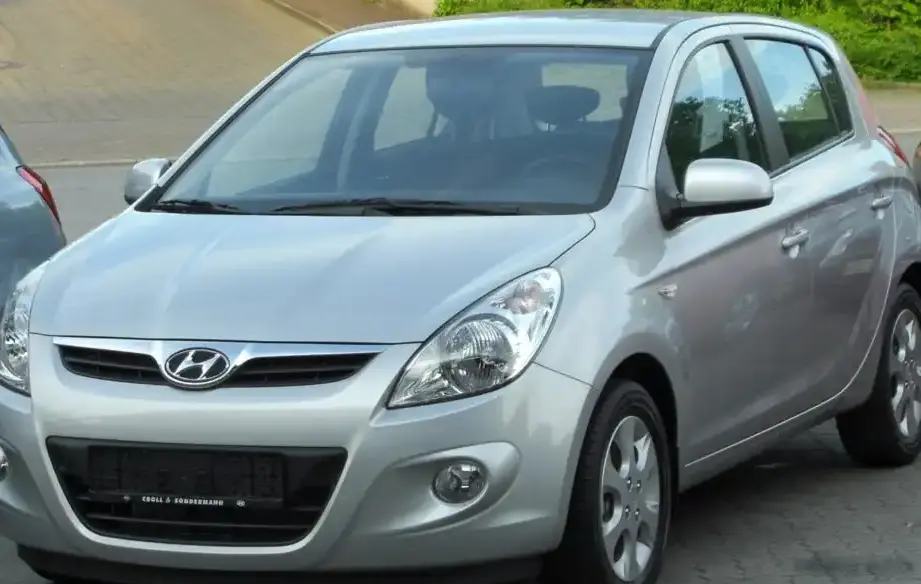
The Hyundai i20 I (PB) 1.6 CRDi, produced primarily for the European market in 2010, represented a significant step forward for Hyundai in the subcompact hatchback segment. This variant, equipped with the D4FB 1.6-liter common rail diesel engine producing 128 horsepower, aimed to offer a blend of fuel efficiency, respectable performance, and a more refined driving experience than its smaller displacement siblings. Positioned as a mid-range offering within the i20 lineup, it bridged the gap between the base 1.2-liter gasoline engine and the more expensive, feature-rich trims.
Technical Specifications
| Brand | Hyundai |
| Model | i20 |
| Generation | i20 I (PB) |
| Type (Engine) | 1.6 CRDi (128 Hp) |
| Start of production | 2010 |
| End of production | 2010 |
| Powertrain Architecture | Internal Combustion engine |
| Body type | Hatchback |
| Seats | 5 |
| Doors | 5 |
| Fuel consumption (urban) | 5.5 l/100 km (42.8 US mpg, 51.4 UK mpg, 18.2 km/l) |
| Fuel consumption (extra urban) | 3.9 l/100 km (60.3 US mpg, 72.4 UK mpg, 25.6 km/l) |
| Fuel consumption (combined) | 4.4 l/100 km (53.5 US mpg, 64.2 UK mpg, 22.7 km/l) |
| Fuel Type | Diesel |
| Acceleration 0 – 100 km/h | 10.4 sec |
| Acceleration 0 – 62 mph | 10.4 sec |
| Acceleration 0 – 60 mph | 9.9 sec |
| Maximum speed | 190 km/h (118.06 mph) |
| Emission standard | Euro 4 |
| Weight-to-power ratio | 9.6 kg/Hp, 104.7 Hp/tonne |
| Weight-to-torque ratio | 4.7 kg/Nm, 212.6 Nm/tonne |
| Power | 128 Hp @ 4000 rpm |
| Power per litre | 80.9 Hp/l |
| Torque | 260 Nm @ 1900-2750 rpm (191.77 lb.-ft. @ 1900-2750 rpm) |
| Engine layout | Front, Transverse |
| Engine Model/Code | D4FB |
| Engine displacement | 1582 cm3 (96.54 cu. in.) |
| Number of cylinders | 4 |
| Engine configuration | Inline |
| Cylinder Bore | 77.2 mm (3.04 in.) |
| Piston Stroke | 84.5 mm (3.33 in.) |
| Compression ratio | 17.3:1 |
| Number of valves per cylinder | 4 |
| Fuel injection system | Diesel Commonrail |
| Engine aspiration | Turbocharger, Intercooler |
| Valvetrain | DOHC |
| Engine oil capacity | 5.3 l (5.6 US qt | 4.66 UK qt) |
| Coolant | 6.8 l (7.19 US qt | 5.98 UK qt) |
| Kerb Weight | 1223 kg (2696.25 lbs.) |
| Max. weight | 1650 kg (3637.63 lbs.) |
| Max load | 427 kg (941.37 lbs.) |
| Trunk (boot) space – minimum | 295 l (10.42 cu. ft.) |
| Trunk (boot) space – maximum | 1060 l (37.43 cu. ft.) |
| Fuel tank capacity | 45 l (11.89 US gal | 9.9 UK gal) |
| Length | 3940 mm (155.12 in.) |
| Width | 1710 mm (67.32 in.) |
| Height | 1490 mm (58.66 in.) |
| Wheelbase | 2525 mm (99.41 in.) |
| Front track | 1487 mm (58.54 in.) |
| Rear (Back) track | 1485 mm (58.46 in.) |
| Ride height (ground clearance) | 150 mm (5.91 in.) |
| Drag coefficient (Cd) | 0.32 |
| Minimum turning circle (turning diameter) | 10.4 m (34.12 ft.) |
| Drivetrain Architecture | The Internal combustion engine (ICE) drives the front wheels of the vehicle. |
| Drive wheel | Front wheel drive |
| Number of gears and type of gearbox | 6 gears, manual transmission |
| Front brakes | Ventilated discs |
| Rear brakes | Disc |
| Assisting systems | ABS (Anti-lock braking system) |
| Steering type | Steering rack and pinion |
| Power steering | Electric Steering |
| Tires size | 185/60 R15 |
| Wheel rims size | 15 |
Powertrain & Engine Architecture
The heart of the i20 1.6 CRDi is the Hyundai D4FB engine, a 1.6-liter inline-four cylinder diesel. This engine utilizes a second-generation common rail direct injection system, delivering fuel at extremely high pressures for optimized combustion. The D4FB features a variable geometry turbocharger (VGT) with an intercooler, enhancing both low-end torque and overall power output. The engine also incorporates a double overhead camshaft (DOHC) valvetrain with four valves per cylinder, contributing to its efficient breathing and power delivery. The compression ratio of 17.3:1 is typical for a diesel engine, maximizing thermal efficiency. The 6-speed manual transmission was the standard offering, chosen for its balance of fuel economy and driver engagement.
Driving Characteristics
The 1.6 CRDi i20 offered a noticeable improvement in performance over the smaller gasoline engines. The 128 horsepower and 260 Nm (192 lb-ft) of torque provided brisk acceleration, with a 0-60 mph time of around 9.9 seconds. The engine’s peak torque, available from 1900-2750 rpm, meant that the car felt responsive in everyday driving situations, offering ample power for overtaking and merging onto highways. The six-speed manual transmission was well-matched to the engine’s characteristics, providing smooth shifts and allowing the driver to keep the engine in its optimal power band. While not a sports car, the 1.6 CRDi i20 offered a comfortable and confident driving experience.
Equipment & Trim Levels
The 1.6 CRDi trim typically included air conditioning, power windows, central locking, and a basic audio system with CD player. Safety features such as ABS (Anti-lock Braking System) and front airbags were standard. Higher trim levels offered options like alloy wheels, a multi-function steering wheel, and upgraded interior trim. The interior generally featured durable, if somewhat basic, plastics. Upholstery was typically cloth, with a focus on practicality rather than luxury.
Chassis & Braking
The i20 I (PB) utilized a front-wheel-drive platform with a MacPherson strut front suspension and a torsion beam rear suspension. This setup provided a reasonable balance between ride comfort and handling. The front brakes were ventilated discs, offering good stopping power, while the rear brakes were solid discs. Electric power steering was standard, providing light and easy steering feel. The suspension was tuned for comfort, prioritizing a smooth ride over sporty handling.
Market Reception & Comparison
The Hyundai i20 1.6 CRDi was generally well-received by automotive critics. It was praised for its fuel efficiency, comfortable ride, and surprisingly refined engine. Compared to its competitors, such as the Ford Fiesta and Volkswagen Polo, the i20 offered a competitive price point and a generous warranty. However, some critics noted that the interior materials were not as high quality as those found in some of its rivals. The 1.6 CRDi offered a significant advantage in fuel economy over the gasoline-powered i20 models, making it a popular choice for drivers who prioritized efficiency. Compared to the base 1.2L engine, the 1.6 CRDi provided a substantial boost in performance, making it a more enjoyable car to drive.
Legacy
The Hyundai i20 I (PB) 1.6 CRDi has proven to be a relatively reliable vehicle, with the D4FB engine generally considered durable. Common issues, when they arise, often relate to the diesel particulate filter (DPF) requiring regeneration, particularly on vehicles primarily used for short trips. The i20’s simple mechanical design and readily available parts contribute to its affordability and ease of maintenance. On the used car market, these models represent a good value proposition for buyers seeking an economical and practical hatchback. The i20 helped establish Hyundai as a serious contender in the European subcompact segment, paving the way for future generations of the i20 to build upon its success.