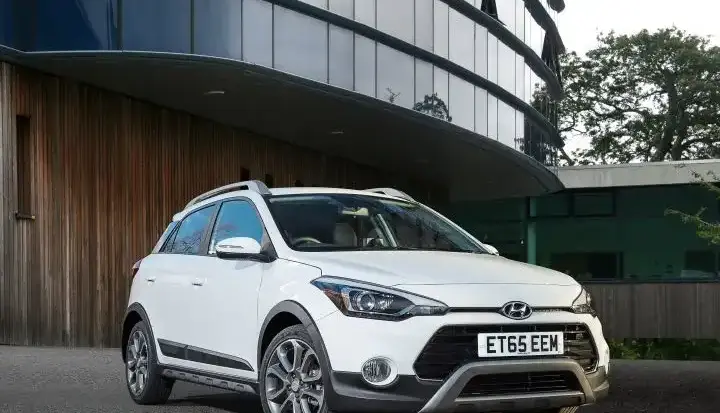
The Hyundai i20 II Active 1.4 CRDi (90 hp) was a subcompact crossover produced by the South Korean manufacturer Hyundai from 2016 to 2018. Positioned as an entry-level offering within the second generation i20 (codenamed PB) range, the Active variant aimed to capitalize on the growing popularity of small crossovers by offering increased ground clearance and rugged styling cues compared to the standard i20 hatchback. It was primarily marketed in Europe and other regions where demand for fuel-efficient and versatile small cars was high. This specific engine and transmission combination represented a balance between affordability and reasonable performance, targeting buyers seeking low running costs and practicality.
Technical Specifications
| Brand | Hyundai |
| Model | i20 |
| Generation | i20 II Active |
| Type (Engine) | 1.4 CRDi (90 Hp) |
| Start of production | 2016 |
| End of production | 2018 |
| Powertrain Architecture | Internal Combustion engine |
| Body type | Crossover |
| Seats | 5 |
| Doors | 5 |
| Fuel consumption (combined) | 4.2 – 4.3 l/100 km (56 – 54.7 US mpg) |
| CO2 emissions | 110 – 115 g/km |
| Fuel Type | Diesel |
| Acceleration 0 – 100 km/h | 12.3 sec |
| Acceleration 0 – 62 mph | 12.3 sec |
| Acceleration 0 – 60 mph | 11.7 sec |
| Maximum speed | 170 km/h (105.63 mph) |
| Emission standard | Euro 6 |
| Weight-to-power ratio | 13.1 kg/Hp |
| Weight-to-torque ratio | 4.9 kg/Nm |
| Power | 90 Hp @ 4000 rpm |
| Torque | 240 Nm @ 1500-2500 rpm (177.01 lb.-ft.) |
| Engine layout | Front, Transverse |
| Engine Model/Code | D4FC |
| Engine displacement | 1396 cm3 (85.19 cu. in.) |
| Number of cylinders | 4 |
| Engine configuration | Inline |
| Cylinder Bore | 75 mm (2.95 in.) |
| Piston Stroke | 79 mm (3.11 in.) |
| Compression ratio | 16:1 |
| Number of valves per cylinder | 4 |
| Fuel injection system | Diesel Commonrail |
| Engine aspiration | Turbocharger, Intercooler |
| Engine oil capacity | 5.3 l (5.6 US qt | 4.66 UK qt) |
| Coolant capacity | 6.4 l (6.76 US qt | 5.63 UK qt) |
| Kerb Weight | 1175 kg (2590.43 lbs.) |
| Max. weight | 1700 kg (3747.86 lbs.) |
| Max load | 525 kg (1157.43 lbs.) |
| Trunk (boot) space – minimum | 326 l (11.51 cu. ft.) |
| Trunk (boot) space – maximum | 1042 l (36.8 cu. ft.) |
| Fuel tank capacity | 50 l (13.21 US gal | 11 UK gal) |
| Length | 4065 mm (160.04 in.) |
| Width | 1760 mm (69.29 in.) |
| Height | 1529 mm (60.2 in.) |
| Wheelbase | 2570 mm (101.18 in.) |
| Front track | 1511-1517 mm (59.49 – 59.72 in.) |
| Rear track | 1513-1519 mm (59.57 – 59.8 in.) |
| Ride height (ground clearance) | 160 mm (6.3 in.) |
| Minimum turning circle | 10.2 m (33.46 ft.) |
| Drivetrain | Front wheel drive |
| Number of gears | 6 |
| Gearbox type | Manual transmission |
Powertrain & Engine Architecture
The i20 Active 1.4 CRDi utilized Hyundai’s D4FC engine, a 1.4-liter inline-four cylinder diesel engine. This engine was a common sight in various Hyundai and Kia models of the period, known for its relatively simple construction and fuel efficiency. The ‘CRDi’ designation stands for Common Rail Diesel Injection, a technology that delivers fuel directly into the cylinders at extremely high pressure, optimizing combustion and reducing emissions. The D4FC featured a turbocharger with an intercooler, which helped to boost power output and improve throttle response. The engine produced 90 horsepower at 4,000 rpm and 240 Nm (177 lb-ft) of torque between 1,500 and 2,500 rpm. This torque curve provided good low-end grunt, making it suitable for everyday driving. The engine was paired with a six-speed manual transmission, which was the standard offering for this variant. While an automatic transmission was available on other i20 models, it wasn’t offered with the 1.4 CRDi 90 hp engine.
Driving Characteristics
The 1.4 CRDi 90 hp engine, coupled with the six-speed manual transmission, provided adequate, though not exhilarating, performance. Acceleration from 0 to 100 km/h (0-62 mph) took around 12.3 seconds, and top speed was limited to 170 km/h (105.63 mph). The engine felt most comfortable in the mid-range, offering sufficient power for overtaking and merging onto highways. The gear ratios were well-chosen to maximize fuel efficiency, but this sometimes came at the expense of outright acceleration. Compared to the more powerful 1.6-liter gasoline engine available in the i20 range, the 1.4 CRDi offered significantly better fuel economy but lacked the same level of responsiveness. The manual transmission provided a more engaging driving experience than an automatic would have, allowing drivers to make the most of the available power.
Equipment & Trim Levels
The i20 Active 1.4 CRDi typically came with a reasonable level of standard equipment. This included air conditioning, power windows, central locking, a basic audio system with USB connectivity, and ABS brakes. The ‘Active’ trim level added some visual enhancements, such as rugged-looking body cladding, roof rails, and slightly raised suspension. Interior upholstery was typically cloth, and the dashboard featured a functional, if somewhat basic, design. Optional extras included alloy wheels, a touchscreen infotainment system with navigation, rear parking sensors, and a panoramic sunroof. The Active trim was positioned as a mid-range offering, bridging the gap between the base ‘S’ trim and the more luxurious ‘SE’ trim levels.
Chassis & Braking
The i20 Active featured a McPherson strut front suspension and a semi-independent coil spring rear suspension. The Active variant benefited from a slightly increased ride height compared to the standard i20, providing better ground clearance for navigating rougher terrain. Braking duties were handled by ventilated discs at the front and solid discs at the rear. ABS (Anti-lock Braking System) was standard, providing enhanced stopping power and stability. The steering was electrically assisted, offering light and precise control. The suspension setup prioritized comfort over sporty handling, providing a smooth and compliant ride on most road surfaces.
Market Reception & Comparison
The Hyundai i20 II Active 1.4 CRDi was generally well-received by automotive critics as a practical and fuel-efficient small crossover. Its low running costs and versatile interior made it an appealing option for budget-conscious buyers. However, some reviewers criticized its relatively modest performance and somewhat unrefined engine note. Compared to other diesel-powered rivals, such as the Volkswagen Polo 1.4 TDI, the i20 Active offered a competitive price point and a longer warranty. Fuel economy was a strong point, with the i20 Active achieving between 4.2 and 4.3 liters per 100 kilometers (56-54.7 US mpg) in combined driving.
Legacy
The Hyundai i20 II Active 1.4 CRDi has proven to be a relatively reliable vehicle in the used car market. The D4FC engine is known for its durability, and routine maintenance is generally affordable. However, like all diesel engines, it’s important to ensure that the diesel particulate filter (DPF) is functioning correctly, as blockages can lead to expensive repairs. Today, these i20 Actives represent a cost-effective option for buyers seeking a fuel-efficient and practical small crossover. While not particularly exciting to drive, they offer a comfortable and reliable transportation solution.