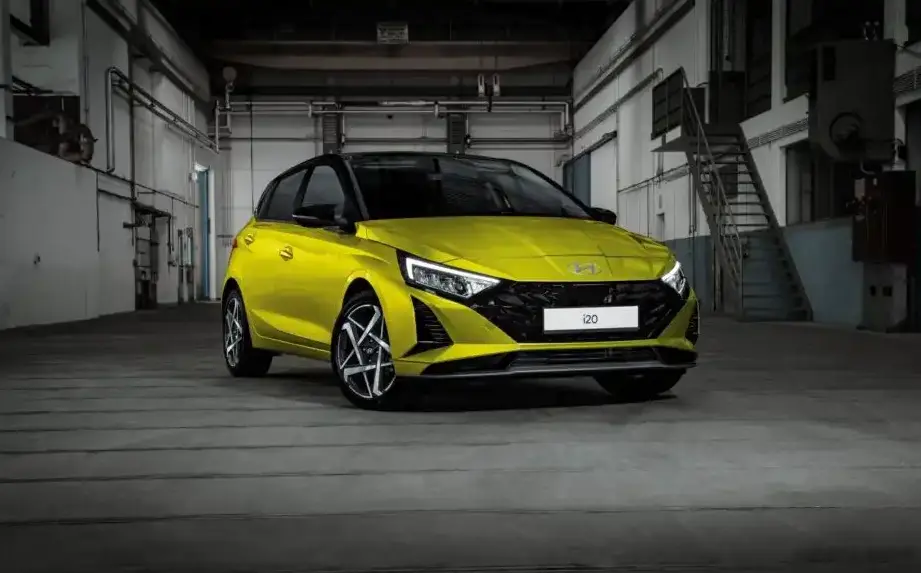
The Hyundai i20 III (facelift, introduced in May 2023) 1.0 T-GDi 100 Hp DCT represents a key offering within Hyundai’s subcompact hatchback lineup. Positioned as a mid-range trim, it balances fuel efficiency with a respectable level of performance and features. This variant builds upon the foundation of the third-generation i20 (launched in 2020), incorporating styling updates and technological enhancements. It primarily targets European and Asian markets, where the demand for small, economical, and well-equipped hatchbacks is high. The “DCT” designation indicates the use of a dual-clutch transmission, a feature increasingly common in this segment for its blend of efficiency and driving engagement.
Technical Specifications
| Brand | Hyundai |
| Model | i20 |
| Generation | i20 III (facelift 2023) |
| Type (Engine) | 1.0 T-GDi (100 Hp) DCT |
| Start of production | May, 2023 |
| Powertrain Architecture | Internal Combustion engine |
| Body type | Hatchback |
| Seats | 5 |
| Doors | 5 |
| Fuel Type | Petrol (Gasoline) |
| Acceleration 0 – 100 km/h | 11.4 sec |
| Acceleration 0 – 62 mph | 11.4 sec |
| Acceleration 0 – 60 mph | 10.8 sec |
| Maximum speed | 185 km/h (114.95 mph) |
| Emission standard | Euro 6D |
| Weight-to-power ratio | 10.9 kg/Hp, 91.7 Hp/tonne |
| Weight-to-torque ratio | 6.3 kg/Nm, 157.8 Nm/tonne |
| Power | 100 Hp @ 4500-6000 rpm |
| Power per litre | 100.2 Hp/l |
| Torque | 172 Nm @ 1500-4000 rpm (126.86 lb.-ft. @ 1500-4000 rpm) |
| Engine layout | Front, Transverse |
| Engine Model/Code | G3LE |
| Engine displacement | 998 cm3 (60.9 cu. in.) |
| Number of cylinders | 3 |
| Engine configuration | Inline |
| Cylinder Bore | 71 mm (2.8 in.) |
| Piston Stroke | 84 mm (3.31 in.) |
| Compression ratio | 10.5:1 |
| Number of valves per cylinder | 4 |
| Fuel injection system | Direct injection |
| Engine aspiration | Turbocharger, Intercooler |
| Valvetrain | DOHC |
| Engine oil capacity | 3.6 l (3.8 US qt | 3.17 UK qt) |
| Coolant | 5.77 l (6.1 US qt | 5.08 UK qt) |
| Kerb Weight | 1090-1200 kg (2403.04 – 2645.55 lbs.) |
| Max. weight | 1630 kg (3593.53 lbs.) |
| Max load | 430-540 kg (947.99 – 1190.5 lbs.) |
| Trunk (boot) space – minimum | 352 l (12.43 cu. ft.) |
| Trunk (boot) space – maximum | 1165 l (41.14 cu. ft.) |
| Fuel tank capacity | 40 l (10.57 US gal | 8.8 UK gal) |
| Max. roof load | 70 kg (154.32 lbs.) |
| Permitted trailer load with brakes (12%) | 1110 kg (2447.13 lbs.) |
| Permitted trailer load without brakes | 450 kg (992.08 lbs.) |
| Length | 4065 mm (160.04 in.) |
| Width | 1775 mm (69.88 in.) |
| Height | 1450 mm (57.09 in.) |
| Wheelbase | 2580 mm (101.57 in.) |
| Front track | 1531-1539 mm (60.28 – 60.59 in.) |
| Rear (Back) track | 1536-1543 mm (60.47 – 60.75 in.) |
| Minimum turning circle | 10.4 m (34.12 ft.) |
| Drivetrain Architecture | ICE drives front wheels |
| Drive wheel | Front wheel drive |
| Number of gears and type of gearbox | 7 gears, automatic transmission DCT |
| Front suspension | Independent type McPherson |
| Rear suspension | Torsion |
| Front brakes | Ventilated discs, 280 mm |
| Rear brakes | Disc, 262 mm |
| Assisting systems | ABS (Anti-lock braking system) |
| Steering type | Steering rack and pinion |
| Power steering | Electric Steering |
| Tires size | 195/55 R16; 215/45 R17 |
| Wheel rims size | 6.0J x 16; 7.0J x 17 |
Powertrain & Engine Architecture
The heart of this i20 variant is the Hyundai-Kia “Kappa” engine family, specifically the G3LE 1.0-liter turbocharged three-cylinder. This engine utilizes direct fuel injection and a single scroll turbocharger with an intercooler to deliver a balance of power and efficiency. The engine code ‘G3LE’ signifies a specific iteration optimized for emissions and fuel economy. The engine’s DOHC (Dual Overhead Camshaft) valvetrain, with four valves per cylinder, contributes to its relatively high power output for its size. The 7-speed Dual Clutch Transmission (DCT) is a crucial component, offering quicker and smoother gear changes compared to a traditional automatic. This DCT utilizes two separate clutches for odd and even gears, pre-selecting the next gear for faster transitions.
Driving Characteristics
The 100 hp output, coupled with 172 Nm (126.86 lb-ft) of torque, provides adequate performance for urban and highway driving. Acceleration from 0-60 mph takes approximately 10.8 seconds, and the top speed is rated at 185 km/h (114.95 mph). While not a performance-oriented trim, the turbocharger provides a noticeable boost in power during acceleration. The DCT contributes to a more engaging driving experience than a conventional automatic, with responsive shifts. Compared to the base 1.2-liter naturally aspirated engine, the 1.0 T-GDi offers significantly more power and torque. However, it doesn’t match the performance of higher-spec i20 models equipped with larger engines. The DCT’s gear ratios are tuned for fuel efficiency, with taller gearing in higher gears to reduce engine speed at cruising speeds.
Equipment & Trim Levels
The 1.0 T-GDi DCT trim typically includes standard features such as air conditioning, a touchscreen infotainment system with Apple CarPlay and Android Auto compatibility, Bluetooth connectivity, and a suite of safety features including ABS, ESC (Electronic Stability Control), and multiple airbags. Higher trim levels within the i20 range offer additional features like a larger touchscreen, navigation system, automatic climate control, and advanced driver-assistance systems (ADAS) such as lane keeping assist and forward collision avoidance. Interior upholstery is typically cloth, with options for premium materials on higher trims. The facelifted 2023 model introduced updated interior trim and improved infotainment graphics.
Chassis & Braking
The i20 III utilizes a McPherson strut front suspension and a torsion beam rear suspension. This setup provides a good balance between ride comfort and handling. The front brakes are ventilated discs measuring 280mm, while the rear brakes are solid discs measuring 262mm. This configuration is adequate for the vehicle’s weight and performance. The electric power steering provides light and precise steering feel. Stabilizer bars are fitted to both the front and rear axles to reduce body roll during cornering.
Market Reception & Comparison
The Hyundai i20 1.0 T-GDi DCT has been generally well-received by automotive critics for its fuel efficiency, comfortable ride, and well-equipped interior. It competes with other subcompact hatchbacks such as the Volkswagen Polo, Ford Fiesta (discontinued in Europe), and Renault Clio. Compared to the Polo, the i20 often offers more features for the price. The 1.0 T-GDi engine provides better fuel economy than larger-displacement engines, but some reviewers have noted that the three-cylinder engine can be slightly noisy under hard acceleration. Reliability has been generally good, with Hyundai’s reputation for building durable vehicles.
Legacy
The G3LE engine and the 7-speed DCT have proven to be relatively reliable powertrains in the Hyundai-Kia lineup. While long-term durability data is still emerging for the facelifted 2023 model, the underlying technology has been used in other Hyundai and Kia vehicles for several years. On the used car market, the i20 1.0 T-GDi DCT is expected to hold its value reasonably well due to its fuel efficiency, practicality, and the growing popularity of turbo-charged engines. Regular maintenance, including oil changes and DCT fluid replacements, will be crucial for ensuring the longevity of this powertrain.