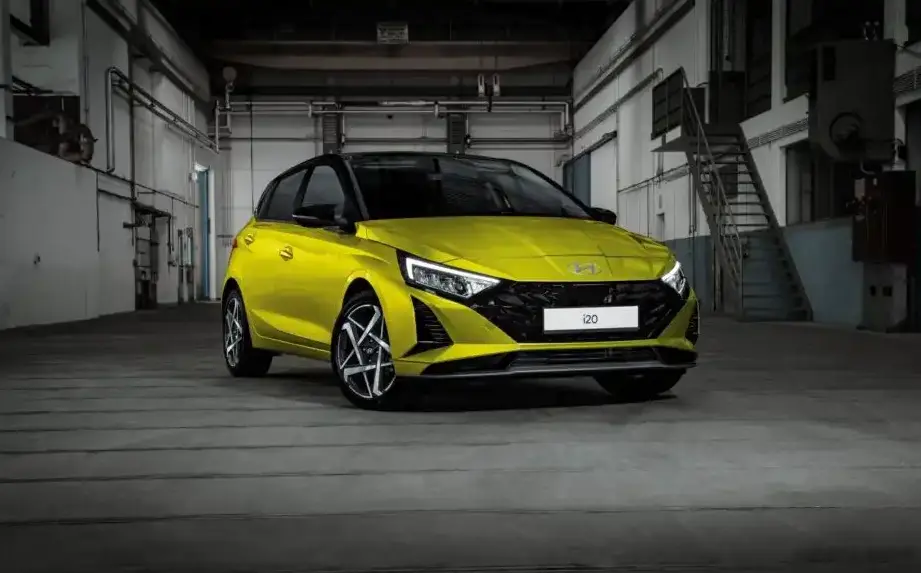
The Hyundai i20 III, specifically the facelifted version introduced in May 2023, represents Hyundai’s continued effort to compete in the highly contested subcompact hatchback segment. The 1.0 T-GDI (120 Hp) Mild Hybrid DCT variant, produced from May 2023 to May 2024, occupies a central position within the i20 III lineup, offering a balance between fuel efficiency, performance, and technology. This model is primarily targeted towards European and Asian markets, where smaller, fuel-efficient vehicles are in high demand. It builds upon the foundation of the PB platform (also known as the i20 III), offering a refreshed design and updated powertrain options.
Technical Specifications
| Brand | Hyundai |
| Model | i20 |
| Generation | i20 III (facelift 2023) |
| Type (Engine) | 1.0 T-GDI (120 Hp) Mild Hybrid DCT |
| Start of production | May, 2023 |
| End of production | May, 2024 |
| Powertrain Architecture | MHEV (Mild Hybrid Electric Vehicle) |
| Body type | Hatchback |
| Seats | 5 |
| Doors | 5 |
| Combined fuel consumption (WLTP) | 5.1-5.5 l/100 km (46.1 – 42.8 US mpg) |
| CO2 emissions (WLTP) | 116-125 g/km |
| Fuel Type | Petrol (Gasoline) |
| Acceleration 0 – 100 km/h | 10.3 sec |
| Acceleration 0 – 62 mph | 10.3 sec |
| Acceleration 0 – 60 mph | 9.8 sec |
| Maximum speed | 190 km/h (118.06 mph) |
| Emission standard | Euro 6d |
| Weight-to-power ratio | 9.3 kg/Hp |
| Weight-to-torque ratio | 5.6 kg/Nm |
| Battery voltage | 48 V |
| Power | 120 Hp @ 6000 rpm |
| Torque | 200 Nm @ 2000-3500 rpm (147.51 lb.-ft. @ 2000-3500 rpm) |
| Engine layout | Front, Transverse |
| Engine Model/Code | G3LF |
| Engine displacement | 998 cm3 (60.9 cu. in.) |
| Number of cylinders | 3 |
| Engine configuration | Inline |
| Number of valves per cylinder | 4 |
| Fuel injection system | Direct injection |
| Engine aspiration | Turbocharger, Intercooler |
| Engine oil capacity | 3.6 l (3.8 US qt | 3.17 UK qt) |
| Coolant capacity | 5.77 l (6.1 US qt | 5.08 UK qt) |
| Kerb Weight | 1115-1225 kg (2458.15 – 2700.66 lbs.) |
| Max. weight | 1650 kg (3637.63 lbs.) |
| Max load | 425-535 kg (936.96 – 1179.47 lbs.) |
| Fuel tank capacity | 40 l (10.57 US gal | 8.8 UK gal) |
| Max. roof load | 70 kg (154.32 lbs.) |
| Length | 4065 mm (160.04 in.) |
| Width | 1775 mm (69.88 in.) |
| Height | 1450 mm (57.09 in.) |
| Wheelbase | 2580 mm (101.57 in.) |
| Front track | 1531-1545 mm (60.28 – 60.83 in.) |
| Rear track | 1536-1549 mm (60.47 – 60.98 in.) |
| Drivetrain Architecture | Front wheel drive, MHEV |
| Number of gears | 7 |
| Gearbox type | Automatic transmission DCT |
| Front suspension | Independent type McPherson |
| Rear suspension | Torsion |
| Front brakes | Ventilated discs |
| Rear brakes | Disc |
| Steering type | Steering rack and pinion |
| Power steering | Electric Steering |
| Tires size | 185/65 R15; 195/55 R16; 215/45 R17 |
| Wheel rims size | 15; 16; 17 |
Powertrain & Engine Architecture
The heart of the i20 1.0 T-GDI Mild Hybrid is the Hyundai-Kia G3LF engine, a 998cc turbocharged three-cylinder gasoline engine. This engine utilizes direct fuel injection and a single scroll turbocharger with an intercooler to deliver a respectable 120 horsepower at 6000 rpm and 200 Nm (147.51 lb-ft) of torque between 2000 and 3500 rpm. The “Mild Hybrid” designation refers to the inclusion of a 48V integrated starter generator (ISG) which assists the engine during acceleration and allows for extended start-stop operation, improving fuel economy. The ISG also recovers energy during braking, storing it in a small battery pack. The engine’s architecture is designed for efficiency, featuring a relatively high compression ratio and optimized combustion chamber design. The engine is paired with a 7-speed Dual Clutch Transmission (DCT), offering quick and smooth gear changes. This DCT is a key component in maximizing the engine’s efficiency and providing a more engaging driving experience compared to a traditional automatic transmission.
Driving Characteristics
The 1.0 T-GDI with the DCT delivers a surprisingly refined driving experience for a subcompact hatchback. While not overtly sporty, the 120 hp output provides adequate power for everyday driving situations, including highway merging and overtaking. The DCT contributes to brisk acceleration, with a 0-60 mph time of around 9.8 seconds. The gear ratios are tuned for fuel efficiency, meaning the engine can feel slightly strained when pushed hard. Compared to the base 1.2L naturally aspirated engine, the 1.0 T-GDI offers significantly more punch. However, it doesn’t match the performance of larger-engined rivals or even higher-spec i20 models. The mild hybrid system is largely unobtrusive, providing a subtle boost during acceleration. The steering is light and precise, making it easy to maneuver in urban environments. Overall, the driving experience is comfortable and composed, prioritizing efficiency and ease of use.
Equipment & Trim Levels
The 1.0 T-GDI Mild Hybrid DCT trim typically sits in the mid-range of the i20 III lineup. Standard equipment generally includes air conditioning, a touchscreen infotainment system with Apple CarPlay and Android Auto compatibility, Bluetooth connectivity, and a suite of safety features such as lane keeping assist, forward collision avoidance assist, and automatic emergency braking. Higher trim levels add features like a larger touchscreen, navigation system, automatic climate control, a rear-view camera, and upgraded interior materials. Interior upholstery is typically cloth, with options for partial leather. The dashboard layout is modern and functional, with a focus on user-friendliness. Optional extras often include a sunroof, premium audio system, and parking sensors.
Chassis & Braking
The i20 III utilizes a McPherson strut front suspension and a torsion beam rear suspension. This setup provides a good balance between ride comfort and handling. The torsion beam rear suspension is a cost-effective solution that minimizes complexity while still offering acceptable handling characteristics. The front brakes are ventilated discs, providing ample stopping power, while the rear brakes are solid discs. The steering is an electric power-assisted rack and pinion system, offering light and precise steering feel. Stabilizer bars are fitted to both the front and rear axles to reduce body roll during cornering. The i20’s chassis is designed to be lightweight, contributing to its fuel efficiency and agility.
Market Reception & Comparison
The Hyundai i20 1.0 T-GDI Mild Hybrid DCT was generally well-received by automotive critics. It was praised for its fuel efficiency, comfortable ride, and well-equipped interior. However, some reviewers noted that the engine could feel strained at higher speeds and that the interior materials, while functional, weren’t particularly luxurious. Compared to other trims in the i20 lineup, the 1.0 T-GDI offers a compelling balance between performance and economy. It’s a more engaging drive than the base 1.2L engine, but it’s more affordable than the higher-powered options. In terms of reliability, the G3LF engine has proven to be generally robust, although some owners have reported issues with the turbocharger and fuel injectors.
Legacy
The Hyundai i20 III 1.0 T-GDI Mild Hybrid DCT represents a significant step forward in terms of powertrain technology and fuel efficiency for the subcompact hatchback segment. The combination of a turbocharged engine, mild hybrid system, and DCT transmission delivers a refined and economical driving experience. While it may not be the most exciting car on the road, it offers a practical and well-rounded package that appeals to a wide range of buyers. On the used car market, these models are becoming increasingly popular due to their fuel efficiency and relatively low running costs. With proper maintenance, the G3LF engine and DCT transmission are expected to provide years of reliable service.